TDICDTS is the Qlik Talend Data Integration Developer Using Talend Studio exam, and it is the credential that proves you can build production jobs rather than simply drag components onto a canvas. Anyone researching a Talend certification quickly notices something unusual about this one: Qlik publishes ten topic areas but attaches no percentage weightings to any of them. There is no largest domain to attack first and no small domain safe to skip. Every area from file handling to debugging can appear, and you need 70% to pass, which is a higher bar than most data platform exams set. This article covers what each of the ten areas actually asks of you, the format and cost, the experience Qlik recommends before you book, and how the exam sits alongside the rest of the Qlik Talend certification range.
What Does the Talend Developer Certification Prove?
TDICDTS proves you can design, run, troubleshoot, and ship a Talend Studio job that survives contact with real data. The syllabus runs from getting started with data integration through to debugging, taking in files, joins, context variables, databases, orchestration, deployment, and project management along the way. It is a working developer’s syllabus, not a tour of the product. The exam assumes the data integration fundamentals the rest of the industry works to, rather than anything Talend invented.
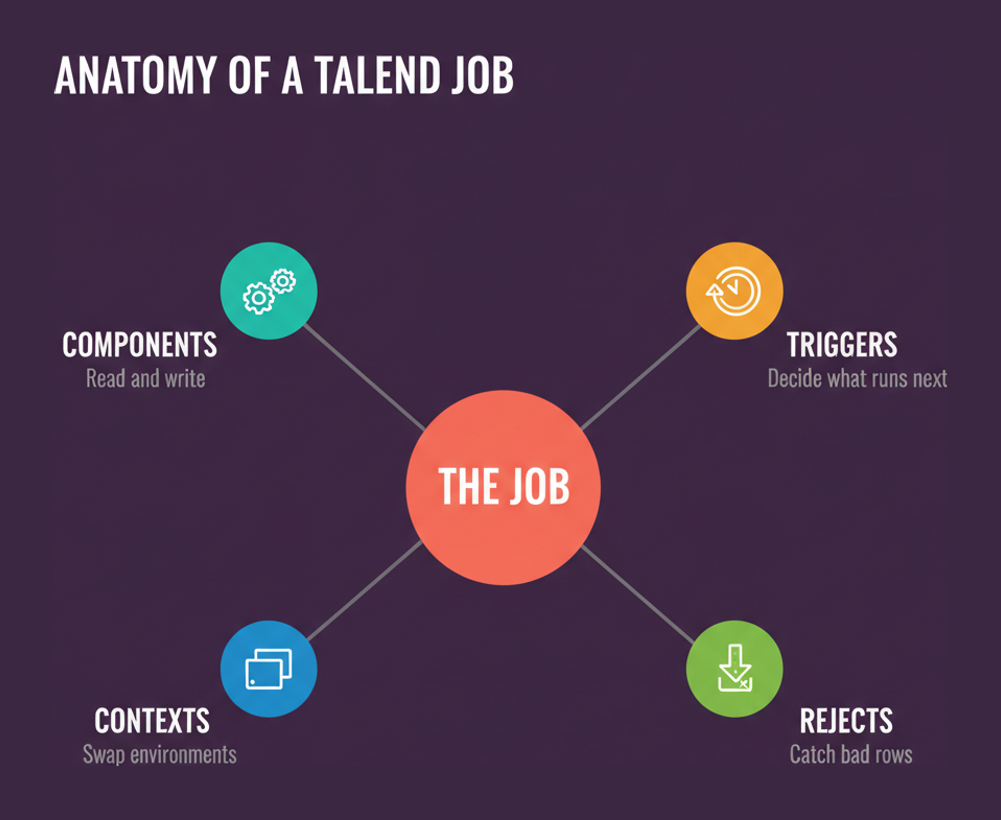
Talend Studio itself is a visual development environment. Qlik’s Job Design documentation defines the central artefact plainly: a Job Design is a graphical design of one or more components connected together that lets you set up and run dataflow management processes. Everything the exam asks about is ultimately about building those designs well.
The distinction that matters is between using Talend and developing with it. Plenty of people can assemble a job that works once on a clean file. The exam is aimed at the person who can make it run every night against a database that occasionally misbehaves, in an environment that is not the one they built it in.
What Is on the TDICDTS Exam?
TDICDTS is a 55 question exam with a 90 minute limit and a 70% pass mark, which means roughly 39 correct answers. It costs $250 USD. Qlik publishes ten topic areas for the exam and, unusually, gives no percentage weighting for any of them, so every area should be treated as examinable.
Format, cost, and scoring
| Attribute | Detail |
|---|---|
| Exam code | TDICDTS |
| Certification | Qlik Talend Data Integration Developer Using Talend Studio |
| Questions | 55 |
| Duration | 90 minutes |
| Passing score | 70% |
| Cost | $250 USD |
| Published weightings | None |
The ten topic areas
Qlik’s official exam details list these areas:
- Getting started with data integration
- Working with files
- Joining and filtering data
- Using context variables
- Error handling
- Working with databases
- Orchestrating Jobs
- Deploying Jobs
- Project management
- Debugging
The 70% pass mark is the number to keep in mind. At 55 questions you can afford to lose about sixteen, and with no weightings to hide behind, a topic you skipped entirely is a direct subtraction from that budget.
How Do You Handle Files, Joins, and Filters?
Through the component families the exam expects you to know by behaviour rather than by name. Working with files, joining and filtering data, and working with databases are three separate topic areas, and together they make up the bulk of everyday Talend development: read something in, reshape it, and write it somewhere useful.
Files first
File handling questions revolve around schemas and delimiters, headers and footers, encoding, and what happens when a file does not match the schema you defined. The predictable trap is assuming an input is always well formed.
Joining and filtering
This is where the mapping component earns its reputation. Candidates need to be clear on the difference between an inner join and a left outer join in a Talend map, what happens to rejected rows, and when a lookup should be loaded into memory rather than streamed. Filtering questions usually test whether you filter early, at the source, or late, after work has already been done.
Databases
Database topics cover connections, reading and writing, and the practical concerns of committing work in batches rather than row by row. As the Talend Studio user guide notes, the platform ships hundreds of prebuilt components and connectors, so recognising the right family of component matters more than memorising individual names.
Why Do Context Variables Matter So Much?
Because they are what makes a job portable, and portability is the difference between a demo and a deployment. Context variables let a single job point at a development database today and a production one tomorrow without editing the design. Qlik gives them their own topic area, which signals how central they are to real Talend work.
The exam themes here are consistent:
- Defining a variable once and grouping related variables together
- Switching between contexts such as development, test, and production
- Supplying values from outside the job at run time rather than hard coding them
- Understanding which value wins when the same variable is set in more than one place
That last point is where candidates most often slip. A job that works on a laptop and fails on a server is usually a context problem, and the exam knows it.
What Does the Exam Expect on Error Handling and Debugging?
It expects you to distinguish between the two, because Qlik lists them as separate topic areas. Error handling is about what a job does when something goes wrong while it is running unattended. Debugging is about how you, the developer, find out why something went wrong while you are sitting in front of it.
Error handling is a design decision
The question behind most error handling items is what should happen next. Should the row be rejected and logged while the job continues, should the subjob stop, or should the whole job fail so an operator notices? Talend gives you reject flows and triggers precisely so that choice is explicit, and the exam wants you to make it deliberately.
Debugging is a workflow
Debugging topics cover stepping through a job, watching data move along a connection, and reading what the console tells you. A useful habit for both the exam and the job is to form a hypothesis about which component is misbehaving before you start looking, then use the tooling to confirm or reject it.
How Are Jobs Orchestrated and Deployed?
Orchestrating Jobs and Deploying Jobs are two more distinct topic areas, and together they cover everything that happens once a single job works. Orchestration is about sequencing: which subjob runs first, what triggers the next one, and what happens on success as opposed to on error. Deployment is about getting that work off your machine and into a schedule.
Reuse belongs to this part of the syllabus too. The Talend Studio design documentation describes Joblets, which factor recurring processing into a reusable unit whose code is folded into the job at runtime rather than generated separately. Knowing when to extract a Joblet is a design judgement the exam rewards.
Project management questions sit alongside these, covering how work is organised, shared, and versioned across a team. It is the least glamorous topic area and an easy one to overlook, which is exactly why it is worth a focused session.
How Much Experience Does Qlik Recommend First?
Qlik recommends at least six months of hands-on experience with Talend products before attempting this exam. It also expects general knowledge of data integration architecture and advanced features such as parallelisation, plus practical work in Talend Studio covering installation, configuration, project and user management, deployment strategies, and troubleshooting.
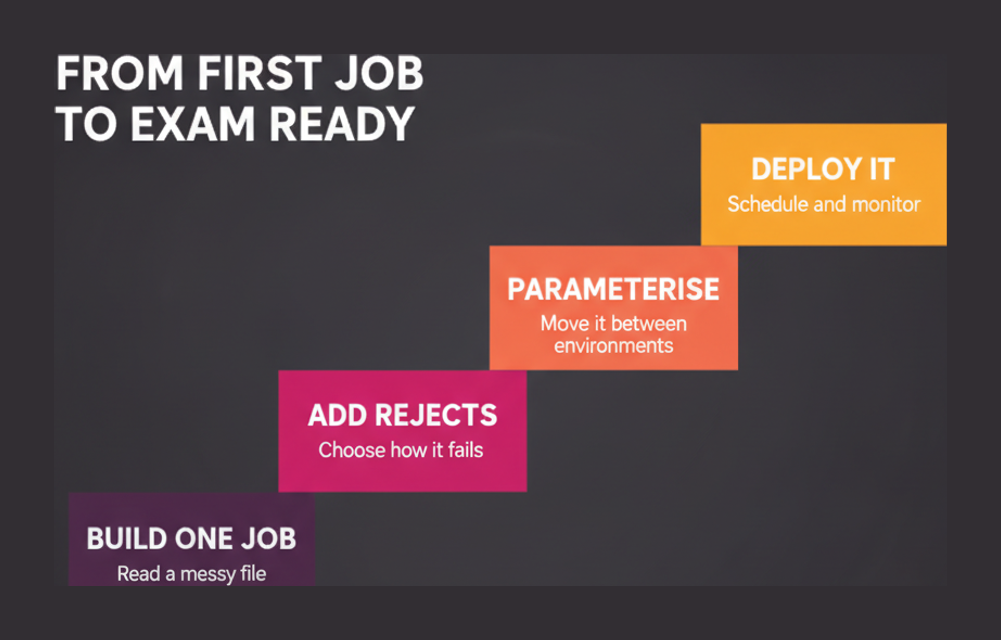
That is guidance rather than a prerequisite, and nothing stops you registering earlier. Given the 70% pass mark and the absence of weightings, though, it is guidance worth taking seriously. A sensible preparation sequence:
- List the ten topic areas and mark each one as done in production, done once, or never touched
- Build a job that reads a messy file, joins it to a database table, and writes the result
- Break it on purpose and add reject handling until it fails in a way you chose
- Parameterise the whole thing with context variables and run it against a second environment
- Wrap it in orchestration, then deploy and schedule it
- Finish with timed practice questions across all ten areas rather than your favourite three
Qlik publishes no target product version for the exam and notes that its content is updated periodically, so check version-sensitive behaviour in the current Talend Studio documentation before exam day. Reviewing TDICDTS practice questions across every topic area is the quickest way to find which of the ten your own projects never forced you to learn.
Where Does TDICDTS Sit in the Qlik Talend Range?
Qlik now offers a broad certification range spanning Qlik Sense analytics and the Talend data integration portfolio it acquired. TDICDTS is the Studio-based development credential: it certifies building jobs in the desktop tool, as opposed to administering the platform, implementing data quality, or managing cloud integration.
| If your work is | The fit is | Because |
|---|---|---|
| Building integration jobs in Studio | TDICDTS | Jobs, components, contexts, deployment |
| Replicating data between systems | Replicate credential | Movement rather than transformation design |
| Analysing and visualising data | Qlik Sense credentials | Front end analytics, not pipelines |
If your day job leans towards moving data between systems rather than transforming it, the Qlik Replicate exam route is the closer match. If you work at the analytics end instead, the Qlik Sense business analyst path covers that ground.
Frequently Asked Questions
How many questions are on the TDICDTS exam?
The exam has 55 questions with a 90 minute limit, giving you a little under 100 seconds each. Most candidates find the timing manageable, so the challenge comes from the spread of topics rather than the clock.
What is the passing score for the Talend developer certification?
You need 70%, which is roughly 39 correct answers out of 55. That is a higher bar than many data platform exams set, and with no published weightings there is no large domain to lean on for easy marks.
How much does the TDICDTS exam cost?
The exam costs $250 USD. Practice exams and training are priced separately, so factor those in if you plan to use structured preparation rather than relying only on project experience.
Are the exam topics weighted?
No. Qlik publishes ten topic areas without percentage weightings, which is unusual. The practical consequence is that no area can be safely skipped, so preparation should cover all ten rather than chasing the biggest domain.
How much experience should you have first?
Qlik recommends at least six months of hands-on work with Talend products, along with familiarity with data integration architecture and features such as parallelisation. It is a recommendation rather than a formal requirement, but a well judged one.
Which Talend Studio version does the exam target?
Qlik does not publish a target version for the exam. It states only that exam content is updated periodically and that the number and difficulty of questions may change, so verify version-sensitive behaviour against the current Talend Studio documentation before booking.
Why do context variables get their own topic area?
Because they are what makes a job portable between development, test, and production. A job that runs locally but fails on a server is very often a context problem, so the exam treats them as a core development skill rather than a detail.
What is the difference between error handling and debugging here?
Error handling is what the job does automatically when something fails while running unattended. Debugging is how a developer investigates a problem interactively. Qlik lists them separately because they are genuinely different skills.
Are there prerequisites for this certification?
No formal prerequisites are published, so you can register whenever you choose. The recommended six months of Talend experience is the practical gate, particularly given the 70% pass mark across all ten topic areas.
Does this exam cover Talend Cloud?
Its focus is Talend Studio, the desktop development environment, covering job design, orchestration, and deployment. Candidates working primarily in cloud integration should check which credential in the Qlik Talend range matches that work instead.
Conclusion
The absence of weightings is the defining feature of TDICDTS. Ten topic areas, all equally examinable, with 70% required to pass, means the sensible strategy is breadth rather than depth in a favourite area. Files, joins, contexts, databases, error handling, orchestration, deployment, project management, and debugging all count.
Treat Qlik’s six month experience recommendation as the real entry requirement, then close your gaps by building one job that does everything the syllabus mentions: read something imperfect, join it, parameterise it, deploy it, and break it deliberately so you learn what failure looks like. Finish with timed questions across all ten areas so nothing on exam day is a surprise.