The Google Professional Cloud Database Engineer exam, usually shortened to PCDE, is the credential Google Cloud built for people who look after databases rather than pipelines. That distinction is the reason this article exists: a large share of candidates arrive having confused the Google Cloud database engineer certification with Professional Data Engineer, which is a different exam for a different job. PCDE runs 50 to 60 questions in two hours, costs $200, and is graded pass or fail. Its weighting is unusual in one respect that says a lot about who sits it: migrating data solutions carries roughly 23% of the paper, close to a quarter. Google is not assuming you are building new databases in the cloud. It is assuming you are moving existing ones there. This article covers all four sections, the product set involved, and how the exam differs from its better-known neighbour. For a comparable cloud platform credential outside Google, the Cloudera administrator credential covers environment setup on AWS.
What Is the Google Cloud Database Engineer Certification?
The Google Professional Cloud Database Engineer certification validates that you can design, manage, migrate and deploy database solutions on Google Cloud. The exam presents 50 to 60 multiple choice and multiple select questions in two hours, costs $200 USD, and is graded pass or fail with the threshold sitting at roughly 70%.
There are no formal prerequisites, so anyone may register. Google’s recommended experience is a far stronger signal than that suggests: five or more years of overall database and IT experience, including two years working hands-on with Google Cloud database solutions. This is not an entry-level credential wearing a professional label.
Booking and delivery
Scheduling runs through Google CertMetrics, and the exam is offered in English and Japanese. You can sit it online proctored from a remote location or onsite at a testing centre, and both routes deliver the same paper. Full programme detail sits on the official certification page.
Is This the Same as Professional Data Engineer?
No, and booking the wrong one is the most expensive mistake available here. Professional Data Engineer is about building data processing systems: pipelines, warehousing, machine learning enablement and analytics. Professional Cloud Database Engineer is about running databases: capacity, availability, access, backup, migration and cost.
The clearest way to tell which you need is to look at what breaks in your week. If your incidents are failed pipeline runs and schema drift in a warehouse, you are a data engineer. If they are slow queries, lock contention, a replica falling behind, or a restore that has to meet an agreed recovery point, you are a database engineer, and PCDE is your exam. A third option in the same family is the professional machine learning exam, aimed at model delivery rather than data platforms.
The overlap is real but narrow
Both exams touch storage choices and both touch cost. Beyond that they diverge sharply. PCDE never asks you to design a streaming pipeline, and Professional Data Engineer never asks you to plan a zero-downtime migration with a fallback path. Candidates who hold one and assume the other will be easy usually find the middle third of the paper unfamiliar.
Anyone weighing the wider Google Cloud track can compare against this Professional Cloud Architect preparation guide, which sits at a different altitude again.
What Is on the PCDE Exam?
PCDE splits across four sections, and the split is more even than most cloud certifications. The largest section carries about 32% and the smallest about 20%, so there is no dominant area to concentrate on and no small area to abandon. The pass mark being pass or fail rather than a published percentage reinforces that.
| Exam detail | Value |
|---|---|
| Exam name | Google Professional Cloud Database Engineer |
| Questions | 50 to 60, multiple choice and multiple select |
| Duration | 120 minutes |
| Passing score | Pass or fail, approximately 70% |
| Price | $200 USD |
| Scheduling | Google CertMetrics |
| Languages | English and Japanese |
| Prerequisites | None, though five years of database and IT experience is recommended |
The presence of multiple select questions matters more than it sounds. A question that asks for two correct answers out of five gives partial knowledge nowhere to hide, and it is the format difference candidates most often underestimate.
| Section | Weight | Core content |
|---|---|---|
| Design innovative, scalable, and highly available cloud database solutions | ~32% | Capacity and usage planning, HA and DR trade-offs, application connectivity and security, choosing between managed and unmanaged services, SQL versus NoSQL, cost analysis, compliance |
| Manage a solution that can span multiple database technologies | ~25% | IAM and access management, monitoring and troubleshooting, backup and recovery design, cost and performance optimisation, task automation |
| Migrate data solutions | ~23% | Migration strategies and plans, zero and near-zero downtime, extended outage and fallback, reverse replication, DDL and DML conversion, migration tool selection |
| Deploy scalable and highly available databases in Google Cloud | ~20% | Provisioning HA solutions, testing HA and DR strategies, multi-regional replication, read replicas, automated provisioning, HA monitoring |
Because the exam is pass or fail with no per-section feedback, working through the PCDE sample questions early is the only practical way to find out which section is your weakest before exam day rather than after it.
What Does the Design Section Expect at 32%?
The design section is the largest at about 32%, and it is where the exam decides whether you think like an engineer or like an operator. It covers capacity and usage planning, high availability and disaster recovery choices, how applications will connect, and how to evaluate which database solution fits a stated requirement.
Capacity planning is treated quantitatively. You are expected to size a solution from current workload metrics plus future requirements, weigh performance against cost across machine and storage types, and size compute and storage to a stated performance target. Guessing generously is not an acceptable answer in this section.
Availability is a trade-off question
The HA and DR objectives ask you to evaluate multi-regional, regional and zonal deployment strategies against requirements, and to set maintenance windows and notifications according to what the application can tolerate. The examinable skill is choosing correctly given constraints, not naming the most resilient option every time.
Choosing the right database
The evaluation objectives are the section’s centre of gravity. They cover managed against unmanaged services, including self-managed, bare metal, Google-managed and partner offerings; SQL against NoSQL across structured, semi-structured, unstructured and vector data; comparative cost analysis; application and database dependencies; regulatory and compliance requirements; organisational policy constraints; and solutions that deliberately span several database technologies through federation, exports or hybrid deployments.
Vector data appearing in that list is not incidental. The syllabus explicitly covers using database technologies to support generative AI and large language model use cases, which is now part of the design conversation rather than a specialism.
Why Does Migration Carry Almost a Quarter of the Paper?
Migration carries roughly 23% of PCDE, which is unusually heavy for a cloud certification, and it tells you who Google expects to sit the exam. The typical candidate is not designing a new estate on a blank sheet. They are moving production databases that people depend on, under a change window, with a rollback plan.
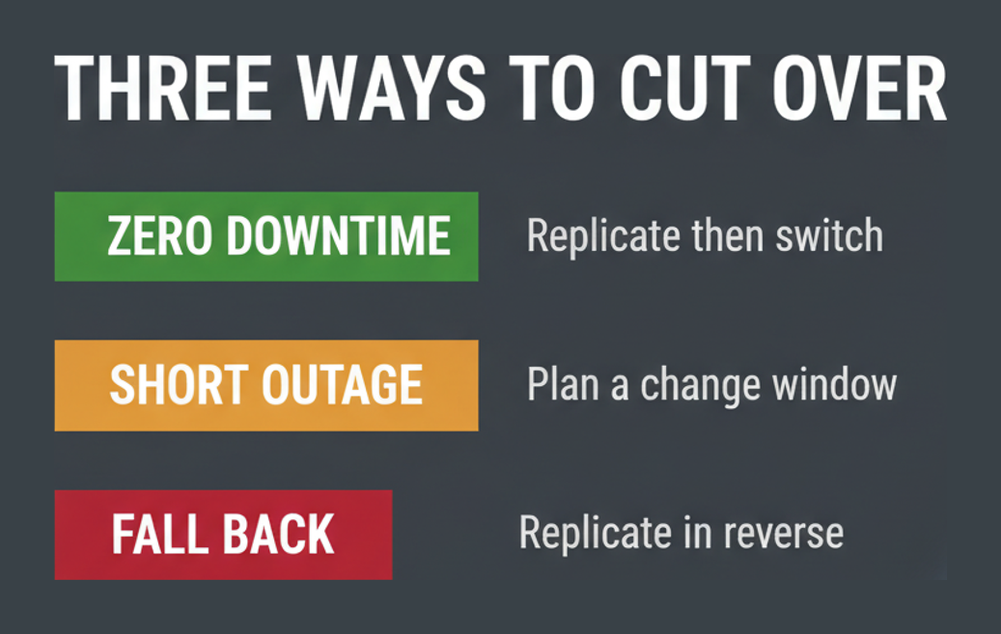
The objectives reflect that reality precisely. You are expected to develop and execute migration strategies covering zero and near-zero downtime, extended outage windows, and fallback, and to plan a migration including its fallback path and the DDL and DML conversion the move requires.
Reverse replication is the detail to notice
One objective names reverse replication from Google Cloud back to the source. That is a rollback mechanism: if the cutover goes wrong after traffic has moved, you need the original system to have kept up. Candidates who have only ever done one-way migrations often miss this, and it is exactly the kind of decision a scenario question is built around.
Tool selection is examinable
The final migration objective is choosing the correct migration tool for a given scenario, including databases hosted outside Google Cloud. That means knowing what each tool supports, what it cannot do, and where a heterogeneous migration needs conversion work rather than straight replication.
Which Databases Does the Exam Actually Cover?
PCDE spans Google Cloud’s full database portfolio rather than a single product, and the design objectives require you to tell them apart by workload shape. Cloud SQL, AlloyDB, Spanner and Bigtable each solve a different problem, and choosing between them under stated constraints is the recurring exam pattern.
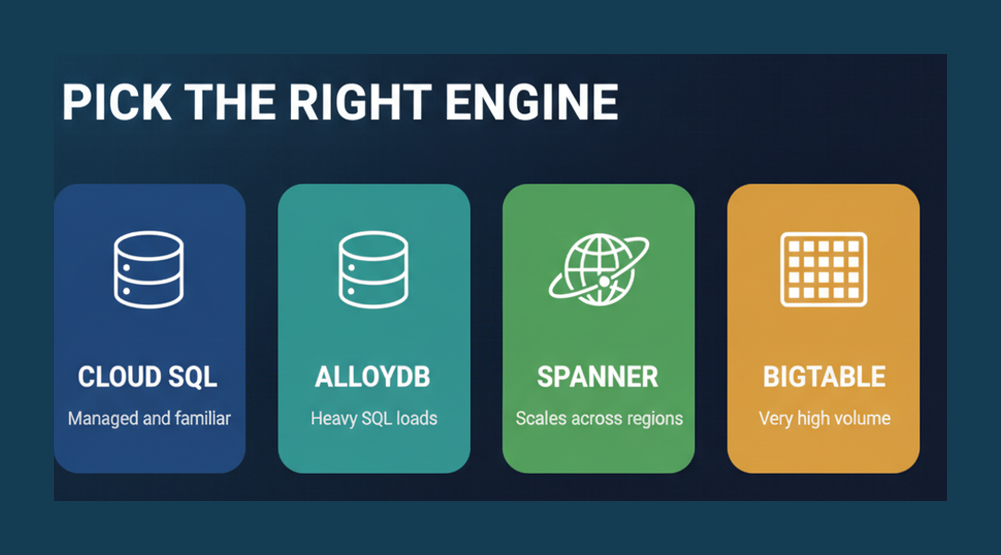
The rough division is worth holding in mind. Cloud SQL is managed conventional relational work. AlloyDB targets demanding relational workloads that need more than standard managed instances offer. Spanner is for horizontally scalable relational data with strong consistency across regions. Bigtable is wide-column NoSQL for very high throughput at scale.
Beyond the first-party set
The objectives also name partner offerings, bare metal and self-managed deployments, which means the exam will not always let you answer “use the managed service”. Sometimes licensing, compliance or an application dependency makes an unmanaged option correct, and recognising when is part of the test. The current portfolio is documented across Google Cloud database products.
For the SQL against NoSQL judgement, independent adoption data such as the Stack Overflow Developer Survey is a useful corrective to vendor framing, because it shows what practitioners actually run rather than what any one provider promotes.
What Do the Manage and Deploy Sections Ask For?
These two sections together carry about 45% of the paper and cover the running of a database estate. Manage, at roughly 25%, is the operational section. Deploy, at roughly 20%, is the implementation section, and the two overlap deliberately around high availability.
Managing across technologies
The manage section starts with access: identity and access management policies for database connectivity, and managing database users including authentication. It then moves to monitoring and troubleshooting, and the objectives here are refreshingly concrete. Slow running queries, database locking, missing indexes, RAM, CPU, storage and I/O vitals, audit logging, quotas, resource contention, and alerting on errors and performance metrics.
Backup and recovery follows, framed around requirements rather than mechanics: recommending backup and recovery options, configuring export and import, and designing for recovery time objective, recovery point objective and point-in-time recovery. Cost and performance optimisation and task automation complete it, covering scale up against scale out, replication strategies, query optimisation, index rebuilds, scheduled exports, managed upgrades and monitoring against agreed service levels.
Deploying for availability
The deploy section turns the design section’s decisions into implementation: provisioning highly available solutions, testing high availability and disaster recovery strategies rather than assuming they work, setting up multi-regional replication, deploying and scaling read replicas, automating instance provisioning, and configuring monitoring specifically for highly available databases.
The word testing in that list deserves attention. An untested DR plan is one of the recurring themes across both sections, and questions are frequently built on the gap between a configured failover and a proven one.
Which Roles Does This Certification Serve?
PCDE serves database administrators, database engineers, cloud infrastructure engineers with database ownership, and the operations side of platform teams. It maps onto accountability for a running estate, which is why the recommended experience is five years rather than one, and why so much of the paper is migration and operations rather than design.
It is also a credible credential for a database administrator moving from on-premises work into cloud. The migration section is effectively a description of that transition, and holding the credential is a reasonable way to signal that the move is deliberate rather than accidental. Independent pay context for the role is available from sources such as independent database administrator pay data, which is more useful than vendor salary claims.
Where it is the wrong choice
If your work is analytics, pipelines or machine learning enablement, Professional Data Engineer fits better. If you architect whole platforms rather than their data layer, Professional Cloud Architect is closer. PCDE is deliberately narrow, and that narrowness is its value. Candidates who want a broader look at the exam’s practical demands can start with these GCP-PCDE preparation tips.
Frequently Asked Questions
How many questions are on the PCDE exam?
Between 50 and 60 questions, mixing multiple choice and multiple select, with a two hour limit. The multiple select items are the harder half, because partial knowledge cannot produce a partially correct answer.
How much does the Google Cloud database engineer certification cost?
The registration fee is $200 USD plus tax where applicable. Training and practice material are priced separately, so budget for those if you plan a structured preparation path.
What score do you need to pass PCDE?
The result is reported as pass or fail rather than as a score, with the threshold sitting at approximately 70%. Because there is no per-section feedback, weak areas only surface through practice beforehand.
Is PCDE the same as Professional Data Engineer?
No. Professional Data Engineer covers pipelines, warehousing and analytics. PCDE covers running databases: capacity, availability, access, backup, migration and cost. They are different exams for different jobs.
Are there prerequisites for the exam?
None are required. Google recommends five or more years of database and IT experience including two years hands-on with Google Cloud databases, which is a realistic description of the level rather than a formality.
Which PCDE section carries the most weight?
Design, at roughly 32%. Managing across database technologies follows at about 25%, migration at about 23% and deployment at about 20%, so the paper is unusually evenly spread.
Which Google Cloud databases does the exam cover?
The full portfolio, including Cloud SQL, AlloyDB, Spanner and Bigtable, plus partner, bare metal and self-managed options. The recurring question pattern is choosing between them under stated constraints.
Does the exam cover vector databases and AI?
Yes, at design level. The objectives include distinguishing vector data among structured, semi-structured and unstructured types, and using database technologies to support generative AI and large language model use cases.
What languages is PCDE offered in?
English and Japanese. You can take it online proctored from a remote location or onsite at a testing centre, and both deliver the same paper under the same two hour limit.
How is the certification renewed?
By passing a renewal exam within the defined renewal eligibility period. Google publishes the current renewal terms alongside the certification, so check them rather than assuming a fixed cycle.
Conclusion
PCDE is an operator’s exam wearing a designer’s title. Design takes the largest share at about 32%, but migration at roughly 23% and management at about 25% mean nearly half the paper is about databases that already exist and already matter to someone.
Two things follow. Confirm you want this exam rather than Professional Data Engineer, using what actually breaks in your week as the test. Then prepare across all four sections rather than concentrating, because a pass or fail result with no section feedback gives you nothing to triage against. Working real questions early is the only reliable way to find the section that will cost you the pass.