Almost every Google Cloud certification assumes you will open a console. The Generative AI Leader certification, exam code GCP-GAIL, assumes you will not. It is 90 minutes, 50 to 60 multiple choice questions, $99, and a pass or fail result at roughly 70 percent, and there is not a single command, query or configuration task anywhere in the syllabus.
What there is instead is a vocabulary test with business consequences. Four domains, weighted 30, 35, 20 and 15 percent, covering what generative AI actually is, what Google sells in that space, how to make a model’s output better, and how to decide whether a gen AI project is worth doing at all. The largest domain is essentially a product catalogue, and it names around twenty five Google services by name. This article groups them into something learnable, walks all four domains, and sets out how to prepare for an exam you cannot practise by building anything. Readers who want the opposite, an exam about running models on real infrastructure, can compare it with the Nutanix NCP-AI certification.
What Does the Generative AI Leader Certification Actually Certify?
It certifies business-level fluency in generative AI, not the ability to build with it. GCP-GAIL asks whether you can define the core concepts, tell Google’s gen AI products apart and say what each is for, describe the techniques that improve model output, and reason about whether and how an organisation should adopt gen AI at all. The building side is examined instead by the Google machine learning engineer, which expects console work throughout.
Google was explicit about this when the credential launched. It arrived in May 2025 as a first of its kind credential, and the intended audience was stated plainly.
“It’s specifically designed for non-technical professionals like managers, strategists and leaders to give them a foundational understanding of AI and how it’s used.”
What that means for how you read the syllabus
Every objective in this exam starts with a verb like describe, identify, define, recognise or explain. None of them says configure, deploy, implement or troubleshoot. If you come from an engineering background that sounds easy, and it usually is, but it also means precision matters more than usual: the difference between grounding and fine-tuning is a definitional distinction here, not a design decision you can reason your way to under pressure. Where this credential stops at describing, the LLM-ACP syllabus expects you to build and tune the retrieval pipeline yourself.
How Are the Four GCP-GAIL Domains Weighted?
Google publishes approximate weightings for all four, which makes planning straightforward. Google Cloud’s own gen AI offerings take the largest share at around 35 percent, the fundamentals take around 30, techniques to improve model output take around 20, and business strategy takes around 15. On a 50 to 60 question paper that is roughly 18 to 21 questions about Google products alone.
| Domain | Weight | Approximate questions | What it is really about |
|---|---|---|---|
| Google Cloud’s gen AI offerings | ~35% | 18 to 21 | Naming Google’s products and saying what each one is for |
| Fundamentals of gen AI | ~30% | 15 to 18 | Core concepts, the ML lifecycle, data types, choosing a foundation model |
| Techniques to improve gen AI model output | ~20% | 10 to 12 | Model limitations, prompting, grounding, RAG, sampling parameters |
| Business strategies for a successful gen AI solution | ~15% | 7 to 9 | Adoption steps, measuring impact, secure AI, responsible AI |
Read that top row carefully, because it is the thing candidates underestimate. Roughly a third of this exam is Google’s own catalogue, and no amount of general AI literacy will substitute for knowing which product is the agent builder and which is the search one. The Google Generative AI Leader resources collected for this exam are the fastest way to find out whether you can already tell them apart.
What Sits Inside the Gen AI Fundamentals Domain?
Around 30 percent of the paper, covering definitions, learning approaches, the machine learning lifecycle, how to choose a foundation model, the data types that feed gen AI, the layers of the gen AI landscape, and Google’s own model families. It is the domain that rewards careful reading of the syllabus, because the terms it asks you to define are listed explicitly.
The definitional list is long and specific: artificial intelligence, natural language processing, machine learning, generative AI, foundation models, multimodal foundation models, diffusion models, prompt tuning, prompt engineering and large language models. Note that prompt tuning and prompt engineering are named separately. They are not synonyms, and a question can turn on that alone.
The lifecycle, and a Google tool for every stage
The syllabus asks for the stages of the machine learning lifecycle, data ingestion, data preparation, model training, model deployment and model management, and then asks which Google Cloud tool serves each one. That pairing is the giveaway: this domain and the offerings domain are designed to interlock, so learning the lifecycle without the tool names leaves half the marks on the table.
Model selection is framed as a business decision rather than a technical one. You choose a foundation model on modality, context window, security, availability and reliability, cost, performance and how far it can be fine-tuned or customised. Four Google model families are named directly and you should be able to say what each is for: Gemini, Gemma, Imagen and Veo.
Data literacy closes the domain. Structured against unstructured, labelled against unlabelled, and the six named characteristics of data quality and accessibility: completeness, consistency, relevance, availability, cost and format. The five layers of the gen AI landscape, infrastructure, models, platforms, agents and applications, are the mental map the rest of the exam hangs on.
Why Do Google’s Own Offerings Take the Largest Share?
Because this is a Google credential aimed at people who will recommend Google products, and the syllabus is unapologetic about it. At around 35 percent it is the biggest domain, and it names roughly twenty five distinct services and APIs. The only way through is to group them by what they do rather than to memorise a flat list.
Four useful groups. First, the platform: Vertex AI Platform with Model Garden and AutoML, Vertex AI Search, Vertex AI Agent Builder, and the choice between Vertex AI Studio and Google AI Studio. Second, the ready-made assistants: the Gemini app, Gemini Advanced with Gems, Gemini for Google Workspace, and Google Agentspace with the Cloud NotebookLM API and multimodal search. Third, the customer-facing set: the Customer Engagement Suite, meaning Conversational Agents, Agent Assist, Conversational Insights and Contact Center as a Service. Fourth, the API toolbox agents call: Speech-to-Text, Text-to-Speech, Translation, Document Translation, Document AI, Cloud Vision, Cloud Video Intelligence and Natural Language, alongside Cloud Storage, databases, Cloud Functions and Cloud Run.
The infrastructure and positioning objectives
Underneath the products sit the arguments. Google’s AI-first approach, the enterprise-ready platform described as responsible, secure, private, reliable and scalable, the open approach, and the AI-optimised infrastructure: the hypercomputer, custom-designed TPUs, GPUs and data centres. Two further objectives cover data control and democratisation through low-code and no-code tools, pre-trained models and APIs.
These read like marketing, and in a sense they are, but they are examinable marketing. The practical advice is to learn one concrete example for each claim rather than the claim itself, because the questions tend to be scenario-shaped: a business need is described and you pick the offering that fits.
What Techniques Does the Exam Expect You to Name?
Around 20 percent of the paper, and it is the most technical-feeling domain in an otherwise non-technical exam. It covers foundation model limitations, the recommended practices that address them, continuous monitoring, prompt engineering, grounding, retrieval-augmented generation, and the sampling parameters that control model behaviour.
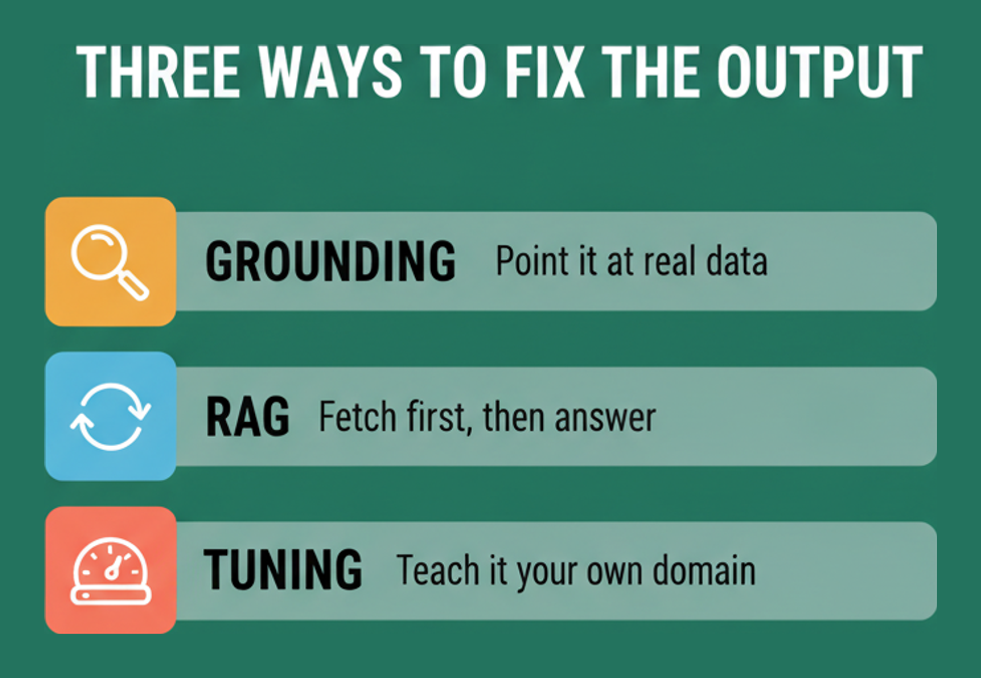
Start with the limitations, because everything else is a response to one of them: data dependency, the knowledge cutoff, bias, fairness, hallucinations and edge cases. The remedies named are grounding, retrieval-augmented generation, prompt engineering, fine-tuning and human in the loop. Being able to match a remedy to a limitation is the single most testable skill in the domain.
Prompting and grounding, named technique by technique
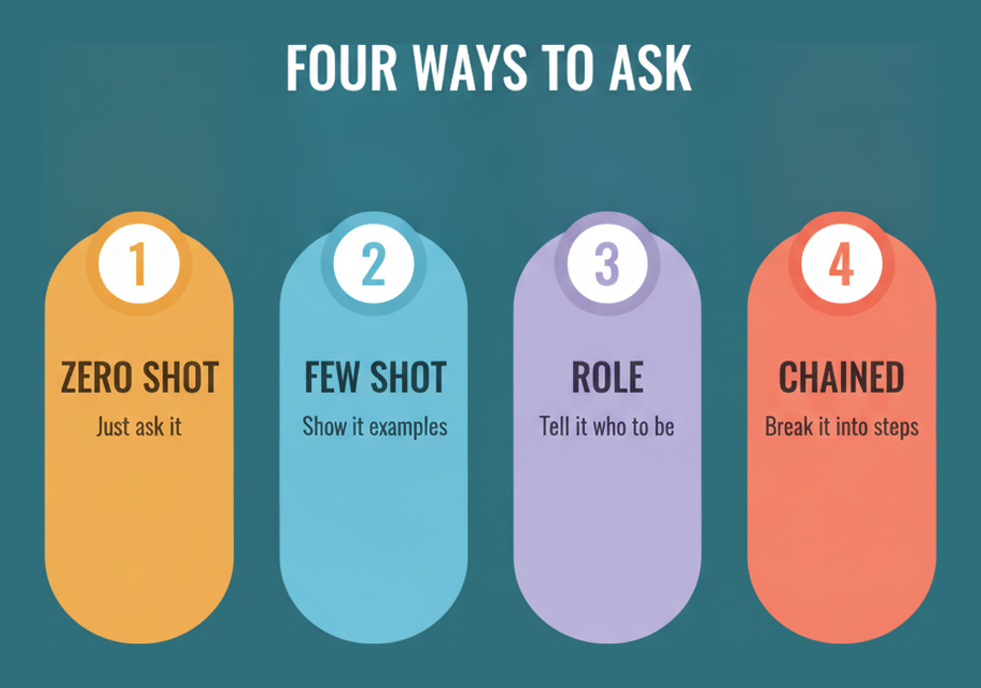
The prompting list is explicit: zero-shot, one-shot, few-shot, role prompting and prompt chaining, then chain-of-thought and ReAct as the advanced pair. Grounding is split three ways by data source, first-party enterprise data, third-party data and world data, and Google’s grounding offerings are named as prebuilt RAG with Vertex AI Search, RAG APIs and grounding with Google Search.
Sampling parameters close the domain and are pure recall: token count, temperature, top-p or nucleus sampling, safety settings and output length. Know what raising temperature does before you sit down. Monitoring is the quieter half of this domain and is worth the same marks: automatic model upgrades, key performance indicators, security patches, versioning, performance tracking, drift monitoring and the Vertex AI Feature Store.
Business Strategy, Secure AI and Responsible AI
The smallest domain at around 15 percent, and the one that sounds softest while asking some of the most concrete questions. It covers choosing a gen AI solution for a business need, integrating it into an organisation, measuring its impact, and then two named frameworks: secure AI and responsible AI.
The adoption half is procedural. Recognise the types of gen AI solution, identify the factors that influence what an organisation needs, choose accordingly, work out the steps to integrate it, and identify techniques to measure the impact. There is a real discipline hiding in that last one, and it is the question most likely to reflect what a reader’s own employer is struggling with.
The security half names Google’s Secure AI Framework directly, alongside security across the machine learning lifecycle and the Google Cloud tools involved: secure-by-design infrastructure, Identity and Access Management, Security Command Center and workload monitoring. If you want the vendor-neutral counterpart that practitioners are also expected to recognise, the NIST AI risk management framework covers the same ground without a product attached.
Responsible AI closes the syllabus with transparency and privacy considerations. It is a small number of marks, it is easy to revise, and it is the part of the exam that most directly matches what a leader is actually asked in a board meeting.
What Are the GCP-GAIL Exam Format and Cost?
Fifty to sixty multiple choice questions in 90 minutes for $99, reported as a pass or fail result at approximately 70 percent, and scheduled through Google CertMetrics. That is the cheapest credential in Google’s certification range by a wide margin, and the only one that publishes its result as a verdict rather than a score.
| Field | Value |
|---|---|
| Exam code | GCP-GAIL |
| Questions | 50 to 60 multiple choice |
| Duration | 90 minutes |
| Result | Pass or fail, approximately 70 percent |
| Price | $99 USD |
| Scheduling | Google CertMetrics |
| Recommended training | Generative AI Leader learning path and study guide |
Ninety minutes for up to sixty questions is 90 seconds each, which is comfortable for a paper made of definitions and product matching. The pressure here is breadth, not time. If you finish early on this exam it is usually because you did not know something rather than because you knew it quickly.
The $99 price is the reason this credential spreads through organisations in groups. It is cheap enough for a manager to expense without a conversation, and Google publishes a free collection of preparation courses alongside it, which removes the other usual barrier. Details of what is and is not published sit on the official certification page.
Who Is This Credential Actually For?
Managers, strategists, product owners, analysts, consultants and anyone who has to make or defend a decision about generative AI without writing the code. Google says so directly, and the syllabus backs it up: there is no hands-on requirement, no prerequisite, and nothing that assumes prior cloud experience.
Engineers get something different from it. If you already build with these tools, GCP-GAIL is not a skills credential, it is a vocabulary and catalogue credential, and its value is in being able to talk to the business side without translating. That is worth 90 minutes for a lot of people, but be honest with yourself about which of the two you are buying.
Where it fits on a certification path
It sits outside the usual Google Cloud ladder rather than at the bottom of it. Nothing depends on it, and it does not lead anywhere in particular. If you want a technical Google credential in an adjacent area, the Google Cloud database engineer exam is a very different proposition and a useful contrast in what a hands-on Google paper looks like.
One published figure is worth knowing before you decide. Google’s own research, conducted with Ipsos across nine countries in late 2024, reports that more than 80 percent of people holding a Google Cloud certification say it opened doors to new opportunities and accelerated their path to promotion. That is a vendor’s own survey rather than an independent one, and it should be read as such, but it is at least a stated and sourced number rather than a vague claim.
How Should You Prepare for an Exam With No Console in It?
Treat it as a naming exercise and a matching exercise, in that order. There is no lab to build and no configuration to rehearse, so preparation is about turning a long list of terms and products into pairs you can recall under mild pressure. A week of short sessions beats a weekend of reading.
- Start by writing one-line definitions for the ten named fundamentals terms in your own words, paying particular attention to the difference between prompt tuning and prompt engineering, which the syllabus lists separately.
- Pair each stage of the machine learning lifecycle with the Google Cloud tool that serves it, because the syllabus asks for the pairing rather than for either list on its own.
- Group the Google offerings into four buckets, the platform, the ready-made assistants, the customer-facing suite and the API toolbox, and learn one concrete business use case for each bucket rather than for each product.
- Match every foundation model limitation to the practice that addresses it, so that hallucination pulls up grounding and retrieval-augmented generation, and a knowledge cutoff pulls up grounding with current data.
- Learn the prompting techniques as an ordered progression from zero-shot through few-shot to chain-of-thought and ReAct, and be able to say when each is worth the extra tokens.
- Finish with the sampling parameters and the two governance frameworks, since temperature, top-p, safety settings and output length are pure recall and the secure and responsible AI objectives are the easiest marks on the paper.
One useful reality check while you study: the wider industry picture is moving fast, and the developer survey on AI is a good vendor-neutral read on how these tools are actually being adopted, which makes the business-strategy domain feel less abstract.
Frequently Asked Questions
How many questions are on the GCP-GAIL exam?
Fifty to sixty multiple choice questions in 90 minutes. That works out at roughly 90 seconds per question, which is comfortable for a paper built from definitions and product matching.
What is the passing score for the Generative AI Leader certification?
The result is reported as pass or fail rather than as a numeric score, at approximately 70 percent. You will not receive a percentage, so there is no partial credit to plan around.
How much does the Generative AI Leader certification cost?
$99 USD, which makes it the least expensive credential in Google’s certification range. Google also publishes a free collection of preparation courses alongside it.
Do you need technical experience to take GCP-GAIL?
No. There is no hands-on requirement and no prerequisite. Google designed the credential for non-technical professionals such as managers, strategists and leaders, and every syllabus objective uses a verb like describe, identify or explain.
Which domain carries the most marks?
Google Cloud’s own gen AI offerings, at around 35 percent, or roughly 18 to 21 questions. It names about twenty five Google products and APIs, which is why grouping them by function beats memorising a flat list.
Which Google models does the exam name?
Gemini, Gemma, Imagen and Veo. You are expected to identify the use cases and strengths of each rather than to know how any of them was built.
What prompting techniques are on the syllabus?
Zero-shot, one-shot, few-shot, role prompting and prompt chaining, plus chain-of-thought and ReAct as the advanced pair. Each is named explicitly, so expect to match a technique to a use case.
What is the difference between grounding and fine-tuning here?
Grounding connects a model’s answers to a source of data at the time of the request, which the syllabus splits into first-party enterprise data, third-party data and world data. Fine-tuning changes the model itself. Both appear as remedies for foundation model limitations, and questions can turn on choosing between them.
How is the exam delivered and booked?
Through Google CertMetrics. The recommended preparation is Google’s own Generative AI Leader learning path and study guide, both named on the exam specification.
Is GCP-GAIL worth taking if you already work with these tools?
It depends what you want from it. It is a vocabulary and catalogue credential rather than a skills one, so its value for a practitioner is in being able to discuss options with the business side fluently, not in proving you can build anything.
Conclusion
GCP-GAIL is an unusual exam and a deliberately unusual one. Ninety minutes, 50 to 60 questions, $99, pass or fail at roughly 70 percent, and four domains that ask you to describe rather than to do. The largest of them is Google’s own product catalogue, and the smallest is the one about deciding whether any of it is worth adopting.
Prepare accordingly: define the terms precisely, pair the lifecycle stages with their tools, group the products by function, and match every model limitation to its remedy. If you want a second view of the exam’s shape before you commit, the GCP-GAIL study companion sets out the same ground from a practice-first angle. Then book it, because at $99 the cost of finding out is genuinely low.