Sixteen functions. Four data set options. Five procedures. That is not a summary of the SAS programming fundamentals exam, it is what the published syllabus actually lists, by name, in the objectives themselves. A00-215 tells you to use UPCASE, PROPCASE, SUBSTR, SCAN, FIND, LENGTH and CATX. It tells you to use MONTH, DAY, YEAR, TODAY and MDY. It tells you ROUND, INT, MEAN and SUM. It names DROP=, KEEP=, RENAME= and OBS=.
Very few certification blueprints are that literal, and it changes what preparation looks like. Instead of guessing what depth is expected, you can build a checklist and work down it until nothing is unfamiliar. The exam gives you 120 minutes for 60 to 65 questions, asks for 68 percent, and costs $120, and it publishes no weightings at all across its seven topics. This guide goes through the whole named list, explains where the marks are likely to concentrate anyway, and shows what the absence of weightings means for a study plan.
Why Does the A00-215 Syllabus Name Individual Functions?
Because SAS is examining a fixed language surface rather than a shifting product. The A00-215 objectives repeatedly say “use” followed by an explicit list, so the exam commits to a bounded set of syntax rather than an open-ended one. That makes the syllabus unusually testable against, and it means a candidate can genuinely know when preparation is finished.
Compare that with a cloud certification, where an objective might read “configure identity and access” and leave the depth entirely to the reader. Here the objective reads “Use Character Functions: UPCASE, PROPCASE, SUBSTR, SCAN, FIND, LENGTH, CATX”. There is no ambiguity about scope, only about how deep each item goes.
The practical consequence is that a checklist beats a course for the final stretch. Read the objectives, list every named item, and mark each one as known, shaky or unseen. Anything still marked unseen a week before the exam is a genuine risk, and there are not many of them.
The Seven Topics, and Why None of Them Carries a Weight
A00-215 publishes seven topics and no percentage against any of them. They run from fundamental SAS concepts and log reading, through exploring data sets, two separate DATA step topics, report generation with PROC steps, utility procedures, and finally importing and exporting non-SAS files.
| Topic | What it asks you to demonstrate |
|---|---|
| Fundamental SAS Concepts | Rules for DATA and PROC steps, rules for SAS statements including global statements, interpreting the log, and telling syntax errors from logic errors including using PUTLOG |
| Explore SAS Data Sets | Naming conventions, character and numeric variable types, creating and manipulating date values, missing data, the LIBNAME statement, PROC CONTENTS, and the DROP=, KEEP=, RENAME= and OBS= data set options |
| Using the DATA Step to Access SAS Data Sets | DATA and SET statements, MERGE and BY for horizontal combining, the IN= option, SET for vertical combining, compilation and execution including the program data vector, and subsetting with WHERE, IF, DROP and KEEP |
| Using the DATA Step to Manipulate Data | Creating and updating variables, character, date, truncation and descriptive statistics functions, conditional processing, controlling output, accumulating variables with SUM and BY group FIRST. and LAST., iterative DO loops, and permanent attributes via FORMAT and LABEL |
| Generate Reports Using PROC Steps | PROC PRINT, PROC MEANS and PROC FREQ with their named options, plus TITLE, FOOTNOTE, temporary FORMAT and LABEL, and WHERE for subsetting |
| Use Utility Procedures | PROC SORT with OUT=, BY and DESCENDING, and PROC FORMAT with the VALUE statement and the OTHER keyword |
| Import and Export non-SAS files | PROC IMPORT and PROC EXPORT for CSV, the LIBNAME statement with the XLSX engine, and ODS to PDF, RTF and EXCEL with the FILE= and STYLE= options |
The absence of weightings is not an oversight. It means no topic can be discounted on arithmetic, so coverage has to be even. It also means the only honest signal about emphasis is the length of each objective, and by that measure the two DATA step topics dwarf everything else. Once the language surface is secure, the statistical track follows, and the SAS regression modeling certification is where that begins.
What Is the SAS Programming Fundamentals Exam Format?
A00-215 presents 60 to 65 questions with a 120-minute limit and a 68 percent passing score, for $120 US dollars. The exam is administered by SAS and Pearson VUE. Two hours across roughly 62 questions is close to two minutes each, which is generous for a paper at this level.
| Detail | Value |
|---|---|
| Exam name | SAS 9.4 Programming Fundamentals |
| Credential | SAS Certified Associate: Programming Fundamentals Using SAS 9.4 |
| Exam code | A00-215 |
| Questions | 60 to 65 |
| Duration | 120 minutes |
| Passing score | 68% |
| Price | $120 USD |
| Registration | Pearson VUE |
| Recommended training | SAS Programming 1: Essentials and SAS Programming 2: Data Manipulation Techniques |
One detail from the SAS credential page deserves attention: the paper is not purely multiple choice. SAS describes it as multiple choice and short-answer questions, which means some items expect you to supply a value rather than recognise one. That changes revision, because recognising correct syntax and producing it are different skills.
Sixty-eight percent of roughly 62 questions is about 42 correct answers, leaving a margin of 20. That is workable, but it is tighter than the 60 percent bars common at associate level, so the even-coverage requirement bites harder than it first appears.
Which Functions Does the Exam Name by Hand?
Sixteen, split into four groups by purpose. The syllabus lists character functions, date functions, truncation functions and descriptive statistics functions as four separate bullet points, each with its own explicit membership. Learn them by group and the structure of the questions becomes predictable.
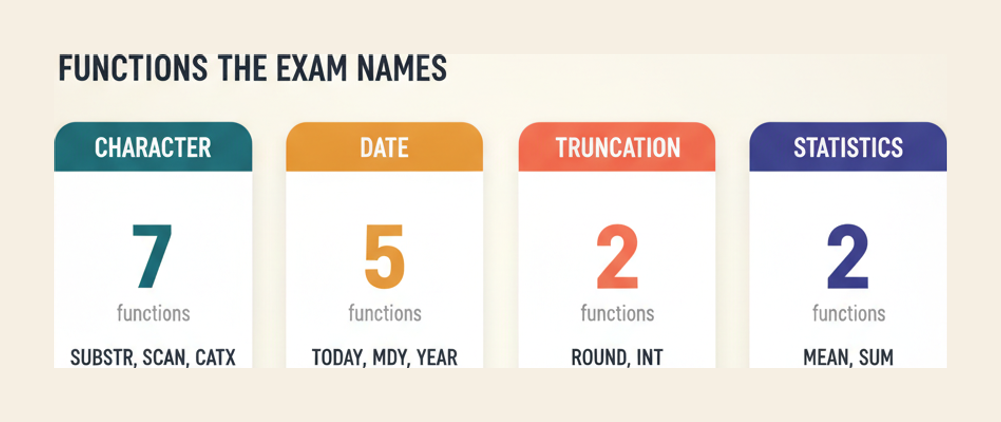
- Character functions: UPCASE, PROPCASE, SUBSTR, SCAN, FIND, LENGTH, CATX
- Date functions: MONTH, DAY, YEAR, TODAY, MDY
- Truncation functions: ROUND, INT
- Descriptive statistics functions: MEAN, SUM
The character group is the one that rewards real practice. SCAN and FIND both search, but they answer different questions, and CATX concatenates while stripping and inserting separators in a way that trips people who reach for it once a year. SUBSTR appears in almost every SAS exam at every level, and it is worth being able to write it without hesitation.
The date group is smaller but connects to a separate objective about how SAS stores date values and how date formats control display. Those two ideas, storage and display, sit behind more questions than the function list alone suggests. Getting them straight early makes several other objectives easier.
Working through A00-215 sample questions function by function is the most efficient way to find which of the sixteen you can recognise but not reproduce, which matters given the short-answer format.
What Does the DATA Step Section Expect You to Do?
More than any other part of the syllabus. Two of the seven topics are DATA step topics, and between them they carry the longest objective lists on the paper. The first covers reading and combining data sets, the second covers manipulating what you have read.
Combining and subsetting
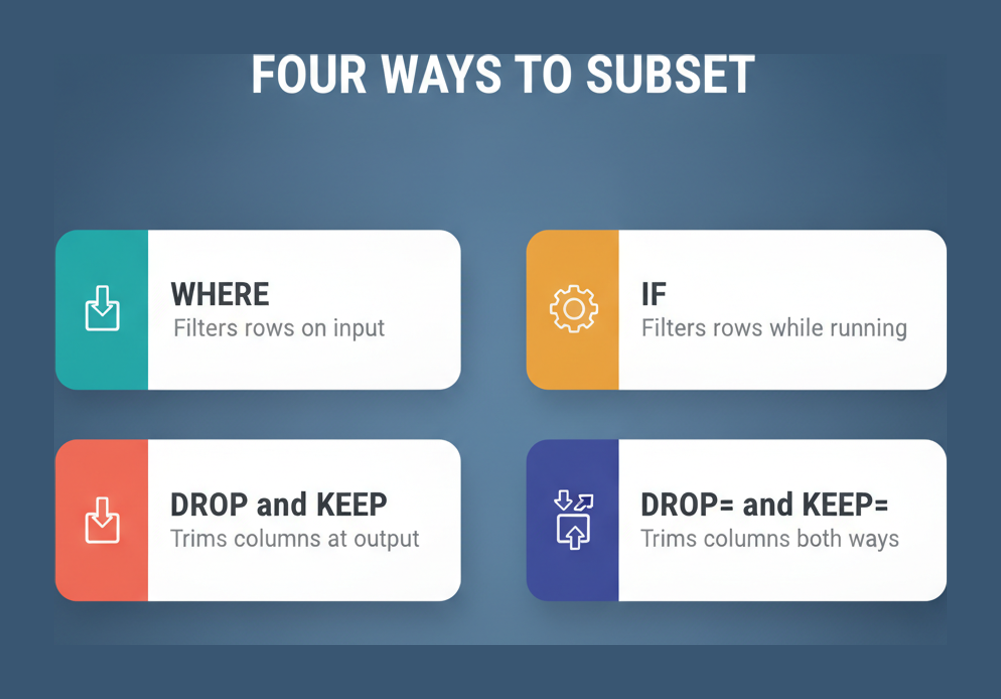
MERGE and BY combine horizontally, SET combines vertically, and the IN= option on MERGE controls which records survive. Subsetting appears four ways, and the exam expects you to know which happens when: WHERE subsets on input, IF subsets during processing, DROP and KEEP statements subset at output, and the DROP= and KEEP= options subset at both input and output.
The program data vector
The objective asks you to describe how the program data vector is created, how the LENGTH statement changes its default behaviour, and how a DATA step iterates. This is the most conceptual material on the exam and the part that separates people who write SAS from people who understand it.
Accumulating and controlling output
The SUM statement builds a running total, and BY group processing with FIRST. and LAST. resets it per group. Alongside that sit the OUTPUT statement for directing and timing output, iterative DO loops, and permanent attributes assigned with FORMAT and LABEL. None of it is difficult in isolation; the questions come from combining two of them.
Which PROC Steps Are Examinable?
Five, and the syllabus names the specific options for each. PROC PRINT, PROC MEANS and PROC FREQ handle reporting. PROC SORT and PROC FORMAT are the utility procedures. Nothing else appears in the objectives, which makes this the easiest part of the syllabus to bound.
| Procedure | Named options and statements |
|---|---|
| PROC PRINT | LABEL and NOOBS options, VAR statement |
| PROC MEANS | MAXDEC= option, VAR and CLASS statements |
| PROC FREQ | ORDER= option, TABLES for one-way and two-way, NOCUM and NOPERCENT, CROSSLIST |
| PROC SORT | OUT= option, BY statement, DESCENDING option |
| PROC FORMAT | VALUE statement, OTHER keyword for missing values |
PROC FREQ carries the most named options, which is a reasonable proxy for how much attention it gets. Two-way tables with CROSSLIST are the least familiar item for most candidates, and worth an hour on their own. Report enhancement through TITLE, FOOTNOTE and temporary FORMAT and LABEL statements sits alongside these and is quick to learn.
How Much Import and Export Work Is on the Paper?
A full topic of it. The seventh topic covers moving data between SAS and the outside world: PROC IMPORT and PROC EXPORT for CSV files, the LIBNAME statement with the XLSX engine for Excel, and the Output Delivery System for sending reports to PDF, RTF and EXCEL destinations using the FILE= and STYLE= options.
This is the topic most likely to be under-studied, because it feels peripheral next to the DATA step. With no published weightings, though, there is no evidence it carries fewer questions than anything else, and it contains the fewest objectives, which makes it the cheapest topic per hour invested.
The ODS objectives are worth particular care. Knowing that a destination is opened and closed around the procedure that produces the output, and what STYLE= actually changes, covers the realistic question shapes without needing to memorise every available style.
Does the SAS Version Actually Matter?
Yes, and SAS is specific about it. The exam is based on SAS 9.4 M5, and the credential name carries the version too: SAS Certified Associate: Programming Fundamentals Using SAS 9.4. Studying against a much newer Viya-oriented resource risks meeting syntax and interfaces the exam does not assess.
That version pinning is also why the named function list stays stable. The Base SAS language surface described in these objectives has been consistent for a long time, which is unusual in certification and is part of why a checklist approach works here at all. Background on how the language is structured is set out in the SAS language overview if the DATA step and PROC step split is new to you.
For anyone weighing the credential against the effort, an associate programming certification remains a recognisable marker in analytics hiring, and published ranges for SAS programmer pay give a realistic picture of where the skill sits in the market. The credential is a starting signal rather than a senior one, which matches its price and its bar.
Version pinning also decides what comes next. The tier directly above is the performance-based Base Programming exam, and the A00-231 Base Programming route reuses almost everything learned here while moving the assessment into a live environment.
How Do You Study a Syllabus With No Weightings?
By using objective length as the only available proxy for emphasis, and by covering everything rather than optimising. With seven unweighted topics and a 68 percent bar, the safe assumption is that any topic can supply enough questions to matter, so the plan below works through them in dependency order rather than syllabus order.
- Begin with fundamental SAS concepts and log reading, because every later topic assumes you can tell a syntax error from a logic error and know what PUTLOG is for.
- Cover data set exploration next, including variable types, how SAS stores date values, missing data, LIBNAME, PROC CONTENTS and the four data set options.
- Give the two DATA step topics the largest share of your time, working MERGE, SET, the IN= option, the four subsetting routes and the program data vector until each is automatic.
- Build the named function checklist by group, then practise writing each of the sixteen rather than recognising them, since some items are short answer.
- Work the five procedures with their named options, spending extra time on two-way PROC FREQ tables with CROSSLIST.
- Finish with import, export and ODS, which is the shortest topic and the cheapest marks per hour on the paper.
Six to eight weeks suits someone new to SAS working alongside a job, and three or four for a candidate who already writes DATA steps but has never sat a SAS exam. Build the checklist in week one so the remaining weeks have a target to shrink.
One practical note on cost: SAS offers free or discounted training through its academic programmes, which is worth checking before paying for courses. The earlier programming fundamentals overview covers why candidates pursue this credential in the first place.
Frequently Asked Questions
How many questions are on the A00-215 exam?
Sixty to sixty-five questions with a 120-minute limit, which is close to two minutes each. SAS describes them as multiple choice and short-answer items rather than multiple choice alone.
What is the passing score for SAS Programming Fundamentals?
Sixty-eight percent. On roughly 62 questions that means about 42 correct answers, leaving a margin of around 20, which is tighter than the 60 percent bars common at associate level.
How much does the A00-215 exam cost?
One hundred and twenty US dollars worldwide. That makes it one of the cheaper vendor certifications available, and the exam is administered by SAS together with Pearson VUE.
Which SAS version is the exam based on?
SAS 9.4 M5. The credential name carries the version as well, so studying against much newer Viya material risks covering interfaces the exam does not assess.
Do the A00-215 topics have percentage weightings?
No. Seven topics are published with no weights against any of them, which means coverage has to be even and no topic can safely be discounted on arithmetic.
Which functions do you need to know?
Sixteen named functions in four groups: UPCASE, PROPCASE, SUBSTR, SCAN, FIND, LENGTH and CATX; MONTH, DAY, YEAR, TODAY and MDY; ROUND and INT; MEAN and SUM.
Does the exam require writing code by hand?
Partly. Because SAS includes short-answer items alongside multiple choice, some questions expect you to supply a value or a piece of syntax rather than pick one from a list.
What is the difference between A00-215 and A00-231?
A00-215 is the Programming Fundamentals associate exam. A00-231 is the Base Programming performance-based exam, which sits above it and expects you to work in a live environment.
Which training does SAS recommend?
SAS Programming 1: Essentials and SAS Programming 2: Data Manipulation Techniques. SAS also offers free or discounted training routes through its academic programmes, which is worth checking first.
How long does preparation usually take?
Six to eight weeks for someone new to SAS studying alongside a job, and three or four weeks for a candidate who already writes DATA steps but has never sat a SAS certification.
Conclusion
A00-215 is one of the few certification syllabuses you can genuinely finish. Sixteen named functions, four data set options, five procedures with their specific options, four ways to subset, and a program data vector to understand. Nothing is left to inference, and nothing is hidden behind a vague objective.
What the syllabus does not give you is a weighting map, so the plan has to be even rather than clever: fundamentals first, then the two DATA step topics for the bulk of the time, then the function checklist, the procedures and finally the short import and export topic. Once every named item on that list is something you can write rather than merely recognise, sample items across all seven topics will confirm whether 42 correct answers is within reach.