A user asks a question, the retriever returns three chunks, and every one of them is from the wrong section of the document. Nothing crashed. The model answered confidently. The answer was wrong, and the reason sits somewhere in parsing, chunking, retrieval or reranking. Diagnosing that is the single largest thing the Alibaba Cloud LLM Engineer certification asks you to do.
Retrieval augmented generation is worth 20 percent of LLM-ACP, more than any other domain, and the syllabus names LlamaIndex and the RAGAS evaluation framework outright rather than describing them generically. Add fine-tuning at 16 percent and agent building at another 16 and just over half the exam is about making systems work rather than about explaining what a large language model is. This guide counts the six domains as published, sets out what an 80 percent pass mark actually costs you in wrong answers, and is direct about who the credential travels well for.
What Is the Alibaba Cloud LLM Engineer Certification?
It is the professional-tier credential earned by passing exam LLM-ACP, formally named Alibaba Cloud LLM Engineer (Professional). The exam runs 75 questions in 120 minutes, costs $200 US dollars, and is passed at 80 out of 100 points. Alibaba Cloud aims it at generative AI developers who already have a programming foundation.
That last qualifier is not decoration. The vendor describes the credential as developing the ability to design and implement large language model driven solutions for complex business scenarios, and the objectives back that up: they ask about API parameters, chunking strategies, fine-tuning datasets, agent orchestration and deployment on specific compute services. There is no domain covering what artificial intelligence is.
The exam is offered in English only, and Alibaba Cloud requires fourteen days between any two professional exams, which matters if you are stacking credentials on a deadline. It is also non-refundable, so the $200 is committed at booking rather than at sitting.
Why Is Retrieval the Largest Domain?
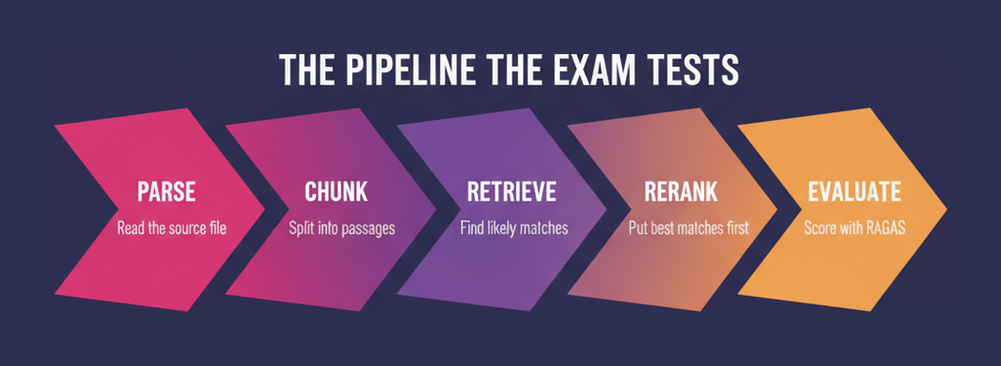
Because retrieval is where production LLM applications actually break. At 20 percent, LLM retrieval augmented generation is the biggest single block on the exam, and its objectives run from file parsing and text chunking through retrieval and reranking to two named optimisation strategies and a named evaluation framework.
The technique itself is well documented outside any vendor’s material, and the general retrieval augmented generation overview is worth reading first if the term is new. The syllabus is unusually specific about what it expects you to know.
- The core components as a pipeline: parsing, chunking, retrieval and reranking, treated as four stages that can each fail independently.
- Two named retrieval strategies, sentence window retrieval and auto-merging retrieval, which are optimisations rather than defaults.
- Practical optimisation work: text parsing quality, title rewriting, and table content enhancement, all of which are document-preparation problems rather than model problems.
- Automated evaluation through the RAGAS framework, so the exam expects you to measure retrieval quality rather than eyeball it.
Two of those names are worth meeting before the exam rather than during it. The pipeline the objectives describe is built on the LlamaIndex project repository, and the evaluation method has its own RAGAS documentation. Neither is Alibaba software, which is a useful signal: the retrieval domain tests transferable engineering rather than a proprietary console.
How Are the Six Domains Weighted?
Retrieval augmented generation leads at 20 percent, followed by LLM application development at 17 percent. Fine-tuning, AI agent applications, and production practices with security compliance sit level at 16 percent each, and prompt engineering closes the syllabus at 15 percent. The six weightings sum to exactly 100.
| Domain | Weight | Approximate questions of 75 |
|---|---|---|
| LLM retrieval augmented generation | 20% | 15 |
| LLM application development | 17% | 13 |
| LLM fine-tuning | 16% | 12 |
| AI Agent Applications | 16% | 12 |
| Production Practices and Security Compliance | 16% | 12 |
| LLM prompt engineering | 15% | 11 |
The flatness of that distribution is the point. No domain is dismissible, and the gap between the largest and smallest is five percentage points, or about four questions. An exam weighted this evenly punishes the common strategy of writing off one topic, which is worth knowing before you plan around LLM-ACP exam material rather than after.
What Does an Eighty Percent Pass Mark Demand?
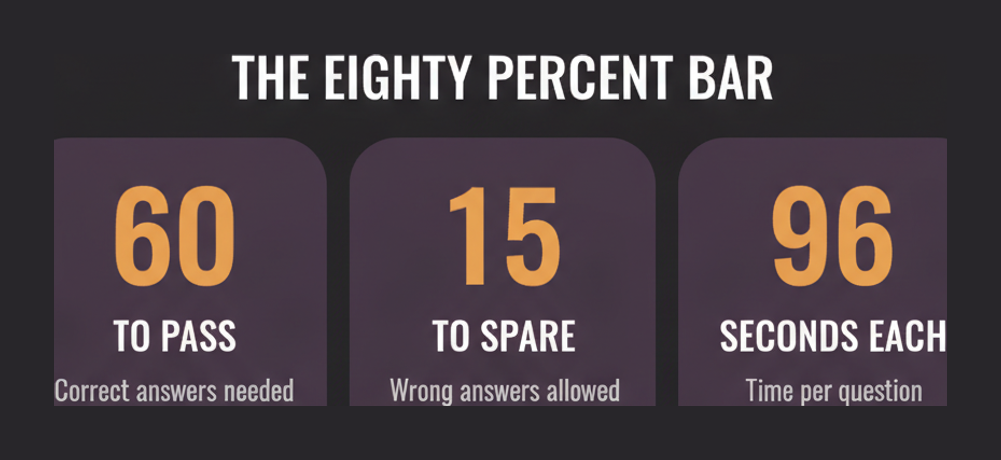
Sixty correct answers out of 75, and no more than fifteen wrong. That is a materially harder bar than most vendor credentials set, and against a flat six-domain distribution it means you cannot afford to lose a whole domain: the smallest domain is worth roughly eleven questions, which would consume nearly the entire error budget on its own.
The arithmetic is worth sitting with. Fifteen permitted mistakes across six domains averages two and a half per domain. Drop the retrieval domain entirely and you are fifteen down before the other five have been marked. There is no combination of strengths that rescues one abandoned topic.
Pace is the second constraint. One hundred and twenty minutes across 75 questions is 96 seconds each, which is comfortable for recall and tight for a scenario that names three deployment services and asks which balances cost against latency. Build the habit of committing to an answer and moving on, because the marginal value of a second reading is low when the bar is 80 percent.
Which Named Tools Does the Syllabus Assume?
The objectives name specific technologies rather than describing capabilities in the abstract, and there are more of them than a professional syllabus usually carries. Three come from the open ecosystem and four are Alibaba Cloud services, which tells you how the exam splits between transferable and vendor-specific knowledge.
| Named in the syllabus | Domain it appears in | What you are expected to do with it |
|---|---|---|
| LlamaIndex | Retrieval augmented generation | Build a RAG pipeline and understand its parsing, chunking, retrieval and reranking stages |
| RAGAS | Retrieval augmented generation | Evaluate a retrieval system automatically rather than by inspection |
| vLLM | Production practices | Deploy a fine-tuned model for serving |
| Model Studio | Agents, and production practices | Build agents through the Model API and deploy fine-tuned models |
| Elastic Compute Service | Production practices | Host a fine-tuned model on general compute |
| Platform for AI | Production practices | Deploy through the managed machine learning platform |
| Function Compute | Production practices | Publish an AI assistant serverlessly |
Read that table as a study checklist. Three of the seven, LlamaIndex, RAGAS and vLLM, are open projects you can install and use today at no cost, which makes the largest domain the cheapest one to rehearse properly.
What Are the LLM-ACP Exam Details?
LLM-ACP is 75 questions in 120 minutes for $200 US dollars, passed at 80 out of 100 points, scheduled through Pearson VUE and delivered either online or at a test centre. It is available in English only and cannot be refunded once booked.
| Detail | Value |
|---|---|
| Exam name | Alibaba Cloud LLM Engineer (Professional) |
| Exam code | LLM-ACP |
| Questions | 75 |
| Duration | 120 minutes |
| Passing score | 80 of 100 |
| Price | $200 USD, non-refundable |
| Language | English only |
| Delivery | Online or at a test centre, chosen at booking |
| Retake spacing | 14 days between any two professional exams |
| Scheduling | Pearson VUE |
The fourteen-day rule deserves a note. It applies between professional exams generally, not only to retakes of the same paper, so a failed attempt costs two weeks before a second sitting and blocks any other professional credential in that window. Alibaba Cloud sets all of this out on the official LLM Engineer certification page, which also confirms the recommended course runs to three chapters and fifteen lessons.
Is This Credential Worth It Outside Its Home Markets?
Partly, and the split is unusually clean. Roughly half the syllabus covers work that transfers anywhere: retrieval pipelines, chunking strategy, fine-tuning method, prompt frameworks and agent orchestration are the same problems on any cloud. The other half names Alibaba Cloud services you will only use if your organisation runs there.
For engineers working in markets where Alibaba Cloud has a real footprint, the calculation is simple and favourable. For everyone else, the honest framing is that the retrieval, fine-tuning and prompt domains are worth studying regardless, while the production domain is a vendor tour that will not appear on your next project.
There is also a recognition question. The credential has very little independent editorial coverage, which is precisely why an article that counts the weightings is useful, but it also means a hiring manager outside the vendor’s ecosystem may not recognise the name. That is a real cost against $200, and it should be weighed rather than dismissed.
Readers coming from a data-platform background rather than an application one should look at the adjacent associate credential first: our guide to whether the ACA Data Engineer credential fits covers who that tier actually suits.
How Should You Prepare for LLM-ACP?
Build the retrieval pipeline first and study everything else around it. The largest domain is also the one you can rehearse for free with open tooling, and doing so teaches the chunking, parsing and evaluation vocabulary that the fine-tuning and agent domains then build on.
- Build a working retrieval pipeline with LlamaIndex over your own documents, so that parsing, chunking, retrieval and reranking become four stages you have debugged rather than four words you have read.
- Measure that pipeline with RAGAS rather than by reading its answers, because the syllabus asks for automated evaluation and the habit of inspecting outputs by hand will not survive the questions.
- Work the two named retrieval optimisations, sentence window and auto-merging, against the same corpus so the difference between them is something you have observed rather than memorised.
- Move to fine-tuning next, concentrating on dataset construction and parameter settings, which is where the objectives put their weight rather than on algorithm theory.
- Build one agent through Model Studio and extend it into a multi-step workflow, since agents and production practices together carry 32 percent and share the same deployment vocabulary.
- Finish with prompt engineering and application development as a confidence pass, then rehearse against the clock at 96 seconds per question with a target of 60 correct.
The order is deliberate rather than conventional. Most preparation plans open with prompt engineering because it feels like the entry point; it is in fact the smallest domain at 15 percent, and starting there spends your freshest study time on your cheapest marks.
Where It Sits Against the Associate Credentials
LLM-ACP is the professional tier of Alibaba Cloud’s language model track, sitting above an associate LLM credential and alongside the wider associate programme covering cloud engineering, data engineering and generative AI. The professional tier is where the syllabus stops describing and starts building.
The gap between the tiers is visible in the objective verbs. Associate material asks you to identify and describe; this exam asks you to construct a RAG pipeline, evaluate it, fine-tune a model and deploy it across three named compute services. Anyone who has not yet built one of these systems end to end will find the associate route a better first step, and our generative AI engineer study guide covers what that tier expects.
For candidates already deploying LLM applications, the professional exam is the one that matches the work. The fourteen-day spacing rule between professional exams is worth planning around if you intend to take more than one in the same quarter.
Frequently Asked Questions
What is the Alibaba Cloud LLM Engineer certification?
A professional-tier credential earned by passing exam LLM-ACP. It validates the ability to build, fine-tune, deploy and evaluate large language model applications on Alibaba Cloud, and targets developers who already have a programming foundation.
How many questions are on the LLM-ACP exam?
Seventy-five, with a 120-minute limit. That works out at roughly 96 seconds per question, which is comfortable for recall items and tight for scenarios naming several deployment services.
What is the passing score for LLM-ACP?
Eighty out of 100 points, which means 60 correct answers from 75 and a budget of fifteen wrong. That is a higher bar than most vendor credentials set at professional level.
How much does the LLM-ACP exam cost?
Two hundred US dollars, and the fee is non-refundable once booked. Scheduling runs through Pearson VUE, with the choice of an online or a test-centre sitting made at booking time.
Which LLM-ACP domain is the largest?
Retrieval augmented generation at 20 percent, roughly 15 of the 75 questions. It covers parsing, chunking, retrieval and reranking, two named retrieval optimisations, and automated evaluation with RAGAS.
Does the exam cover LlamaIndex?
Yes, by name. The retrieval domain asks candidates to build RAG with LlamaIndex and to understand its core components, which makes it one of the few open-source tools examined directly by a vendor credential.
What language is the LLM-ACP exam available in?
English only, according to Alibaba Cloud’s own exam overview. That is narrower than most cloud credentials, which typically offer several languages at professional level.
How long must you wait between Alibaba Cloud professional exams?
Fourteen days. The rule applies between any two professional exams rather than only to retakes, so a failed attempt also blocks a different professional credential during that window.
Is prompt engineering a big part of LLM-ACP?
It is the smallest domain at 15 percent, roughly 11 of the 75 questions. It covers prompt frameworks, separators and templates, the role of the system prompt, and applied tasks such as batch intent classification.
Do you need an associate credential before LLM-ACP?
No formal prerequisite exists. Alibaba Cloud recommends a programming foundation rather than a prior credential, though candidates who have not built an LLM application end to end will find the associate tier a more realistic starting point.
Conclusion
The Alibaba Cloud LLM Engineer certification is more technical than its low profile suggests. Retrieval augmented generation at 20 percent, fine-tuning and agents at 16 percent each, named open tooling in the objectives, and an 80 percent pass mark that leaves room for only fifteen wrong answers across six evenly weighted domains.
Start with the retrieval pipeline, because it is the largest domain and the one you can build for free before spending anything on the exam. If that work feels like your day job, the credential describes what you already do. If it feels like a new subject, the associate tier is the better first purchase.