Of the three SnowPro Specialty exams, Native Apps is the one that asks you to stop thinking like a data professional and start thinking like a software vendor. Versions, patches, release channels, distribution settings, monetisation, security scanning before a listing goes live: the syllabus reads like a shipping checklist, because that is exactly what it is testing.
NAS-C02 covers the full lifecycle of an application that runs inside somebody else’s Snowflake account. Fifty five questions, 85 minutes, scaled scoring with 750 to pass, and 38 percent of the marks in a single build domain. The data science specialism runs the other way, keeping the work inside the platform, and the Snowflake data scientist certification covers it.
Table of Contents
- What does SnowPro Specialty Native Apps actually certify?
- The exam code has moved to NAS-C02
- How is the NAS-C02 exam delivered and scored?
- How are the four domains weighted?
- Why does Build carry 38 percent on its own?
- What does the exam expect about privileges and execution rights?
- Release channels and upgrades are the Manage domain in miniature
- Why is Deploy the smallest domain at 11 percent?
- Who is NAS-C02 actually written for?
- How should you prepare for NAS-C02?
- Frequently Asked Questions
- Conclusion
What does SnowPro Specialty Native Apps actually certify?
SnowPro Specialty Native Apps certifies that you can design, build, deploy and support applications that run inside a consumer’s Snowflake account using the Snowflake Native App Framework. Snowflake describes it on its own Native Apps certification page as covering native application workloads across their complete lifecycle.
The distinction that matters is ownership of the runtime. A normal Snowflake workload runs in your account, on your data, with your privileges. A native app runs in somebody else’s account, on their data, with privileges they have to agree to grant, and it has to keep working when they upgrade it. Everything unusual about the syllabus follows from that one fact.
It is one of three exams in the SnowPro Specialty series, alongside Snowpark and Gen AI. Those two test capability within Snowflake. This one tests distribution.
The exam code has moved to NAS-C02
Snowflake’s current code for this exam is NAS-C02. The older NAS-C01 path on Snowflake’s own certification site now returns a 404, and the live page is version stamped C02, so the successor is not merely announced but already in place.
This matters because most third party study material has not moved. Courses, practice sets and community write ups are still published under NAS-C01, and some catalogue listings carry the old code alongside a current syllabus. Two practical rules follow:
- Check any study resource against the four domain names and weightings below rather than against the code on its cover
- Where a resource predates the C02 page, treat its stated question count, duration and scoring as unverified, because beta era figures circulated widely and differ from the current published ones
The domains themselves did not change name, which is why a lot of C01 material remains substantively useful. It is the specifications, not the subject matter, that need checking.
How is the NAS-C02 exam delivered and scored?
NAS-C02 is 55 questions in 85 minutes, priced at $225 USD, and scored on a scaled range of 0 to 1000 with 750 required to pass. It is delivered through Pearson VUE. Snowflake’s certification page does not render a question count, duration or price to an automated reader, so those figures come from the money site’s published syllabus rather than from Snowflake directly.
| Field | Value |
|---|---|
| Credential name | SnowPro Specialty: Native Apps |
| Exam code | NAS-C02 |
| Questions | 55 |
| Duration | 85 minutes |
| Scoring | Scaled 0 to 1000, with 750 to pass |
| Price | $225 USD |
| Delivery | Pearson VUE |
| Domains | Four, all weighted |
Scaled scoring is worth understanding rather than converting. A 750 on a 0 to 1000 scale is not the same as answering 75 percent of the items correctly, because items are weighted by difficulty and the scale is calibrated across forms. The practical consequence is that there is no clean number of questions you can afford to lose, which argues for even coverage rather than betting on a strong domain carrying a weak one. Running a NAS-C02 practice test by domain is the reliable way to find out where your coverage is thin.
Eighty five minutes across 55 questions is about 93 seconds each, which is adequate rather than generous given how much of this syllabus is scenario shaped.
How are the four domains weighted?
The NAS-C02 syllabus has four domains, and the weighting is heavily front loaded toward building. Build is 38 percent, Manage is 29 percent, Design is 22 percent and Deploy is 11 percent. Build and Manage together are 67 percent of the exam.
| Domain | What it covers | Weight |
|---|---|---|
| Build Snowflake Native Applications | Application package components, manifest structure, setup scripts and artifacts; versioned schemas; application logic through stored procedures, external functions, UDFs, UDTFs, Streamlit and Snowpark Container Services; data bundling and in-app sharing; distribution settings; external object references; privilege specification and application roles; event tables and event sharing; test, development and debug modes; version and patch release workflows | 38% |
| Manage Snowflake Native Applications | Version release management, release directives and release channels; auto-fulfillment; metadata and usage metrics; consumer upgrade policies and maintenance windows; uninstalled application behaviours; idempotent upgrade code, schema changes and data integrity safeguards | 29% |
| Design Snowflake Native Applications | Choosing between Secure Data Sharing, Declarative Native Apps and Snowflake Native Apps; schema separation; framework limitations and constraints; security and privilege strategy including least privilege in manifest requests, provider and consumer boundaries, cross-account security and consumer approval workflows; application role hierarchies; data protection; external access from Snowflake | 22% |
| Deploy Snowflake Native Applications | Publishing to Snowflake Marketplace, private against public listings, security scanning and approval; monetisation through subscription, usage and container billing; installation procedures, cross-account installation, multiple instances per consumer, consumer-side event tables; troubleshooting installation failures | 11% |
Converted to a 55 item paper, that is roughly 21 questions on Build, 16 on Manage, 12 on Design and 6 on Deploy. Deploy is the only domain small enough that a candidate could survive losing most of it, and even then only if everything else is solid.
Why does Build carry 38 percent on its own?
Build is 38 percent because it absorbs almost everything that is specific to the Native App Framework rather than to Snowflake generally. Its objectives run from manifest file structure and setup scripts through versioned schemas, application logic in five different execution styles, data bundling, distribution modes and event configuration, to the release workflow itself.
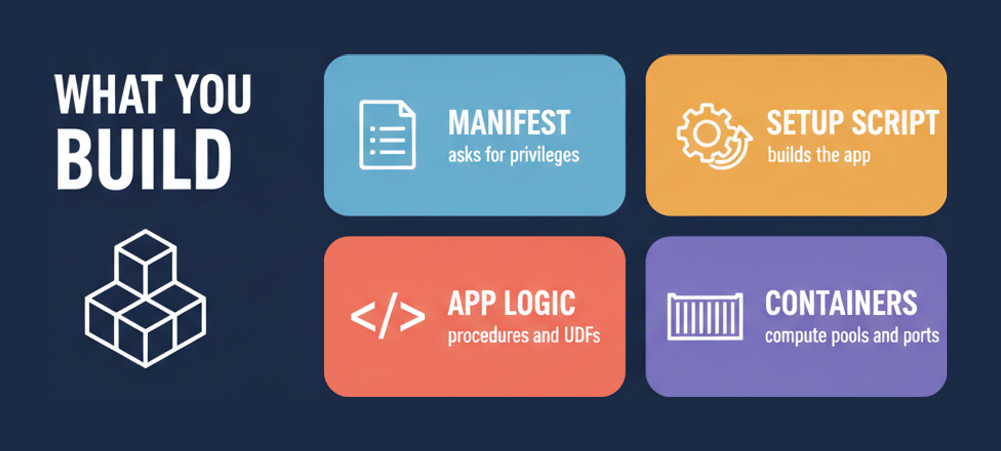
Read as a list it looks sprawling. Read as a build order it is coherent: you declare the package and its manifest, you write the setup script that constructs the application, you add logic, you decide what data travels with the app and what stays behind a boundary, you wire up events so you can see what is happening in a consumer account you cannot log into, and you version the result.
The five ways application logic can run
The syllabus names stored procedures, external functions, UDFs, UDTFs, Streamlit and Snowpark Container Services as the vehicles for application logic. Questions rarely ask what one of them is; they ask which one fits a stated constraint. Container Services in particular brings its own sub objectives around compute pool settings and service endpoint binding, which is a different mental model from the SQL and Python surface the rest of the domain uses. It assumes you are comfortable with the container image conventions defined by the Open Container Initiative, since that is what a compute pool is ultimately running.
The Native App Framework documentation is the correct depth here, and it is unusually well organised around exactly these components. Where the syllabus mentions Python environment configuration through environment.yml, it is worth knowing how the packaging conventions of the wider Python ecosystem map onto what Snowflake accepts, because the exam assumes that background rather than teaching it.
What does the exam expect about privileges and execution rights?
Privileges appear in both Design and Build, and the execution rights material is the single most distinctive thing on this syllabus. The framework lets application code run either with the rights of the application object’s owner or with a restricted caller’s rights, and the syllabus lists both explicitly along with consumer-side grant workflows and the limitations of the restricted mode.
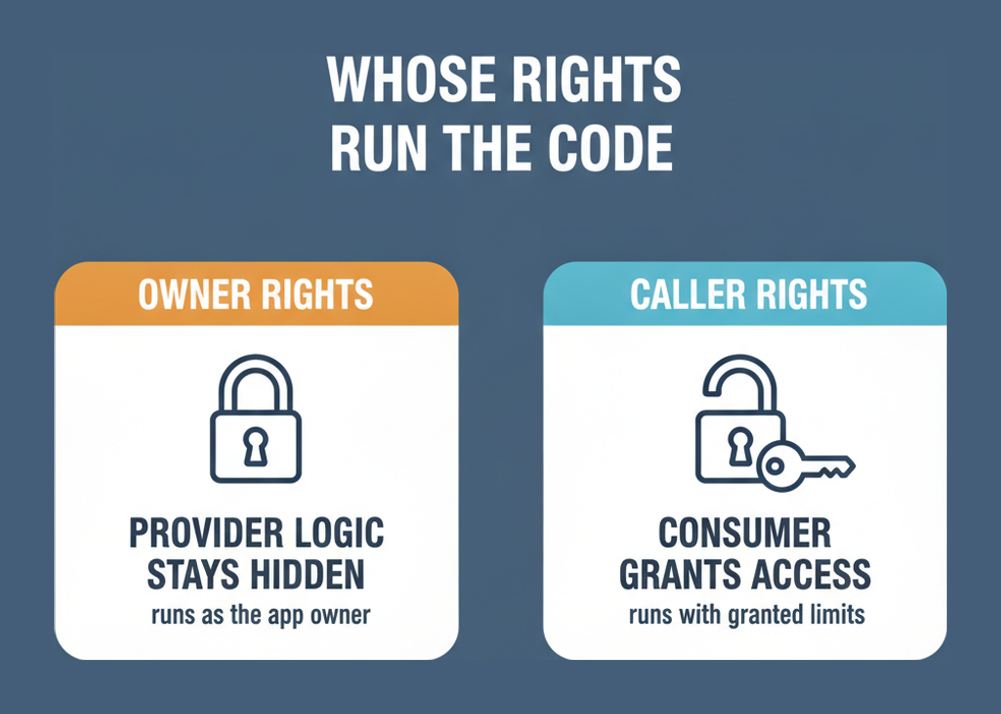
This is not an access control detail. The syllabus says outright that execution rights are how intellectual property is protected in a native app, because they determine what a consumer can see of the provider’s logic. A question describing a provider worried about exposing proprietary code is an execution rights question, however it is dressed.
Alongside it sits a specific list of global privileges the exam names: EXECUTE TASK, EXECUTE MANAGED TASK, CREATE WAREHOUSE, MANAGE WAREHOUSES and CREATE DATABASE, plus configuring IMPORTED PRIVILEGES on databases. These are worth knowing as a list, because they are the ones a manifest actually requests and a consumer actually approves.
Release channels and upgrades are the Manage domain in miniature
Manage is 29 percent and its centre of gravity is release management. The syllabus names release directives, both default and custom, and release channels with the specific examples QA, ALPHA and DEFAULT, along with channel types, monetisation implications, version assignment workflows and the privileges needed to run any of it.
The second half of the domain is the consumer’s side of the same coin: upgrade policies, maintenance windows that block updates during set periods, delayed upgrade schedules with start dates, and control over when an automatic upgrade lands after a directive is issued. A provider pushes; a consumer decides when to catch it.
Underneath both sits the maintenance objective, which asks for idempotent upgrade code, managed database schema changes, data integrity safeguards during upgrades and a versioning strategy. Anyone who has shipped software will recognise this as ordinary release engineering. Anyone whose background is purely analytical will find it the least familiar part of the exam.
Why is Deploy the smallest domain at 11 percent?
Deploy is 11 percent, roughly six questions, and it is small because most of it is procedural rather than architectural. Publishing to the Marketplace, choosing a private or public listing, passing security scanning, configuring billing and installing into a consumer account are steps with correct answers rather than trade-offs with defensible alternatives.
Two parts of it do reward attention despite the low weight. The security scanning objectives name code readability requirements, source map requirements for minified code and dependency vulnerability scanning, which are concrete and easy marks. And monetisation covers subscription and usage based billing, container billing with surcharge configuration, and custom billing events, which is genuinely unfamiliar territory for most engineers.
The rest is installation troubleshooting, which reads naturally once you understand the provider and consumer boundary from the Design domain. If you are working through the Specialty series, our walkthrough of the SnowPro Specialty Gen AI exam covers the sibling credential that shares this exam’s format and scoring model.
Who is NAS-C02 actually written for?
Snowflake states the candidate profile explicitly: one or more years of experience with Snowflake in an enterprise environment, plus six or more months of recent hands-on experience developing native applications. It also names basic knowledge of Snowflake-supported languages such as Python, and basic familiarity with development release cycles such as SDLC.
That second pair is the honest filter. A strong Snowflake practitioner with no software release background will find Manage and half of Build unfamiliar, because those domains are about shipping rather than querying. Conversely a software engineer new to Snowflake will read the release material easily and struggle with schema separation, application roles and the framework’s constraints.
The candidates who pass comfortably have shipped at least one real application package, even a trivial one, into a second account. Six months of that is worth more than any amount of reading, and it is precisely what Snowflake’s own profile asks for. If your Snowflake foundations need work first, the SnowPro Specialty Snowpark route covers the developer surface this exam builds on.
How should you prepare for NAS-C02?
Preparation for NAS-C02 has to be hands-on, because the objectives describe actions rather than facts. Six to eight weeks is realistic for someone who already works in Snowflake but has not shipped an application package. The order below follows the build order rather than the domain order, which is how the material actually makes sense.
- Build a trivial application package first, with a manifest and a setup script, and install it into a second account so the provider and consumer boundary stops being abstract
- Add application logic in at least three of the named styles, including one Streamlit surface and one Snowpark Container Services component, so compute pools and endpoint binding are concrete
- Work through privileges next, requesting them in the manifest, building an application role hierarchy, and running the same procedure under owner rights and then under restricted caller rights to see the difference
- Configure an event table and share events back, because observability into an account you cannot enter is a recurring theme across two domains
- Version the app, issue a patch, set a release directive and move it across release channels, then upgrade it consumer side under a maintenance policy
- Finish with the Deploy material, covering listing settings, security scanning requirements and the billing models, then sit timed sets until 55 scenario questions in 85 minutes is comfortable
Skipping step one is the classic mistake. Almost every scenario in the exam assumes you know what actually happens when an app is installed into an account you do not control, and that is not something reading conveys.
Frequently Asked Questions
What is the current exam code for SnowPro Specialty Native Apps?
NAS-C02. Snowflake’s version stamped certification page carries that code, and the older NAS-C01 path on Snowflake’s own site now returns a 404. Much third party study material still names C01.
How many questions are on the NAS-C02 exam?
Fifty five questions within 85 minutes, according to the money site’s published syllabus. Snowflake’s certification page does not render a question count to an automated reader, so this is not an officially confirmed figure.
What score do you need to pass NAS-C02?
Seven hundred and fifty on a scaled range of 0 to 1000. Because the scale is calibrated rather than a raw percentage, it does not correspond to a fixed number of correct answers.
How much does the SnowPro Specialty Native Apps exam cost?
$225 USD according to the published syllabus. Snowflake’s own FAQ quotes prices for the Core and Advanced series but does not state a Specialty price on the certification page itself.
Which NAS-C02 domain carries the most marks?
Build Snowflake Native Applications at 38 percent, roughly 21 of 55 questions. Manage follows at 29 percent, Design at 22 percent and Deploy at 11 percent.
What experience does Snowflake recommend before taking it?
One or more years with Snowflake in an enterprise environment plus six or more months of recent hands-on native application development. Snowflake also names basic knowledge of a supported language such as Python and of development release cycles such as SDLC.
What is the difference between owner rights and restricted caller’s rights?
They determine whose privileges application code executes with, and therefore how much of the provider’s logic a consumer can observe. The syllabus ties this directly to intellectual property protection, so scenarios about exposing proprietary code are usually execution rights questions.
Does the exam cover Snowpark Container Services?
Yes, inside the Build domain. The objectives name compute pool settings, service endpoint binding requirements and container-based application architecture, and Deploy adds container billing and surcharge configuration.
What are release channels and why do they matter?
Release channels control which consumers receive which version, with QA, ALPHA and DEFAULT named in the syllabus. They sit inside the Manage domain along with release directives, version assignment workflows and the privileges required to operate them.
Is NAS-C02 harder than SnowPro Core?
It is narrower and more specialised rather than simply harder. Core tests breadth across the platform; Native Apps tests one framework in depth and assumes software release experience that Core does not require.
Conclusion
NAS-C02 is the SnowPro Specialty exam for people distributing software rather than analysing data. Fifty five questions, 85 minutes, $225 USD, scaled scoring with 750 to pass, and four domains weighted 38, 29, 22 and 11 percent.
Two things decide the outcome. The first is whether you have actually shipped an application package into an account you do not control, because Build and Manage are 67 percent of the paper and both assume it. The second is whether your study material is current: the exam is now NAS-C02, a great deal of what is published still says NAS-C01, and the specifications are the part that moved. Check the domains, build the app, ship a patch, then book it.