You will never be told your score on the Google Cloud Professional Data Engineer exam. The result that arrives after the two hour sitting says pass or fail, and Google displays no passing score anywhere on its certification page, so the 70 percent figure that circulates on practice test listings is an estimate dressed up as a rule. That has a practical consequence: a timed GCP data engineer practice exam is the only place in the whole journey where you will see a percentage next to your name, and it is worth knowing how to read one.
This article sets out what Google actually publishes about the exam and its scoring, how the five syllabus domains are weighted, why a scenario-based paper rewards timed practice more than most certifications do, a four pass method for turning practice results into a domain by domain readiness picture, which services the syllabus names, and how the one hour renewal exam differs from the two hour standard one. It is written for a candidate deciding whether to spend the $200 yet.
What Does a Pass or Fail Result on the Professional Data Engineer Exam Actually Mean?
A pass or fail result on the Google Cloud Professional Data Engineer exam means you cleared or missed a threshold that Google does not publish. The certification page displays the length, the fee, the languages, the question format and the two year validity, and no passing score at all. Treat any percentage you read elsewhere as that source’s guess, not Google’s rule.
This matters because candidates arriving from other vendors expect a number. Many certifications publish a scaled cut score and a result report broken down by domain; Google publishes neither for this exam. You get the verdict, and the way to learn anything more granular about your own readiness is to measure it yourself before the sitting, which is the subject of the rest of this article.
Everything Google does display is on its Professional Data Engineer page, and the practice exam and syllabus pages on VMExam carry the same core figures.
| Exam detail | Google Cloud Professional Data Engineer |
|---|---|
| VMExam exam code | GCP-PDE |
| Length | 2 hours (120 minutes) |
| Registration fee | $200 USD, plus tax where applicable |
| Questions | 40 to 50 multiple choice and multiple select questions |
| Result | Pass or fail; no passing score is published by Google |
| Languages | English, Japanese |
| Delivery | Online proctored from a remote location, or onsite at a testing centre |
| Prerequisites | None |
| Recommended experience | 3+ years in industry, including 1+ years designing and managing solutions on Google Cloud |
| Validity | 2 years |
| Registration | Google CertMetrics |
Two details on that table deserve a second look. The question count is a range, not a number, so two candidates sitting on the same day may answer a different number of items. And “multiple select” is not decorative: some items require more than one correct option, and a practice exam that never asks you to pick two or three answers is training you on the easier half of the format.
How Are the Five GCP-PDE Domains Weighted?
The GCP-PDE syllabus has five domains, weighted at roughly 22, 25, 20, 15 and 18 percent of the exam. Ingesting and processing the data is the largest at about 25 percent, preparing and using data for analysis the smallest at about 15, and the remaining three sit within six points of each other, so no domain can be safely skipped.
The table reproduces the domains and their first level objectives as the VMExam syllabus page lists them. Google’s own standard exam guide, a PDF linked from the certification page as version 4.2, is the document these objectives follow.
| Domain | Share | First level objectives |
|---|---|---|
| Designing data processing systems | ~22% | Designing for security and compliance; designing for reliability and fidelity; designing for flexibility and portability; designing data migrations |
| Ingesting and processing the data | ~25% | Planning the data pipelines; building the pipelines; deploying and operationalizing the pipelines |
| Storing the data | ~20% | Selecting storage systems; planning for using a data warehouse; using a data lake; designing for a data platform |
| Preparing and using data for analysis | ~15% | Preparing data for visualization; preparing data for AI and ML; sharing data |
| Maintaining and automating data workloads | ~18% | Optimizing resources; designing automation and repeatability; organizing workloads based on business requirements; monitoring and troubleshooting processes; maintaining awareness of failures and mitigating impact |
Read the objectives rather than the headings. “Designing for reliability and fidelity” sounds architectural, but its considerations include preparing and cleaning data with Dataform, Dataflow and Cloud Data Fusion, prompting LLMs for query generation, and ACID decisions. “Preparing data for AI and ML” includes preparing unstructured data for embeddings and retrieval augmented generation. The AI material is spread through the domains rather than parked in one, which is why a candidate who skipped it expecting a small standalone section tends to be surprised. The full objective list, including the tools cited under each consideration, is in the official exam guide.
Why Does a GCP Data Engineer Practice Exam Matter More Here Than for Most Certifications?
A GCP data engineer practice exam matters more for this credential because the paper is scenario based, the result is pass or fail with no breakdown, and the question count varies. Those three facts together mean the only way to know which domain is costing you marks, and whether 120 minutes is enough for your reading speed, is to sit a timed run under exam conditions before booking.
The scenario style is visible in the sample questions. One describes an IT team exporting BigQuery results to CSV and emailing them to finance, and asks how to improve the process while keeping the finance team’s familiar tools; the expected answer is to save the query results to a shared Google Sheet, not to hand out Looker Studio dashboards or Cloud Storage links. Another describes a business critical PostgreSQL system serving millions of customers worldwide with manual scaling, and asks where to migrate it for global scale with minimal maintenance; the answer is Spanner, not Cloud SQL and not BigQuery. Neither question can be answered by recalling a definition. Both require you to weigh a requirement against four plausible services.
That is the skill a practice exam measures and a flashcard deck does not. A timed set of 40 to 50 items also exposes the pacing problem: at the top of the range you have under two and a half minutes per question, and scenario stems are long. The GCP-PDE practice exam on VMExam runs with the syllabus weights, the time limit and shuffled options so that a run reproduces those conditions rather than a leisurely review.
What the sample questions reveal about the question writers
Several of the published samples test design heuristics rather than product facts: keep Bigtable row keys short and built from the fields you query by; nest author fields inside a BigQuery record instead of joining a separate table; place a Compute Engine instance in the same zone as the Bigtable instance it reads from. Each of these is a recommendation from Google’s own documentation, and each appears as the correct option against three plausible but worse alternatives. When a practice question of this type goes wrong for you, the lesson is to read the relevant best practice page, not to memorise the answer.
How Should You Read Practice Exam Results Domain by Domain?
Read practice exam results by tallying each wrong answer against the five GCP-PDE domains and comparing the tally with the domain weights, rather than by looking at the overall percentage. A 78 percent run with every miss in the 25 percent ingestion domain is a different readiness picture from a 78 percent run with misses spread evenly, and only the tally shows the difference.
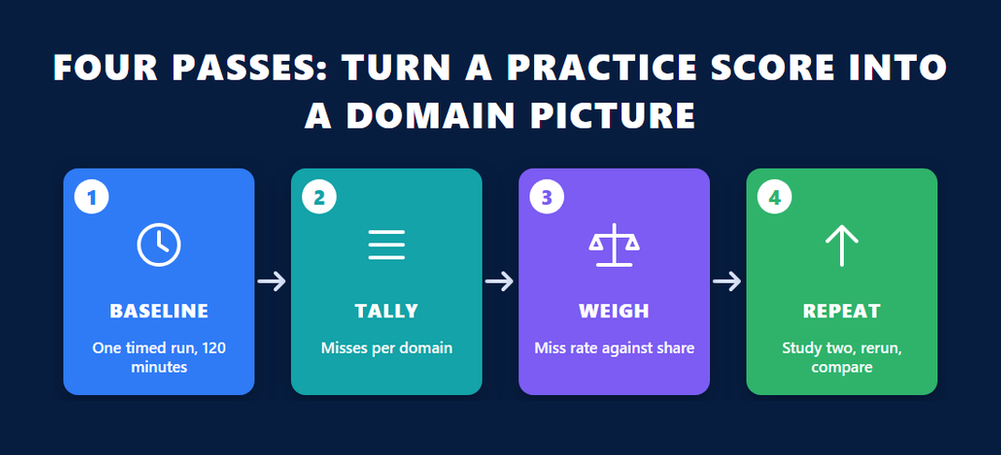
The method below is deliberately simple. It needs a timed practice exam that reports which items you missed, the syllabus table above, and a spreadsheet with five rows.
- Sit one full timed run of 40 to 50 questions in 120 minutes before you study anything, so the first result is a baseline rather than a reflection of the last topic you revised.
- Tally every wrong answer against the domain its objective belongs to, using the syllabus table, so that each of the five domains has a miss count.
- Divide each domain’s miss count by the number of questions it contributed, and compare the resulting miss rate with the domain’s share of the exam, so that a weak domain carrying 25 percent of the marks is treated as more urgent than a weak domain carrying 15.
- Study the two domains with the worst weighted miss rate, then repeat the full timed run and compare the new tally with the old one, so that improvement is measured per domain rather than guessed from the overall score.
Three full runs is usually enough to see whether the pattern is stable. A domain that stays weak across three runs after study is a knowledge gap; a domain that swings between runs is usually a reading problem, which is a pacing issue rather than a content one. Candidates who treat the overall percentage as the only signal often study the wrong thing, because a strong domain with many questions can mask a weak one with few.
What the overall percentage is still good for
The overall number is not useless; it is simply not the readiness measure. Because Google publishes no cut score, a practice percentage cannot be compared with a real threshold. What it can do is show trend: three timed runs on fresh question sets that move in the same direction tell you more than any single figure. Treat a plateau as the signal to stop drilling and go back to the documentation for the domains that stalled.
Which Google Cloud Services Does the Syllabus Name?
The GCP-PDE syllabus names more than thirty products and projects, from BigQuery, Dataflow, Dataproc and Pub/Sub in the pipeline domains to BigLake, AlloyDB, Bigtable, Spanner, Cloud SQL, Firestore and Memorystore in storage, with Dataplex, Cloud Composer, Workflows, Analytics Hub and BigQuery reservations across governance, orchestration and operations. Knowing which service fits which requirement is most of the exam.
A few names recur across domains and deserve the deepest preparation. Dataflow appears under reliability, pipeline building and the streaming considerations of windowing and late arriving data; its programming model is Apache Beam, which one of the published sample questions tests directly by asking which Apache project the Dataflow SDKs became. Google’s Dataflow documentation is where the trigger types, the windowing behaviour and the batch versus streaming decisions in the syllabus are explained. BigQuery is named in design, storage, analysis and operations, with specific features called out: BI Engine, materialized views, BigQuery ML, Analytics Hub for sharing, and Editions and reservations for capacity management. Cloud Composer appears twice, once for job orchestration and once for creating directed acyclic graphs, so a candidate who has never written a DAG should fix that before the sitting.
A note on product names
Google’s certification page carries a notice that the exam will soon be updated to reflect recent branding changes, and directs candidates to the exam guide for the product names used on the exam. In practice this means a question may use a name you know under a newer or older label. Prepare with the names in the current guide, and when a practice question uses a name you do not recognise, check whether it is a renamed service you already know rather than a gap in your knowledge.
Services the syllabus names only once
Transfer Appliance, Database Migration Service, Datastream and the BigQuery Data Transfer Service appear together under designing data migrations, and Cloud DLP appears once under preparing data for visualization alongside data masking and IAM. Firestore and Memorystore are listed among the managed storage options but nowhere else. These single mentions are still testable, and a scenario question about a one time petabyte scale migration or a sensitive column in a report is exactly where they surface.
Standard Exam or Renewal Exam: Which One Are You Sitting?
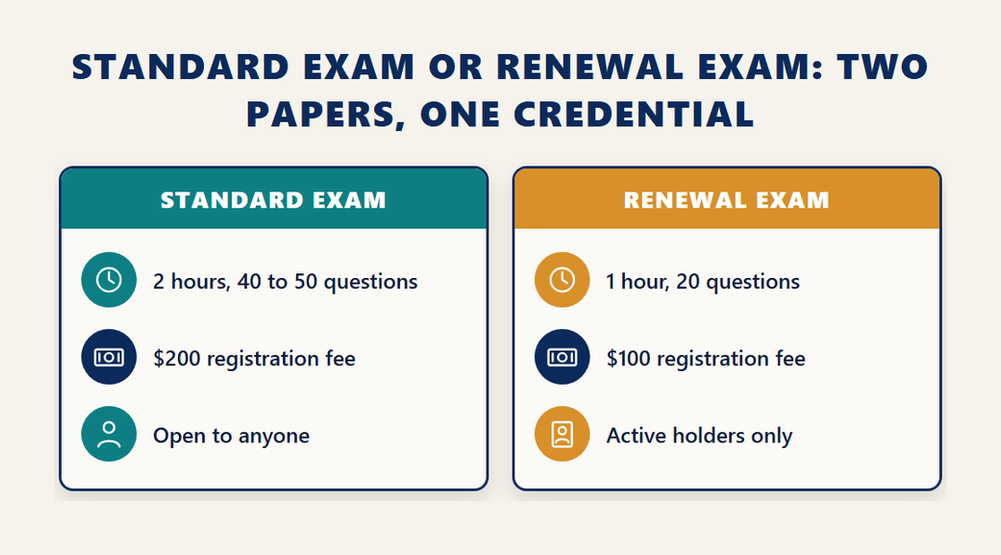
Google now runs two papers for this credential: the standard exam of 40 to 50 questions in 2 hours for $200, and a renewal exam of 20 questions in 1 hour for $100, open only to holders whose certification is still active and inside its renewal window. Both carry a 2 year validity, and a third renewal route uses designated courses or skill badges instead of an exam.
The distinction matters for how you practise. A first time candidate is preparing for the standard paper and its full domain spread. A holder approaching expiry can choose between the shorter renewal paper, which has its own renewal exam guide, and the full standard exam; the course based route in Google Skills gives a 1 year validity and must be completed within the last year of the certification’s active date. Google displays all three routes on the certification page.
| Detail | Standard exam | Renewal exam |
|---|---|---|
| Who can sit it | Anyone; no prerequisites | Active holders within the renewal eligibility period |
| Length | 2 hours | 1 hour |
| Questions | 40 to 50 multiple choice and multiple select | 20 multiple choice and multiple select |
| Registration fee | $200 plus tax | $100 plus tax |
| Languages | English, Japanese | English, Japanese |
| Validity earned | 2 years | 2 years |
| Content | Standard exam guide | Renewal exam guide |
Two practical points follow. First, 20 questions in an hour is three minutes per item against roughly two and a half on the standard paper, so the renewal exam is less of a pacing test and more of a currency test on what changed in the platform since you last certified. Second, because the renewal exam has its own guide, a holder practising on standard exam question sets is practising for a broader paper than the one booked; that is not wasted effort, but the domains that matter most for renewal are the ones with the newest material, and the AI and governance objectives are the obvious candidates.
Who Is the Professional Data Engineer Credential Built For?
The Professional Data Engineer credential is built for people who design, build, operate and secure data processing systems on Google Cloud, and Google recommends 3 or more years of industry experience including at least 1 year designing and managing solutions on the platform. There are no formal prerequisites, so the recommendation is advice about readiness rather than a gate.
The syllabus describes the job directly. The design domain expects decisions about IAM, encryption, personally identifiable information, data sovereignty and multi environment setups. The pipeline domains expect you to choose between Dataflow, Dataproc, Cloud Data Fusion and the open source stack of Spark, Hadoop and Kafka, and to deploy what you build through CI/CD. The storage domain expects you to match access patterns to BigQuery, Bigtable, Spanner, Cloud SQL or Cloud Storage and to plan for cost and lifecycle. The operations domain expects monitoring, quotas, reservations and failover. A data engineer who has done that work for a year on Google Cloud will recognise the paper; an analyst or a data scientist who has only consumed the outputs will find the design and operations domains, together about 40 percent of the exam, the hardest ground.
For a candidate below that experience line, Google’s associate level data credential is the sensible first sitting, and the GCP-ADP study companion covers what that exam asks instead. The professional paper rewards the judgement that comes from having operated a pipeline that failed at three in the morning, not from having read about one.
How Do PDE, Associate Data Practitioner and Machine Learning Engineer Fit Together?
Google’s data credentials form a ladder of three: the Associate Data Practitioner at the entry rung, the Professional Data Engineer in the middle, and the Professional Machine Learning Engineer at the modelling end. PDE is the one that owns the pipelines, the storage and the operations that the other two depend on, and it is the natural first professional level exam for most data roles.
The overlap with the machine learning credential is real but narrow. PDE’s analysis domain includes preparing data for feature engineering, training and serving with BigQuery ML, and preparing unstructured data for embeddings and retrieval augmented generation; the machine learning exam takes those topics and goes much further into model development and MLOps. A candidate who holds PDE and is deciding whether the ML paper is next should read how the machine learning engineer exam was reorganised before assuming the data engineering preparation carries over.
Across vendors, the comparable credentials are the AWS Certified Data Engineer Associate, the Databricks and Snowflake data engineer certifications and the Microsoft Azure data engineer track. They test the same discipline on different platforms, and search demand for “data engineer certification” is split across all of them. The Google paper is distinguished by its weight on BigQuery and Dataflow and by the pass or fail reporting described at the start of this article.
Frequently Asked Questions
What is the passing score for the GCP Professional Data Engineer exam?
Google does not publish a passing score for this exam. The certification page displays the length, fee, format and validity, and reports the result as pass or fail only. Percentages quoted on practice test listings are estimates, not Google’s figure.
How many questions are on the Professional Data Engineer exam?
Between 40 and 50 multiple choice and multiple select questions, answered in 2 hours. The renewal exam for existing holders has 20 questions in 1 hour.
How much does the Google Cloud data engineer certification cost?
The standard exam costs $200 plus tax where applicable. The renewal exam costs $100 plus tax. Both figures are displayed on Google’s certification page.
What score should I reach on a GCP data engineer practice exam before booking?
There is no official threshold to compare against, because Google publishes none. The more useful test is the domain tally: three timed runs in which no domain’s weighted miss rate is out of line with the others, and the overall trend is upward, is a stronger signal than any single percentage.
How many domains does the GCP-PDE syllabus have and how are they weighted?
Five: designing data processing systems at about 22 percent, ingesting and processing the data at about 25, storing the data at about 20, preparing and using data for analysis at about 15, and maintaining and automating data workloads at about 18.
Does the Professional Data Engineer exam include AI and machine learning topics?
Yes, spread across domains rather than in one section. The syllabus names prompting LLMs for query generation, AI data enrichment in pipelines, preparing data for BigQuery ML, and preparing unstructured data for embeddings and retrieval augmented generation.
How long is the Google Professional Data Engineer certification valid?
Two years. Holders can renew by passing the standard exam again, by passing the shorter renewal exam, or by completing designated courses or skill badges in the Google Skills renewal learning path within the last year of the active period.
Is there a prerequisite for the Professional Data Engineer exam?
No. Google recommends 3 or more years of industry experience including at least 1 year on Google Cloud, but the recommendation is not enforced at registration.
In which languages can I take the exam?
English and Japanese, for both the standard and the renewal exam, delivered either online with a remote proctor or at a testing centre.
What does GCP-PDE mean?
GCP-PDE is the exam code VMExam uses for the Google Cloud Professional Data Engineer certification. Google itself does not assign codes to its certification exams, so you will not see the label on Google’s own pages.
Conclusion
The Google Cloud Professional Data Engineer exam tells you only whether you passed. Everything you want to know beyond that, which domain is weak, whether two hours is enough, whether the multiple select items trip you, has to be measured before the sitting, and a timed GCP data engineer practice exam read domain by domain is the instrument for it. Take the published facts as they are: 40 to 50 questions in 2 hours for $200, five domains weighted from 15 to 25 percent, no published cut score, 2 years of validity and a shorter renewal paper afterwards. Then run the four pass method until the tally stops moving, fix the domains it names, and book the exam when the pattern is stable rather than when the overall number looks comfortable.