If you have kept a SAS 9.4 platform running for years, the SAS Viya admin exam will not ask you to forget everything you know. It will ask you to stop looking for the metadata layer. The SAS 9 platform administration exam gives a whole domain to Managing Metadata Authorization; the A00-451 blueprint has no metadata domain at all, and in its place sit CAS roles, Kubernetes node pools, content rules and a backup schedule you manage from Environment Manager.
This article reads the A00-451 exam from that starting point. It sets out the format SAS publishes, the five weighted domains, what carries over from SAS 9 administration and what is genuinely new, and a preparation order that puts the heaviest domain first. Every figure comes from the AnalyticsExam syllabus page for A00-451, checked against the SAS credential page.
What Is the SAS Viya Admin Exam, and Who Is It For?
The SAS Viya admin exam is A00-451, Administering SAS Viya, and passing it earns the SAS Certified Specialist: Administration of SAS Viya credential. It is written for the person who keeps a Viya deployment healthy: servers and services, CAS, users and groups, content permissions and data access, rather than the person writing SAS programs on it.
SAS lists five skills the credential proves: managing a SAS Viya environment, monitoring and troubleshooting it, managing identities and users, managing content and functionality, and managing data in CAS. That list reads like the job description of a SAS 9 platform administrator, which is exactly why the exam suits one. The difference lies underneath each skill, in the tools and the architecture you are expected to know.
It also suits newer administrators who have only ever worked on Viya. Nothing in the published exam details names a prerequisite certification, so the question is readiness rather than eligibility.
What Does A00-451 Look Like on Exam Day?
A00-451 has 60 to 65 multiple choice questions, a 110 minute time limit and a 65 percent passing score. The fee is $180, charged in US dollars in every country, and registration runs through Pearson VUE. The credential expires after five years, and SAS states that the exam is based on the 2024.03 LTS release of Viya.
| Exam detail | A00-451 |
|---|---|
| Exam name | Administering SAS Viya |
| Credential | SAS Certified Specialist: Administration of SAS Viya |
| Questions | 60 to 65, multiple choice |
| Duration | 110 minutes |
| Passing score | 65 percent |
| Fee | $180 (USD) |
| Registration | Pearson VUE |
| Validity | 5 years |
| Software basis | SAS Viya 2024.03 LTS |
The LTS detail matters more than it looks. Viya updates on a regular cadence, and the exam objectives themselves ask you to understand the SAS release cadence. Studying against a deployment far newer than 2024.03 is fine for concepts, but expect the exam to describe screens and options as they stood in that long term support release.
Because every item is multiple choice, the exam tests recognition and judgement rather than hands-on configuration. A good way to see how SAS phrases administration scenarios is to work through the A00-451 admin exam questions on AnalyticsExam and note which ones turn on a command line tool versus Environment Manager. The full facts block is also on the SAS credential page.
How Are the Five A00-451 Domains Weighted?
SAS weights A00-451 across five domains. Managing a SAS Viya Environment is the largest at 35 to 40 percent. Monitoring, logging and troubleshooting and content and functionality management each carry 15 to 20 percent, while identity and user management and data management in CAS each carry 10 to 15 percent.
| Domain | Weight |
|---|---|
| Managing a SAS Viya Environment | 35 to 40 percent |
| Monitoring, logging and troubleshooting in a SAS Viya Environment | 15 to 20 percent |
| Identity and user management | 10 to 15 percent |
| Content and functionality management | 15 to 20 percent |
| Data management in SAS Cloud Analytic Services (CAS) | 10 to 15 percent |
The first domain alone is more than a third of the exam, and it is also the one that changed most from SAS 9. That combination is the main reason a SAS 9 administrator should not assume experience will carry the paper. The smaller domains are where existing habits help most.
What Carries Over From SAS 9 Administration, and What Does Not?
The duties carry over: users, data access, backups, monitoring and server management appear in both the SAS 9 platform exam and A00-451. What changes is the mechanism. SAS 9 administration centres on metadata authorization, while the Viya exam tests Kubernetes based servers and services, CAS roles, authorization rules for functionality and content migration.
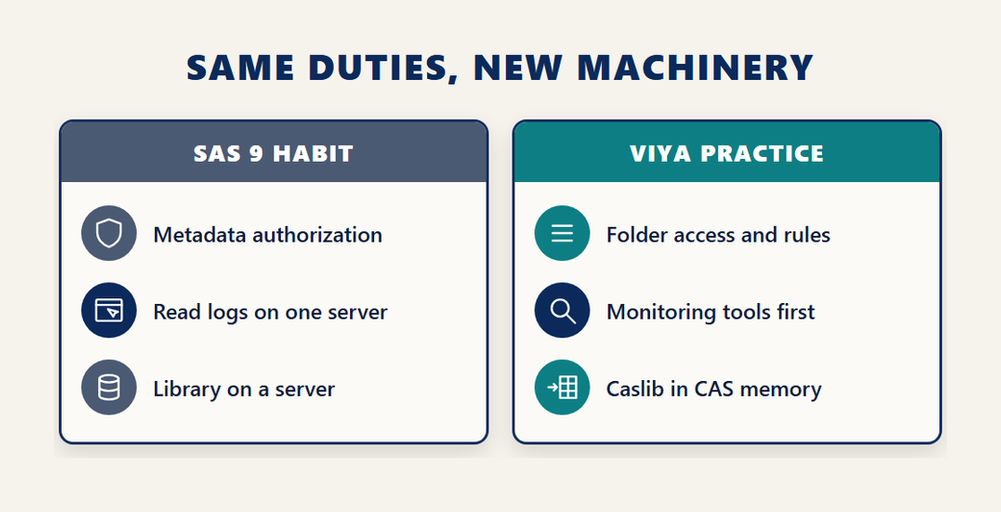
Comparing the two official blueprints makes the shift concrete. The SAS 9 platform exam, A00-250, is based on SAS 9.4 Maintenance 8 and gives 20 percent to Managing Metadata Authorization and 22 percent to Administering Users. A00-451 folds users into a 10 to 15 percent identity domain and spends its largest share on the environment itself.
| Point of comparison | A00-250 (SAS 9) | A00-451 (SAS Viya) |
|---|---|---|
| Questions | 65 | 60 to 65 |
| Duration | 110 minutes | 110 minutes |
| Passing score | 66 percent | 65 percent |
| Software basis | SAS 9.4 Maintenance 8 | SAS Viya 2024.03 LTS |
| Security focus | Managing Metadata Authorization | Folder authorization and rules for functionality |
| Largest domain | Administering Users (22 percent) | Managing a SAS Viya Environment (35 to 40 percent) |
What still feels familiar
Backup and restore, diagnosing problems from logs, managing groups, creating authentication domains and storing credentials all have SAS 9 equivalents. If you have built authentication domains for database access in SAS 9, the A00-451 objective that asks you to tell authentication, connection and encryption domains apart will feel close to home.
What is genuinely new
The architecture objectives are the break. You are expected to define the node pools of a Viya deployment, explain the stateful and stateless split, and give the purpose of supporting services such as Consul and RabbitMQ. Content migration is new ground too: the syllabus names importing content from SAS 9, from SAS Viya 3.x and from SAS Viya 4, and promoting resources with Environment Manager or the command line tools.
Why Does Managing the Environment Carry Up to 40 Percent?
Managing a SAS Viya Environment carries 35 to 40 percent because it covers the whole running platform: programming run-time servers, the CAS server, deployment updates, backup and restore, scaling servers and services, and the Viya architecture itself. It is effectively the operations manual for a Viya deployment compressed into one domain.
Run-time servers and contexts
The syllabus asks you to administer SAS Studio, work with server configuration instances and configure contexts for compute, launcher, batch and connect. A SAS 9 administrator knows workspace and batch servers well; on Viya the same work is organised around contexts, and you need to know which context launches what.
The CAS server
CAS objectives cover CAS roles, CAS server configuration instances and the CAS disk cache. This is the in-memory engine at the heart of Viya analytics, and there is no direct SAS 9 counterpart to lean on.
Updates, licences and the release cadence
You should be able to update the SAS licence, read the contents of a software order, apply patch updates, explain the SAS release cadence and describe a use case for a mirror registry. These are routine tasks in a Viya shop and a frequent source of scenario questions.
Backup, restore and architecture
Backup objectives go beyond “take a backup”: best practices, what a backup contains, viewing backup and recovery history, changing the schedule and restoring. Architecture objectives sit on top of Kubernetes, which the project describes as “a portable, extensible, open source platform for managing containerized workloads and services.” Reading the Kubernetes overview once is worth the hour if pods and node pools are unfamiliar. For Consul, the Consul documentation explains the service discovery role it plays; RabbitMQ is a messaging broker, and the exam asks only what each service is for, not how to run it.
How Does the Exam Treat Monitoring and Logging?
Monitoring, logging and troubleshooting carries 15 to 20 percent of A00-451. It asks you to change logging levels in Environment Manager, evaluate available resources, diagnose server and service problems from logs, monitor CAS sessions and services, explore system and audit reports, configure CAS logging and know SAS Viya Monitoring for Kubernetes.
That last objective names a real SAS project. The official SAS monitoring repository describes it as scripts and customisation options to deploy monitoring, alerts and log aggregation for Viya 4 running on Kubernetes. Reading its README gives you the vocabulary the exam uses for metrics and log tools.
For a SAS 9 administrator, the habit worth retraining is where you look first. Log files are still useful, but the objectives put Environment Manager, the monitoring tools and CAS session views ahead of reading files on a single server.
What Do the Identity, Content and CAS Data Domains Test?
These three domains are the remaining share of the exam, each weighted between 10 and 20 percent. Identity covers synchronisation with an identity provider, custom groups and external credentials. Content covers migration, folder authorization and functionality rules. CAS data management covers caslibs, loading data into memory, CAS authorizations, user-defined formats and table state.
Identity and user management (10 to 15 percent)
Expect identity filtering and caching, the difference between groups and custom groups, the CASHostAccountRequired custom group, the sasboot password, setting up the assumable SAS Administrators custom group and CAS superuser membership. Authentication, connection and encryption domains and stored credentials complete the domain.
Content and functionality management (15 to 20 percent)
Migration is the headline: importing content from SAS 9, Viya 3.x and Viya 4, then promoting and mapping resources with Environment Manager or the command line tools. Around it sit folder structure, authorization on folders and objects, troubleshooting authorization, and modifying rules to grant or limit access to application capabilities.
Data management in CAS (10 to 15 percent)
Here you create and manage caslibs, understand CAS data architecture and how data loads into CAS memory, use an authentication domain in a caslib definition, manage CAS authorizations and user-defined formats, and understand CAS table state management.
How Should a SAS 9 Administrator Prepare for A00-451?
Prepare in weight order and start with what is newest to you. A SAS 9 administrator gains most by learning the Viya architecture and the environment domain first, then monitoring, then the content and migration objectives, and leaving identity and CAS data until last because they build on concepts already familiar from SAS 9.
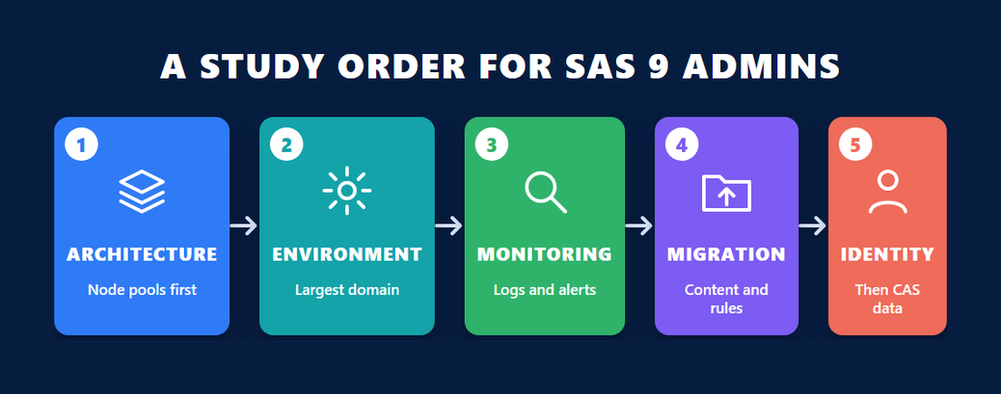
- Learn the Viya architecture first, including node pools, the stateful and stateless split and the purpose of Consul and RabbitMQ, because every other domain assumes it.
- Work through the environment domain objective by objective, covering contexts, CAS configuration, licence and patch updates, the release cadence and a full backup and restore.
- Practise monitoring and logging in Environment Manager and read the SAS Viya Monitoring for Kubernetes documentation.
- Study content migration and authorization, including imports from SAS 9 and promotion with the command line tools.
- Finish with identity and CAS data management, then sit timed practice questions to check pacing across the 110 minutes.
SAS gathers training courses, content guides, sample questions and practice exams for each credential in its certification pathways on learn.sas.com, so use those alongside a working Viya environment if your employer has one. If you want an earlier take on the same credential for comparison, this site’s Viya administration specialist overview covers it from a general angle.
Is the Viya Administration Credential Worth Adding?
For an administrator whose organisation runs or is moving to SAS Viya, yes. A00-451 is the only SAS credential aimed squarely at Viya administration, it lasts five years, and its blueprint maps directly to the work of keeping a Viya deployment secure, monitored and backed up. For a SAS 9 only shop, A00-250 remains the closer fit.
“SAS Viya is one of the most comprehensive analytics platforms on the market today.”
The breadth Vesset describes is exactly what makes Viya administration a distinct skill: many services, one platform, and someone has to own it. Holding both credentials tells an employer you can run the legacy platform and the one replacing it, which is useful for any team still running both. If you are still weighing the SAS 9 exam, the A00-250 exam tips post on this site covers that route.
Frequently Asked Questions
How many questions are on the SAS Viya admin exam?
A00-451 has 60 to 65 multiple choice questions, answered in 110 minutes.
What score do you need to pass A00-451?
The passing score is 65 percent.
How much does the A00-451 exam cost?
The fee is $180, and SAS charges it in US dollars in every country. Academic discounts are available for students and educators.
How long is the SAS Viya administration certification valid?
SAS states that the certification expires after five years.
Which version of SAS Viya is the exam based on?
SAS says the exam is based on the 2024.03 LTS release of SAS Viya.
Do I need the SAS 9 platform administration certification first?
No prerequisite certification is listed for A00-451. A SAS 9 background helps with users, backups and authentication domains, but it is not required.
Which domain carries the most weight?
Managing a SAS Viya Environment, at 35 to 40 percent, covering run-time servers, the CAS server, updates, backup and restore and the Viya architecture.
Does the exam test content migration from SAS 9?
Yes. The content and functionality domain includes importing content from SAS 9, SAS Viya 3.x and SAS Viya 4, and promoting resources with Environment Manager or the command line tools.
Are A00-451 questions hands-on tasks?
No. SAS describes all of them as multiple choice, so the exam tests whether you recognise the right administrative action in a scenario rather than asking you to perform it in a live system.
Conclusion
The SAS Viya admin exam rewards a SAS 9 administrator who is willing to relearn the platform underneath familiar duties. Users, backups, logs and data access are all still there, but the metadata layer is gone, and in its place come Kubernetes node pools, CAS roles, functionality rules and content migration. With 60 to 65 multiple choice questions, 110 minutes, a 65 percent pass mark and a $180 fee, A00-451 is a manageable step. Start with the architecture and the environment domain, the largest single share of the marks, practise with realistic questions, and book the exam once the newest material feels as routine as your SAS 9 work.