
A slow Qlik app is nearly always a modelling problem rather than a hardware one. The Qlik Sense Data Architect (QSDA) certification from Qlik confirms that you can turn raw source systems into fast, reliable analytics models. It targets the professionals who sit behind the dashboards: the people writing load scripts, shaping associative data models, and cleaning data before a single chart appears. A Qlik Sense data architect owns that unglamorous but decisive layer of every analytics project.
This guide looks at the role first and the exam second. You will see what data architects do day to day, how the QSDA blueprint mirrors that work, and where the exam concentrates its questions. Data modeling and load-script transformations carry the heaviest weight, so most of your study time belongs there. By the end, you will know which skills to build, how the 50 questions are structured, and how to plan a preparation path that matches the way Qlik actually tests candidates.
Table of Contents
- What Does a Qlik Sense Data Architect Actually Do?
- What Is the QSDA Certification and Who Should Take It?
- What Does the QSDA Exam Format Look Like?
- Which Domains Does the QSDA Syllabus Cover?
- How Do You Design Efficient Data Models in Qlik Sense?
- Why Do Data Transformations Carry the Most Exam Weight?
- How Should You Prepare for the QSDA Exam?
- What Career Opportunities Follow QSDA Certification?
- Frequently Asked Questions About the QSDA Certification
- Conclusion
What Does a Qlik Sense Data Architect Actually Do?
A Qlik Sense data architect connects source systems to Qlik Sense, then builds the data model that every app depends on. The role covers gathering requirements, choosing connectors, writing load scripts, and validating the result. Where a business analyst designs visualizations, the data architect makes sure the underlying data is accurate, associative, and fast enough to explore in real time.
Qlik is a business intelligence vendor known for its in-memory associative engine, and its data layer behaves differently from a traditional star-schema warehouse. That difference shapes the whole job. The modelling vocabulary the exam assumes is the same one set out in the DAMA body of knowledge, which helps frame why associative modeling matters.
Typical responsibilities include:
- Translating business questions into data requirements and granularity levels
- Selecting the right connectors and connection methods for each source
- Building extract, transform, and load layers with reusable scripts
- Resolving synthetic keys, circular references, and null handling
- Testing and documenting the model so other developers can extend it
What Is the QSDA Certification and Who Should Take It?
The QSDA certification is Qlik’s official credential for data architects working in Qlik Sense. It validates that you can gather requirements, connect data sources, design an efficient associative model, and transform data through load scripting. It suits developers, ETL specialists, and analytics engineers who already work with Qlik Sense and want proof of their data-modeling ability.
This exam is not aimed at pure dashboard designers. If your work is mostly front-end visualization, the analyst-track credentials fit better. The data architect path rewards people comfortable in the data load editor rather than the sheet canvas. Candidates who enjoy scripting, debugging joins, and optimizing memory usage are the natural audience.
Before registering, it helps to have hands-on time inside a real Qlik Sense environment. Qlik offers structured preparation through its official Qlik training programs, including instructor-led data modeling courses. Practical exposure to messy, multi-source data will teach you more than any single reading list, because the exam is built around applied scenarios rather than definitions.
What Does the QSDA Exam Format Look Like?
The QSDA exam contains 50 questions and gives you 120 minutes to complete them. You need a score of 62% to pass, and registration costs $250 USD through Qlik. The questions are scenario-based, asking you to choose the correct data-modeling or scripting approach for a described business situation rather than to recall isolated facts.
Because the pass mark sits at 62%, you can miss a fair number of items and still qualify, but the applied format makes guessing risky. Working through realistic scenarios is the fastest way to build confidence. A set of QSDA practice questions mirrors the phrasing and difficulty you will meet on exam day.
| Exam Attribute | Detail |
|---|---|
| Certification name | Qlik Sense Data Architect |
| Exam code | QSDA |
| Number of questions | 50 |
| Exam duration | 120 minutes |
| Passing score | 62% |
| Exam price | $250 (USD) |
| Registration | Qlik |
Which Domains Does the QSDA Syllabus Cover?
The QSDA syllabus is built around five objective areas, and their weightings are uneven by design. Data Transformations and Data Model Design together account for 66% of the exam, which signals where Qlik expects real competence. Requirements gathering, connectivity, and validation fill out the remaining questions and reflect the full lifecycle of a Qlik Sense data project.
Study the weightings before you build a plan. A domain worth 38% deserves far more of your attention than one worth 6%. The table below lists each objective area and its share of the exam exactly as published on the certification syllabus.
| Objective Area | Exam Weight | Focus |
|---|---|---|
| Identify Requirements | 20% | Business users, stakeholders, metrics, granularity, security levels |
| Data Connectivity | 8% | Choosing data sources, connectors, and connection methods |
| Data Model Design | 28% | Measures, attributes, model type, optimization, efficient structures |
| Data Transformations | 38% | Load scripts, null handling, date logic, cleansing, incremental loads |
| Validation | 6% | Validating and testing scripts and data |
How Should the Weightings Shape Your Study Time?
Treat the percentages as a budget. Spend roughly two-thirds of your preparation inside the data load editor practicing transformations and model design, since that is where most questions live. Give requirements gathering steady attention, and keep connectivity and validation as lighter review topics you revisit near the end.
How Do You Design Efficient Data Models in Qlik Sense?
Efficient Qlik Sense modeling means choosing the right structure, removing redundancy, and letting the associative engine do the linking. Data architects decide the measures and attributes to keep from each source, pick between star and snowflake shapes, and optimize the model so it stays fast in memory. The QSDA exam tests these decisions through scenario questions worth 28% of the total.
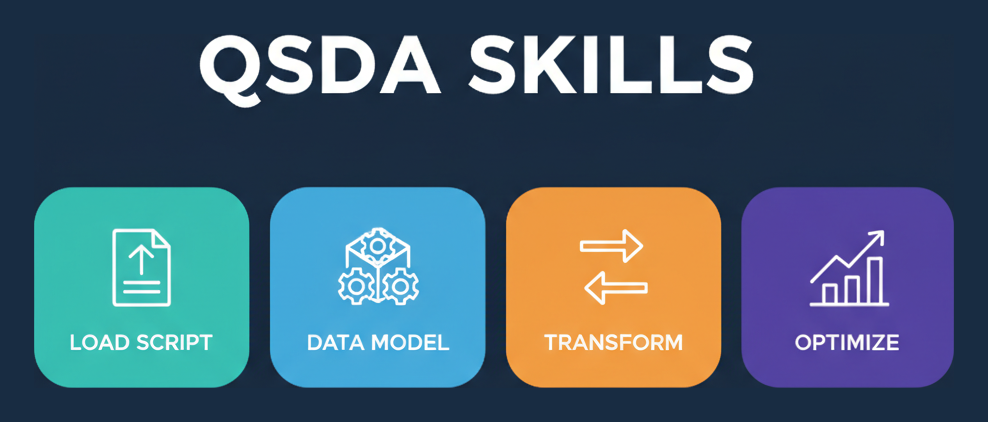
The associative engine is what makes Qlik Sense different from a fixed query tool, and it rewards clean, well-keyed models.
“Qlik’s one-of-a-kind associative analytics engine brings unmatched power to explore your data and uncover insights.”
To model well for that engine, focus on a few core practices:
- Resolve synthetic keys by renaming or concatenating fields deliberately
- Break circular references before they distort selections
- Use a single link table or star schema instead of many overlapping joins
- Drop unused fields to reduce the in-memory footprint
Understanding how the wider Qlik Sense platform stores and compresses data helps you predict which model choices keep an app responsive at scale.
Why Do Data Transformations Carry the Most Exam Weight?
Data Transformations is the largest QSDA domain at 38% because load scripting is where a data architect spends most working hours. This area covers building data content to match requirements, handling null and blank values, documenting scripts, managing dates, cleansing data, and setting up incremental loads for the extract layer. These are the skills that decide whether a model is trustworthy.
What Scripting Skills Does This Domain Test?
The exam expects fluency in the load editor, not just theory. You should be comfortable writing preceding loads, applying mapping tables, and using resident loads to reshape data. Date handling is a recurring theme, so master the canonical date and calendar techniques Qlik recommends.
- Building and reusing load scripts across multiple sources
- Handling null and blank values so filters behave correctly
- Applying consistent date and calendar logic
- Cleansing and organizing scripts for readability
- Designing incremental loads to avoid full reloads
Why Does Incremental Loading Matter So Much?
Incremental loading keeps large models refreshing quickly by pulling only new or changed records into the extract layer. Full reloads become impractical as data grows, so architects rely on stored QVD files and variables to append deltas. Expect scenario questions that ask you to choose the correct incremental strategy for a given source.
How Should You Prepare for the QSDA Exam?
Effective QSDA preparation blends structured study with heavy hands-on practice in the data load editor. Because the exam is scenario-driven, reading alone will not carry you. Build a plan that follows the domain weightings, spend real time transforming messy data, and rehearse under timed conditions so 50 questions in 120 minutes feels comfortable.
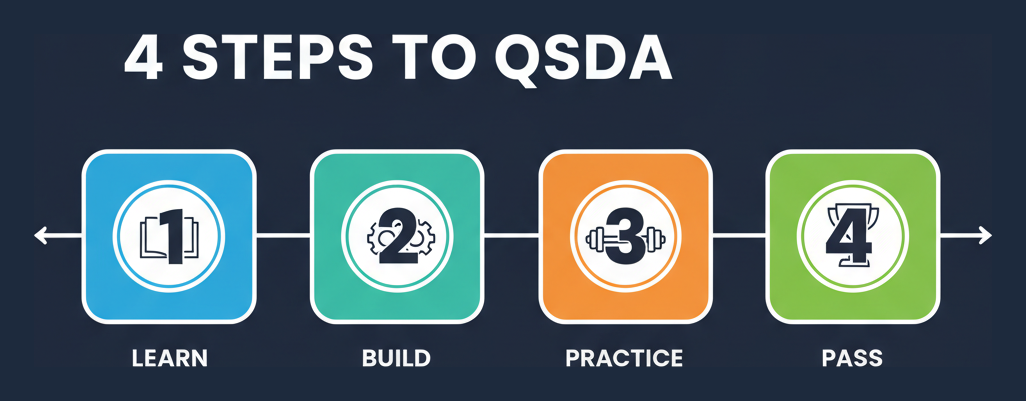
A practical study sequence looks like this:
- Read the official syllabus and map each objective to a skill you can practice
- Complete a data modeling course through the Qlik course catalog
- Rebuild a multi-source model from scratch, resolving keys and circular references
- Write incremental load scripts using QVD files and variables
- Take timed practice sets and review every incorrect answer
Older candidate write-ups still hold useful field notes on pacing and pitfalls; this walkthrough on how to pass the QSDA exam covers habits that transfer well to the current version. Combine that experience with fresh practice on the live platform for the best result.
What Career Opportunities Follow QSDA Certification?
QSDA certification strengthens roles that sit at the data layer of analytics teams. Certified professionals commonly work as Qlik developers, business intelligence engineers, ETL developers, and analytics consultants. The credential signals that you can be trusted with the model every dashboard depends on, which matters to employers standardizing on Qlik Sense.
Demand tends to cluster in organizations running large, multi-source Qlik deployments where model performance is a real constraint. Pairing data-architect skills with front-end knowledge widens your options further. If you also want to design analytics for end users, the Qlik Sense Business Analyst track complements the architect path and rounds out a full-stack BI profile.
Roles that value the QSDA credential include:
- Qlik Sense developer or lead developer
- Business intelligence or analytics engineer
- ETL and data integration specialist
- Analytics consultant or solution architect
Frequently Asked Questions About the QSDA Certification
What is the QSDA certification?
QSDA is the Qlik Sense Data Architect certification from Qlik. It validates your ability to gather requirements, connect data sources, design associative data models, and transform data through load scripting in Qlik Sense.
How many questions are on the QSDA exam?
The QSDA exam contains 50 questions. You have 120 minutes to answer them, and the scenario-based format asks you to choose the correct modeling or scripting approach for described business situations.
What score do you need to pass QSDA?
You need to score 62% to pass the QSDA exam. Because the format is applied rather than recall-based, practicing realistic scenarios is more effective than memorizing isolated facts before test day.
How much does the QSDA exam cost?
The QSDA exam costs $250 USD. Registration is handled through Qlik, and the fee covers a single attempt at the 50-question, 120-minute assessment.
Which QSDA domain has the highest weight?
Data Transformations carries the most weight at 38% of the exam. Data Model Design follows at 28%, so scripting and modeling together make up two-thirds of your total score.
Is QSDA suitable for beginners?
QSDA suits candidates who already have hands-on Qlik Sense experience. Beginners should first practice load scripting and data modeling in a live environment before attempting the scenario-based questions.
What is the difference between QSDA and the analyst track?
QSDA focuses on the data layer: connectivity, modeling, and load scripting. The business analyst track focuses on the front end, covering visualization, dashboards, and how end users explore data in Qlik Sense.
How long does it take to prepare for QSDA?
Preparation time varies with experience. Practicing data architects often need a few focused weeks, while newcomers should plan longer to build fluency in the data load editor and associative modeling techniques.
Does QSDA require a prerequisite exam?
Qlik does not mandate a prior certification for QSDA. However, practical experience with Qlik Sense data loading and modeling is strongly recommended before you register for the exam.
Conclusion
Becoming a Qlik Sense data architect is about owning the data layer that every app relies on. The QSDA exam mirrors that responsibility, weighting data transformations and model design most heavily because those skills define a strong analytics foundation. Focus your study where the questions live, practice load scripting on real multi-source data, and rehearse under timed conditions.
Treat the syllabus weightings as your roadmap and back your reading with genuine hands-on work. When you are ready to test your readiness, working through a set of QSDA practice questions is a natural next step toward earning the credential and standing out as a Qlik data-modeling specialist.