The Snowflake SnowPro Advanced: Architect (ARA-C01) certification, offered by Snowflake, targets professionals who design production data platforms rather than simply query them. It sits above the SnowPro Core credential and measures whether you can shape accounts, security, sharing, and performance for real workloads. This guide takes an architecture-first view of the exam. Instead of listing generic study tips, it walks through how each ARA-C01 domain maps to decisions an enterprise data architect actually makes, from role hierarchies to multi-cluster warehouse sizing. You will find the verified exam format, the four weighted domains, the design skills each one assesses, and a practical path to sit the test with confidence. Whether you already run Snowflake in production or you are moving from a Core-level role toward platform ownership, the sections below show what “advanced” means in Snowflake terms and how to prove it.
Table of Contents
- What Does the SnowPro Advanced Architect Certification Validate?
- Who Should Pursue the ARA-C01 Exam?
- What Is the ARA-C01 Exam Format and Cost?
- How Is the ARA-C01 Syllabus Weighted Across Domains?
- How Do You Design Snowflake Accounts and Security at Scale?
- Which Snowflake Architecture Patterns Does the Exam Test?
- What Data Engineering Skills Does an Architect Need?
- How Do Architects Optimize Snowflake Performance?
- How Should You Prepare for the ARA-C01 Exam?
- What Career Opportunities Follow the Architect Credential?
- Frequently Asked Questions
- Conclusion
What Does the SnowPro Advanced Architect Certification Validate?
The SnowPro Advanced Architect certification (ARA-C01) validates that you can translate business requirements into a secure, scalable Snowflake design. Snowflake positions it for people who define account strategy, access models, data sharing, and performance tuning across an organization. It confirms design judgment, not just feature recall, so passing signals you can own a Snowflake platform end to end.
Where the Core exam checks whether you understand Snowflake features, the Architect exam checks whether you can combine those features into a coherent system. Questions frame trade-offs: one account or many, which role model, when to replicate, how to control cost. You are expected to reason like the person accountable for the whole environment. Readers comparing cloud vendors at this level may also want the GCP machine learning certification.
Snowflake publishes the credential through its official training program, and you can review the scope on the official certification page. That framing matters because the exam rewards architects who justify decisions against security, governance, and workload constraints rather than memorized defaults.
Who Should Pursue the ARA-C01 Exam?
The ARA-C01 exam suits data architects, senior data engineers, platform leads, and solution architects who already work with Snowflake in a design or ownership capacity. Snowflake recommends two or more years of hands-on experience as an architect in a production Snowflake environment before attempting it, and notes that successful candidates often bring coding experience beyond SQL and DevOps or DataOps design work. It is not an entry point; candidates usually hold the SnowPro Core credential first. Architects working across clouds often add the database migration certification to cover the Google managed database estate.
You are a good fit if you regularly make platform-level calls: shaping RBAC hierarchies, planning data sharing between business units, or sizing warehouses for competing workloads. Candidates moving up from ingestion-focused roles often pair this study with a foundation refresh, and many start by revisiting the SnowPro Core certification to close feature gaps before tackling design scenarios.
- Data architects owning a Snowflake environment across multiple teams
- Senior data engineers ready to move from pipelines to platform design
- Cloud and solution architects integrating Snowflake into wider systems
- Technical leads responsible for security, governance, and cost control
What Is the ARA-C01 Exam Format and Cost?
The ARA-C01 exam contains 65 questions and runs for 115 minutes. It costs $375 USD and is delivered through Pearson VUE, either at a test center or via online proctoring. Scoring is scaled from 0 to 1000, and a passing result requires 750 or higher. Questions use multiple choice and multiple select formats built around applied design scenarios. Architects who package their designs for distribution should also read Snowflake Native Apps credential.
Because scoring is scaled, you do not need a fixed percentage of correct answers; the passing bar reflects question difficulty. Time management still matters, since scenario questions take longer to read than recall questions. Working through a realistic ARA-C01 practice exam helps you calibrate pace before test day.
| Exam Attribute | Detail |
|---|---|
| Exam name | Snowflake SnowPro Advanced: Architect |
| Exam code | ARA-C01 |
| Number of questions | 65 |
| Duration | 115 minutes |
| Passing score | 750 (scaled 0 to 1000) |
| Exam cost | $375 USD |
| Delivery provider | Pearson VUE |
How Is the ARA-C01 Syllabus Weighted Across Domains?
The ARA-C01 syllabus splits across four weighted domains: Snowflake Architecture at 30%, Accounts and Security at 25%, Data Engineering at 25%, and Performance Optimization at 20%. Architecture carries the most weight, which reflects the exam’s focus on design decisions. Together these domains cover account strategy, governance, ingestion, transformation, and tuning at production scale.
Reading the weighting as a study budget helps. More than half the exam sits in Architecture and Accounts and Security combined, so design and governance deserve the deepest preparation. The table below shows how to allocate attention across the blueprint.
| Domain | Weight | Core focus |
|---|---|---|
| Snowflake Architecture | 30% | Data models, data sharing, object hierarchy, recovery |
| Accounts and Security | 25% | Account strategy, RBAC, governance, authentication |
| Data Engineering | 25% | Loading, connectors, transformation, dynamic tables |
| Performance Optimization | 20% | Query profiling, warehouse tuning, clustering, caching |
How Do You Design Snowflake Accounts and Security at Scale?
The Accounts and Security domain, worth 25%, tests how you design account strategy and a governance model that meets security, privacy, and compliance requirements. You must weigh single versus multiple accounts, build role hierarchies, and apply data protection controls. This is where architecture decisions become organizational policy, so scenarios reward defensible trade-offs.
Account strategy and parameter hierarchy
Expect questions on when to isolate accounts and how account, object, and session parameters interact. The exam wants you to explain why one account simplifies sharing while multiple accounts improve isolation for regulated data or separate business units.
Role-based access control and governance
RBAC is central. You should distinguish functional roles from access roles, understand privilege inheritance, and know secondary and database roles. Snowflake’s own model is direct on this point:
“Role-based Access Control (RBAC): Access privileges are assigned to roles, which are in turn assigned to users.”
Beyond roles, the domain covers governance features such as secure views, dynamic data masking, row access policies, object tagging, and data lineage. Reviewing Snowflake’s role-based access control guidance clarifies how these controls layer together for column and row protection.
Authentication and network security
Rounding out the domain are authentication and network controls: SSO, OAuth, MFA, key-pair authentication, network policies, and private connectivity through AWS PrivateLink, Azure Private Link, or Google Cloud Private Service Connect. Architects choose the right mix for enterprise identity and network isolation needs.
Which Snowflake Architecture Patterns Does the Exam Test?
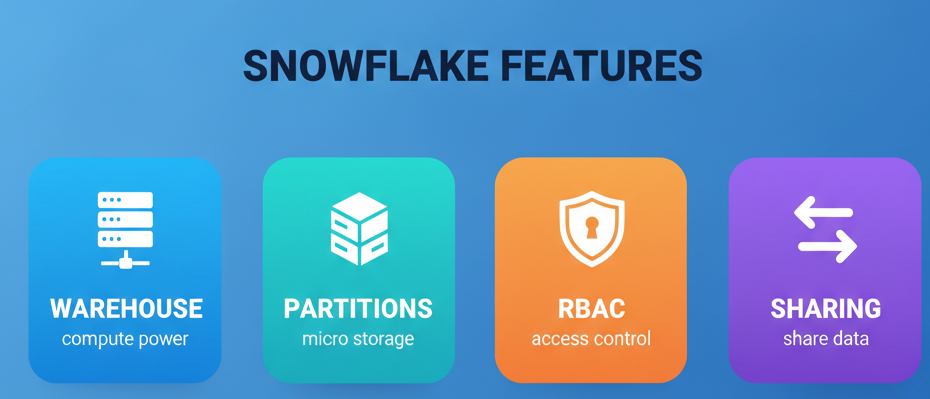
Snowflake Architecture, the largest domain at 30%, tests data modeling, data sharing, development lifecycle support, the object hierarchy, and data recovery. You must recommend patterns for real scenarios, such as choosing a data vault or star schema, or designing cross-region sharing. This domain rewards architects who match Snowflake capabilities to workload and organizational shape.
Data modeling and object hierarchy
You should compare data vault and star schema approaches and know how key constraints behave with ENABLE, RELY, and VALIDATE. Understanding how databases, schemas, tables, views, stages, streams, and tasks fit the object hierarchy helps you reason about privileges and dependencies.
Data sharing and recovery design
Data sharing scenarios span the same account, cross-region, cross-cloud, and sharing with non-Snowflake consumers through the Marketplace, Data Exchange, or Data Clean Rooms. Snowflake’s secure data sharing documentation explains how shares expose data without copying it. Recovery design adds Time Travel, zero-copy cloning, Fail-safe, and replication with failover for disaster recovery planning.
- Sharing within an organization or across separate Snowflake accounts
- Cross-region and cross-cloud auto-fulfillment for global consumers
- Time Travel and zero-copy cloning for point-in-time recovery
- Replication and failover for regional disaster recovery
What Data Engineering Skills Does an Architect Need?
The Data Engineering domain, weighted 25%, checks whether an architect can choose the right loading, connector, and transformation solutions for business needs. It moves beyond writing pipelines toward selecting ingestion patterns, understanding ecosystem tools, and designing transformation layers that stay cost-aware and maintainable at scale.
On ingestion, you should know when to use bulk COPY, Snowpipe, Snowpipe Streaming, or external tables, and how change data capture and Iceberg tables fit modern designs. Schema detection and schema evolution appear where source structures change over time, so architects plan for drift rather than reacting to it.
The domain also expects fluency in Snowflake’s ecosystem: Kafka and Spark connectors, JDBC and ODBC drivers, the SQL API, SnowSQL, the Snowflake CLI, and Snowpark for Python, Scala, and Java. On transformation, dynamic tables, streams and tasks, stored procedures, and user-defined functions each carry cost and performance implications you must weigh.
- Select ingestion methods matched to latency and volume requirements
- Design transformation layers using dynamic tables, streams, and tasks
- Integrate external systems through connectors, drivers, and Snowpark
- Account for cost impact when choosing views, tables, or UDFs
How Do Architects Optimize Snowflake Performance?
The Performance Optimization domain, worth 20%, tests how you diagnose and resolve performance problems in existing architectures. You interpret query profiles, tune virtual warehouses, apply clustering, and control cost through caching and monitoring. The exam frames performance as a design responsibility, not an afterthought, so scenarios ask you to pick the right lever for a symptom.
Query profiling sits at the center. You should read a Query Profile to spot bottlenecks such as warehouse queuing or spilling to disk, then recommend a fix. Warehouse tuning covers auto-suspend and resume, resizing, multi-cluster scaling, and Snowpark-optimized warehouses for memory-heavy work.
Clustering and pruning reduce scanned data at scale. Understanding natural clustering, auto-clustering, and clustering keys alongside micro-partition pruning lets you explain why a query reads less data after tuning. Caching layers, the search optimization service, and resource monitors round out cost-aware performance design, supported by Account Usage and Information Schema views for monitoring and alerting.
How Should You Prepare for the ARA-C01 Exam?
Preparing for the ARA-C01 exam works best when you study by domain weight and practice design reasoning, not memorization. Start with a Snowflake environment you can build in, map your study time to the four domains, and rehearse scenario questions until you can justify each choice quickly. A structured plan keeps the broad blueprint manageable.
- Audit your gaps against the four domains, giving Architecture and Security the most time.
- Build hands-on labs: role hierarchies, secure views, data shares, and dynamic tables.
- Practice reading Query Profiles and tuning warehouses on real workloads.
- Work timed scenario questions to sharpen design trade-off reasoning.
- Review focused prep resources, then sit a full mock under exam conditions.
Candidates often benefit from a targeted refresher on the credential itself. This ARA-C01 preparation guide outlines a lightweight routine you can adapt around the domain priorities above.
What Career Opportunities Follow the Architect Credential?
Earning the SnowPro Advanced Architect credential positions you for senior roles such as data architect, cloud data architect, analytics platform lead, and principal data engineer. As enterprises consolidate analytics on Snowflake, demand grows for professionals who can design governed, cost-efficient environments rather than only operate them. The certification signals that design capability to employers.
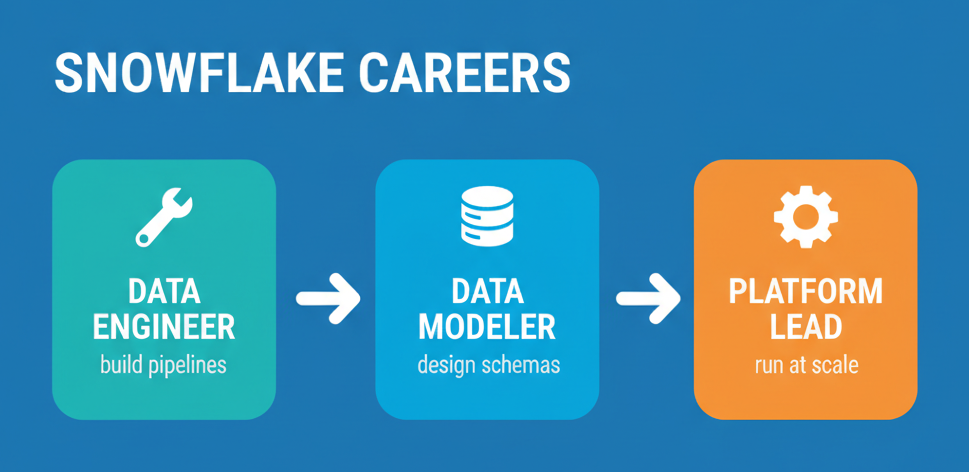
The credential also strengthens your standing inside a team. Architects who can defend account strategy, RBAC design, and performance tuning tend to lead platform decisions and mentor engineers. Combined with hands-on delivery, the certification supports moves into lead and principal roles where design ownership and stakeholder communication matter as much as SQL.
- Data architect and cloud data architect roles owning platform design
- Analytics platform lead guiding governance and cost strategy
- Principal or staff data engineer with design authority
- Consulting positions delivering Snowflake environments for clients
Frequently Asked Questions
What is the passing score for the ARA-C01 exam?
The ARA-C01 exam uses scaled scoring from 0 to 1000, and you need 750 or higher to pass. Because scoring is scaled, the effective number of correct answers depends on question difficulty rather than a fixed percentage across every version of the test.
How many questions are on the SnowPro Advanced Architect exam?
The exam includes 65 questions delivered over 115 minutes. They use multiple choice and multiple select formats, and most are scenario based, so you should budget reading time carefully rather than rushing through the applied design questions.
Is the SnowPro Core certification required first?
Snowflake recommends strong platform knowledge and typically expects candidates to hold SnowPro Core before attempting the Architect exam. While not always a strict gate, Core-level fluency in Snowflake features makes the advanced design scenarios far easier to reason through.
Which domain carries the most weight on ARA-C01?
Snowflake Architecture is the heaviest domain at 30%, covering data models, sharing, object hierarchy, and recovery. Accounts and Security and Data Engineering follow at 25% each, with Performance Optimization at 20%, so design topics dominate the blueprint.
How much does the ARA-C01 exam cost?
The exam costs $375 USD and is delivered through Pearson VUE. You can take it at a physical test center or through online proctoring, depending on availability in your region and your preference for the testing environment.
What is the difference between the Architect and Data Engineer exams?
The Architect exam focuses on designing accounts, security, sharing, and performance across a platform, while the Data Engineer exam emphasizes building and operating pipelines. Architect questions ask you to make design trade-offs rather than implement a single ingestion or transformation task.
How long should I study for the ARA-C01 exam?
Preparation time varies with experience, but engineers already working in Snowflake often prepare over several weeks of focused study. Allocating time by domain weight, with extra attention on Architecture and Security, gives the most efficient path to readiness.
Does the exam test data sharing across clouds?
Yes. The Architecture domain covers sharing within an account, across regions, and across cloud providers, including Cross-Cloud Auto-Fulfillment, the Marketplace, Data Exchange, and Data Clean Rooms. You should understand which sharing method fits each use case and its security implications.
Is the ARA-C01 certification worth it for data engineers?
For engineers moving toward platform ownership, the credential is valuable because it validates design judgment beyond pipeline work. It supports transitions into architect and lead roles and signals that you can own security, governance, and performance decisions at scale.
Conclusion
The SnowPro Advanced Architect certification rewards the ability to design Snowflake platforms that stay secure, governed, and performant as they grow. Its four domains push you from feature knowledge toward defensible design decisions across accounts, security, sharing, and tuning. Study by domain weight, build hands-on labs, and rehearse scenario reasoning until trade-offs feel natural. If you are ready to test that judgment under exam conditions, working through a full ARA-C01 practice set is the logical next step toward sitting the exam with confidence and earning a credential that marks you as a Snowflake platform designer.