GES-C02 is the exam code for the Snowflake SnowPro Specialty Gen AI certification, and it is the current version, replacing the earlier GES-C01 that much of the internet still describes. Fifty-five questions, eighty-five minutes, $225, and 750 on a scaled score running from 0 to 1000. The blueprint is unusual in one respect: 38 percent of the paper sits in a single domain about Cortex functions, and that domain names roughly forty individual functions. This is a memorisation-plus-judgement exam in a way that most certifications are not.
This guide organises those functions into families you can actually hold, separates Cortex Search from Cortex Analyst from Cortex Agents, explains why governance takes 29 percent, and sets out what Snowflake means when it says it expects a year of Gen AI work on the platform before you sit.
What Does the SnowPro Specialty Gen AI Exam Cover?
GES-C02 certifies that you can build and govern generative AI workloads inside Snowflake using the Cortex feature set. It has four domains: an overview of Snowflake’s Gen AI capabilities, the Cortex AI functions themselves, governance covering access control and cost, and document processing. The exam is 55 questions in 85 minutes and costs $225.
What it is not is a general AI exam. Nothing here asks you to reason about transformer architecture or to compare model families in the abstract. Every objective is anchored to something you type into Snowsight or into a SQL statement, which makes it a narrow exam with a deep surface.
The current code is GES-C02. If a study resource is describing GES-C01, it predates the version change, and the function list in particular has moved on. The official credential page is the safest confirmation of which version you are booking.
How Are the 55 Questions Split Across the Four Domains?
Snowflake publishes weightings for GES-C02 and they are lopsided. Gen AI functions carry 38 percent, governance 29 percent, the platform overview 18 percent and document processing 15 percent. Functions and governance together account for 67 percent of the paper, roughly 37 of the 55 questions.
| Domain | Weight | Approximate questions |
|---|---|---|
| Snowflake Gen AI Functions | 38% | 21 |
| Snowflake Gen AI Governance | 29% | 16 |
| Snowflake for Gen AI Overview | 18% | 10 |
| Snowflake Document Processing | 15% | 8 |
That distribution surprises people. Most candidates arrive assuming a Gen AI exam will be mostly about building things, and it is instead more than a quarter about who is allowed to run what and how much it costs. Governance at 29 percent is worth more than the platform overview and document processing combined.
The practical instruction is straightforward. Learn the functions because they carry the most marks, but do not treat governance as an afterthought, because it is the second heaviest domain and it is the one a hands-on practitioner is least likely to have absorbed by accident.
Which Cortex AI Functions Do You Actually Need to Know?
The functions domain names roughly forty individual functions, which is unmanageable as a flat list and straightforward once grouped. There are four families: general completion functions, task-specific AI functions, vector functions, and helpers. Knowing which family a function belongs to gets you most of the way to the right answer.
The four families
- General – AI_COMPLETE and its structured-output form. This is the workhorse, and most scenarios that do not have a specialised function use it.
- Task-specific – AI_CLASSIFY, AI_EXTRACT, AI_PARSE_DOCUMENT, AI_SENTIMENT, SUMMARIZE, AI_SUMMARIZE_AGG, AI_TRANSLATE, AI_EMBED, AI_FILTER, AI_AGG, AI_SIMILARITY, AI_TRANSCRIBE and AI_REDACT. Each does one job well, and the exam tests whether you reach for the specialised function rather than prompting a general one.
- Vector – the distance and aggregate functions, covering inner product, L1 and L2 distance, cosine similarity, truncate, normalise, sum, min, max and average.
- Helpers – AI_COUNT_TOKENS, TRY_COMPLETE, the recursive character and markdown-header text splitters, TO_FILE and PROMPT.
The distinction that earns marks
The most common exam pattern gives you a task and several plausible functions. AI_REDACT rather than a prompt asking the model to remove personal data. AI_FILTER rather than post-processing a completion. TRY_COMPLETE rather than COMPLETE where a failure must not break a pipeline. The Cortex AISQL documentation is the definitive list, and reading it once end to end is more efficient than learning functions as you meet them.
Performance considerations sit in this domain too: choosing a model on latency, accuracy and capability, reducing hallucinations through fine-tuning, and provisioned throughput. Working through GES-C02 sample questions is the quickest way to see how those trade-offs are actually phrased in the exam.
What Do Cortex Search, Analyst and Agents Each Do?
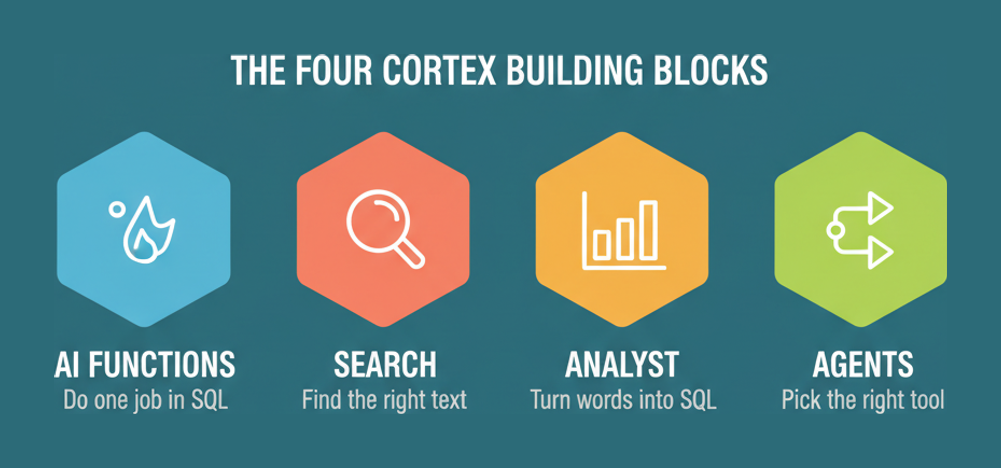
Three named Cortex components appear across the overview and functions domains, and candidates regularly confuse them. Cortex Search does retrieval over unstructured text. Cortex Analyst does text to SQL over structured data. Cortex Agents orchestrate both, deciding which to call for a given question.
Cortex Search
This is the retrieval component, covering RAG use cases and unstructured data. The blueprint names multi-index queries, access control requirements, recursive markdown text splitting, chunk sizing, embedding models and semantic reranking. The Cortex Search overview covers the mechanics; the exam cares about the sizing and access decisions on top.
Cortex Analyst
Analyst is text to SQL, and it depends on semantic views. The blueprint names Semantic Views Autopilot, the YAML specification for semantic views, verified queries, custom instructions and the verified query repository. It also names integration with Cortex Search, because a real question often needs both a document and a number.
Cortex Agents and Snowflake Intelligence
Agents sit above the other two and route work between them. Snowflake Intelligence is the interface layer, alongside AI Studio, SQL and the REST API. Cross-region inference appears here too, including the CORTEX_ENABLED_CROSS_REGION parameter and the latency and availability trade-offs it creates. The Model Context Protocol is named as a way of exposing Snowflake data to external models, which is worth knowing by name.
Why Is Governance Worth 29 Percent?
Governance carries 29 percent because Cortex spends money and touches sensitive data every time it runs. The domain covers model access controls, role-based access control, cost management and monitoring, and AI observability. Four objective groups, roughly sixteen questions, and almost none of it is about writing AI code.
Access control
You are expected to restrict which models can be used at all, through application roles and an account-level allowlist parameter, and to grant the right roles: CORTEX_USER, CORTEX_ANALYST_USER, CORTEX_AGENT_USER and CORTEX_EMBED_USER. Each maps to a different capability, and mixing them up is a reliable way to lose marks. Data safety appears here too, covering cross-region inference implications, guardrails, sensitive data handling through AI_REDACT, and methods for reducing hallucination and bias.
Cost, which is the underrated half
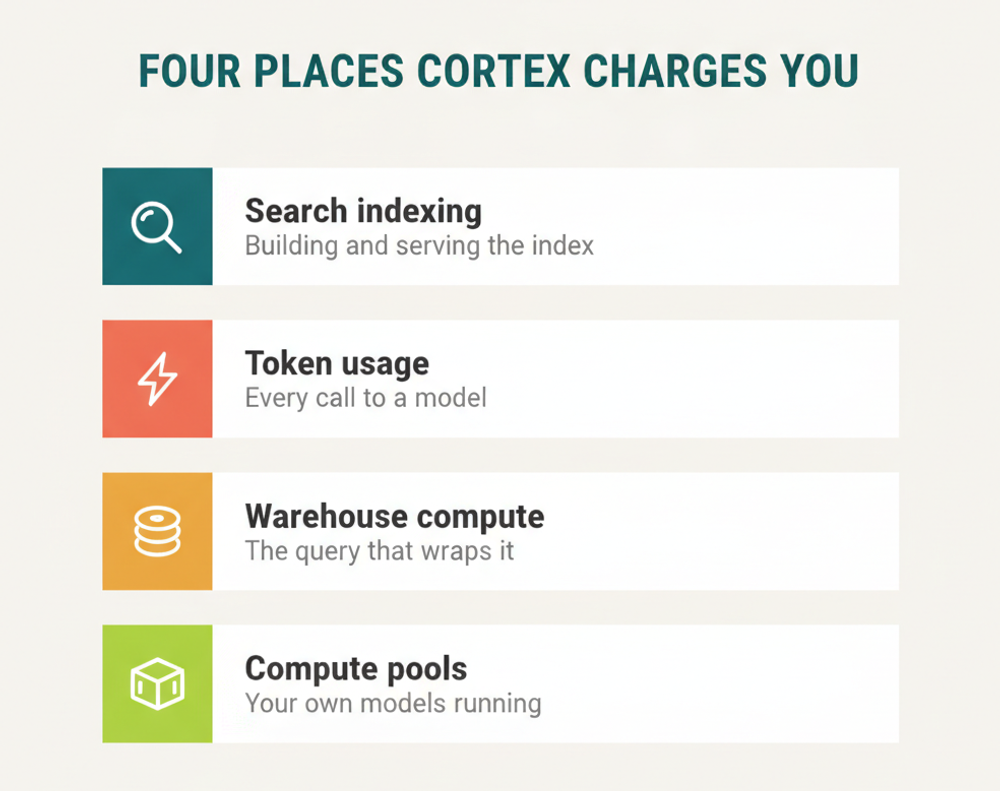
The cost objectives are unusually specific. You are expected to know that Cortex Search bills across virtual warehouse, embedding, serving and indexing separately; that token usage drives Agent and AI function cost; and that Snowpark Container Services bills through compute pools. Snowflake also names the usage-history views by name, covering Analyst, AISQL, Search daily usage, REST API and provisioned throughput, plus the general metering views and object tagging for attribution.
Observability closes the domain: evaluation metrics, comparisons, tracing, logging, event tables and the Trulens SDK. This is the material a practitioner is least likely to have used, and at 29 percent it is not optional.
What Does the Document Processing Domain Ask?
Document processing carries 15 percent, roughly eight questions, and it is the most self-contained domain on the exam. It covers parsing documents with AI_PARSE_DOCUMENT and AI_EXTRACT, preparing and managing documents, building automated pipelines, and troubleshooting when extraction goes wrong.
The specifics that get tested
AI_PARSE_DOCUMENT has named modes and parameters: OCR mode, LAYOUT mode, page splitting and page limits. AI_EXTRACT has its own response format and prompting approach. Upload requirements, supported formats and size limits all appear as objectives, which means they are fair game as recall questions.
Pipeline construction uses streams and tasks for orchestration, so this domain quietly assumes ordinary Snowflake data engineering knowledge alongside the AI functions. Troubleshooting covers extraction query errors, the GET_PRESIGNED_URL function, required privileges, and cost and best-practice considerations. Fine-tuning the extraction models is named as well.
Because it is compact and concrete, this is the domain to secure first. Eight questions is worth more than it sounds on a 55-question paper, and the material is learnable in a way the governance domain is not.
What Does GES-C02 Cost and What Experience Does Snowflake Expect?
GES-C02 costs $225 USD and runs 55 questions in 85 minutes through Pearson VUE, with a passing score of 750 on a scale from 0 to 1000. That is roughly ninety-three seconds per question, which is comfortable for function-recall items and tighter for the governance scenarios.
| Detail | Value |
|---|---|
| Exam name | Snowflake SnowPro Specialty – Gen AI |
| Exam code | GES-C02 |
| Questions | 55 |
| Duration | 85 minutes |
| Passing score | 750, scaled from 0 to 1000 |
| Price | $225 USD |
| Delivery | Pearson VUE |
The experience Snowflake actually recommends
Snowflake recommends one or more years of Gen AI experience with Snowflake, in an enterprise environment, and states plainly that data engineering and SQL knowledge is assumed rather than taught. Read the word “with Snowflake” literally. A year of building generative AI applications on another platform does not substitute, because the whole exam is about this platform’s specific functions and roles.
That requirement is less restrictive than it sounds. Independent developer survey data shows how quickly AI tooling has moved from experiment to routine in professional work, and Cortex has been generally available long enough that most Snowflake teams have shipped something with it. The gap for most candidates is depth rather than exposure.
There is no mandatory prerequisite certification, so SnowPro Core is not formally required. Most candidates hold it, and the platform overview domain is noticeably easier if you do. If you are still building that base, the SnowPro Core study guide covers the ground this specialty exam assumes you already have.
How Should You Prepare for a Function-Heavy Specialty Exam?
The efficient order is to secure document processing first because it is compact, then work the function families, then governance, and leave the overview domain until last because it becomes obvious once the rest is in place. Trying to learn forty functions before understanding what Cortex Search and Analyst do is the common mistake.
- Run AI_PARSE_DOCUMENT and AI_EXTRACT over a real document set in both OCR and LAYOUT mode, so the smallest domain is secure before anything else.
- Group the AI functions into the four families and learn one representative from each properly rather than skimming all forty.
- Build a Cortex Search service over your own text and change the chunk size twice, because sizing decisions are examined rather than described.
- Create a semantic view and query it through Cortex Analyst, then add a verified query, since the verified query repository is named explicitly.
- Grant and revoke each of the four Cortex roles in turn and note exactly what breaks, which is the fastest way to learn the access-control objectives.
- Query the usage-history views for a workload you have actually run, so the cost objectives attach to real numbers rather than to names.
- Finish with timed practice at roughly ninety seconds a question, checking that governance items are as reliable as function items.
Snowflake publishes official example projects, and the Cortex Agents quickstart is a faster way into the agent material than assembling it yourself. Most candidates with real Cortex exposure report four to seven weeks of part-time study. Those coming from a Snowflake background without Gen AI work should plan longer, and anyone weighing the specialty against the advanced track will find the advanced architect route a useful comparison before committing.
Frequently Asked Questions
How many questions are on the GES-C02 exam?
The SnowPro Specialty Gen AI exam has 55 questions and an 85-minute limit, which is roughly ninety-three seconds per question. Function-recall items move quickly. The governance scenarios take longer, so most candidates find the pacing comfortable in the first half and tighter in the second.
What is the passing score for the Snowflake Gen AI certification?
You need 750 on a scale that runs from 0 to 1000. Because the score is scaled rather than a raw percentage, it adjusts for the difficulty of the exam form you sit. Strong performance in the functions and governance domains, which carry 67 percent between them, is what makes the difference.
How much does GES-C02 cost?
The exam costs $225 USD and is delivered through Pearson VUE. Note that Snowflake’s Specialty series is priced separately from Core and Advanced, so figures quoted for those tracks do not apply here. Some third-party sites repeat the Advanced price for this exam, which is incorrect.
Is GES-C01 still valid or has it been replaced?
GES-C02 is the current code for the SnowPro Specialty Gen AI certification. A great deal of study content still describes the earlier GES-C01 version, and the named function list in particular has moved on since then. Check the code on any resource before relying on it.
Which domain carries the most marks in the Snowflake Gen AI exam?
Gen AI functions, at 38 percent, or roughly 21 of the 55 questions. Governance follows at 29 percent, the platform overview at 18 percent and document processing at 15 percent. Functions and governance together decide the outcome for most candidates.
Do you need SnowPro Core before the specialty exam?
No certification is mandatory before GES-C02. Snowflake does assume data engineering and SQL knowledge, and the platform overview domain is noticeably easier for candidates who already hold Core. Most people take Core first for that reason rather than because a rule requires it.
What is the difference between Cortex Search and Cortex Analyst?
Cortex Search retrieves from unstructured text and powers retrieval augmented generation use cases. Cortex Analyst converts natural language into SQL over structured data using semantic views. Cortex Agents sit above both and decide which one a given question needs.
Does the exam test Cortex cost management?
Yes, in detail. You are expected to know which components of Cortex Search bill separately, how token usage drives function and agent cost, how Snowpark Container Services bills through compute pools, and which usage-history views report each of those. Object tagging for cost attribution is named too.
How much Gen AI experience does Snowflake recommend?
One or more years of Gen AI experience with Snowflake specifically, in an enterprise environment. The wording matters: experience building generative AI applications on another platform does not substitute, because the exam is anchored entirely to Snowflake’s own Cortex functions, roles and interfaces.
Is the Snowflake Gen AI certification hands-on?
No, it is a question-based exam rather than a lab. The questions assume hands-on experience, particularly around chunk sizing, role grants and cost attribution, which are difficult to answer convincingly from documentation alone. Building one real Cortex workload is worth more than extra reading.
Conclusion
GES-C02 is narrower than most AI certifications and deeper inside that narrow scope. Two domains carry 67 percent of the marks, and only one of them is what candidates expect: the functions domain rewards knowing which specialised function replaces a general prompt, while the governance domain rewards knowing which of four Cortex roles a task needs and where the bill comes from. Document processing is the compact domain to secure early, and the platform overview resolves itself once the rest is in place.
Group the functions into families rather than memorising a list, build one real Cortex workload and read its usage history, and check that any study resource you use is describing C02 rather than C01. Once governance items feel as reliable as function items, timed practice is the fastest way to confirm you are ready.