If you studied for this exam last year, the product names in your notes have changed. Google says so on the certification page itself: the exam was updated to reflect the transition from Vertex AI to Gemini Enterprise Agent Platform.
That is not a cosmetic edit to a marketing page. It runs through the objectives, so the Workbench, Feature Store, Model Registry, Pipelines and Model Monitoring you are expected to name are all now Agent Platform components. The Google Professional Machine Learning Engineer exam, code GCP-PMLE, is 50 to 60 multiple choice and multiple select questions in two hours at 200 US dollars, across six weighted domains that run from low-code AI solutions through to monitoring what you deployed. This guide sets out where the marks sit, what the rename actually affects, and how much of the paper is operations rather than modelling.
What Does the Google Professional Machine Learning Engineer Exam Cover?
GCP-PMLE covers six domains: architecting low-code AI solutions, collaborating across teams to manage data and models, scaling prototypes into ML models, serving and scaling models, automating and orchestrating ML pipelines, and monitoring AI solutions. It follows a model from an idea in a notebook through to something running in production with alerts on it.
The scope is deliberately wide at both ends. One domain is about building a working model in BigQuery ML or AutoML without writing much code at all, and another is about hyperparameter tuning, distributed training across GPUs and TPUs, and choosing between data and model parallelism. The same paper asks about both.
Generative AI is threaded through, not bolted on
Fine-tuning Gemini models, selecting from Model Garden, evaluating with an LLM as a judge, optimising a Gemini application for cost and latency, and protecting against malicious prompting all appear inside domains that were originally about classical machine learning. This is no longer a predictive-modelling exam with an AI section at the end.
What Are the GCP-PMLE Exam Details?
GCP-PMLE is 50 to 60 multiple choice and multiple select questions in two hours, priced at 200 US dollars and registered through Google CertMetrics. The result is reported as pass or fail, with the money-site syllabus putting the threshold at roughly 70 percent. Google offers the exam in English and Japanese.
| Field | Value |
|---|---|
| Exam name | Google Professional Machine Learning Engineer |
| Exam code | GCP-PMLE |
| Questions | 50 to 60, multiple choice and multiple select |
| Duration | 120 minutes |
| Passing score | Pass / Fail, approximately 70% |
| Price | $200 USD plus tax where applicable |
| Languages | English and Japanese |
| Registration | Google CertMetrics |
| Published domains | 6, weighted approximately |
Two hours across up to 60 questions is two minutes each, which is generous by professional-exam standards. It has to be, because the questions typically describe a business problem, a data shape and a constraint before asking which Google Cloud service you would reach for. Google confirms the length, the fee and the format on its own ML engineer certification page.
Google publishes a renewal process rather than a headline validity figure on that page, so check the renewal guidance directly rather than assuming a term.
What Changed When Vertex AI Became Gemini Enterprise Agent Platform?
Google states plainly that the exam was updated to reflect the transition from Vertex AI to Gemini Enterprise Agent Platform, and points candidates to a new exam guide for the current product list. The capabilities have not moved; the names attached to them have, and the objectives now use the new ones throughout.
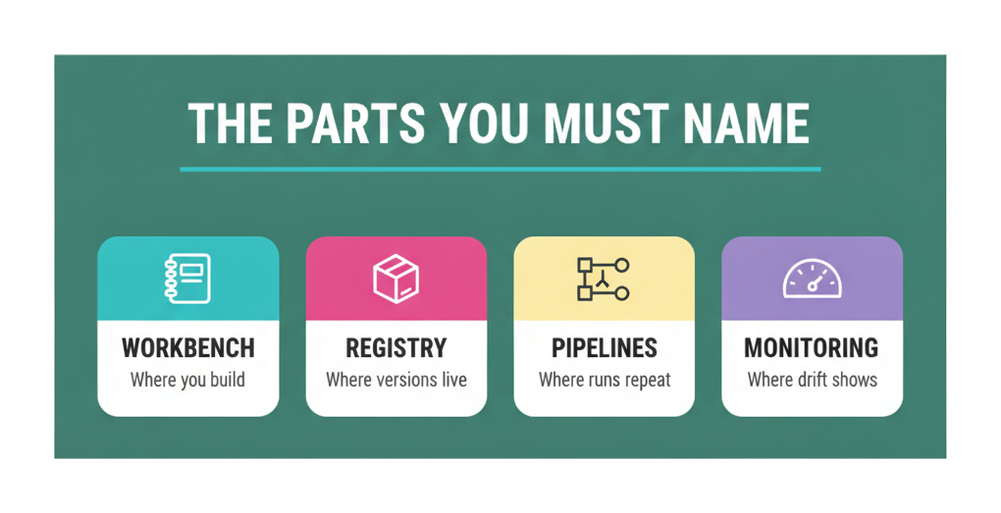
Practically, that means the components you have to be able to name are now Agent Platform components: Workbench and Colab Enterprise for notebooks, Feature Store for features, Model Registry for versioning, Pipelines for orchestration, Experiments and ML Metadata for tracking, Model Monitoring for drift, Inference for serving, and Model Garden for choosing a foundation model.
Why this matters more than a rename usually would
Multiple choice and multiple select questions are answered by recognising the right option, and the distractors are other real product names. A candidate who learned the Vertex AI vocabulary is being asked to recognise labels they have never used, under time pressure, and against options that will all look plausible.
The fix is cheap but it is not optional: read the current official exam guide and re-learn the component names before doing anything else. Older courses and books will not have caught up.
How Are the Six GCP-PMLE Domains Weighted?
Scaling prototypes into ML models is the largest at roughly 21 percent, followed by serving and scaling models at about 20 and pipeline automation at about 18. Collaboration and data management takes around 16 percent, and low-code AI solutions and monitoring take about 13 percent each. The weightings are published as approximate rather than exact.
| Domain | Approximate weight | What it asks for |
|---|---|---|
| Scaling prototypes into ML models | ~21% | Choosing model type and product, training and troubleshooting, hyperparameter tuning, fine-tuning foundation models, CPU against GPU against TPU |
| Serving and scaling models | ~20% | Batch and online inference, prebuilt and custom containers, Model Registry versioning, A/B and canary rollouts, feature serving, endpoint choice |
| Automating and orchestrating ML pipelines | ~18% | End-to-end pipelines, validating data and models, retraining policy, CI/CD/CT deployment |
| Collaborating to manage data and models | ~16% | Exploring and preprocessing data, choosing the preprocessing tool by scale, handling personal data, notebooks, experiment tracking |
| Architecting low-code AI solutions | ~13% | BigQuery ML and AutoML, industry APIs, model selection from Model Garden, tuning Gemini applications for cost and latency |
| Monitoring AI solutions | ~13% | Securing against exfiltration and malicious prompting, responsible AI, explainability, drift and skew monitoring, evaluating generative solutions |
Read together, training and serving are about 41 percent and the two smallest domains are the two that bracket the lifecycle. That is a fair description of the job: most of an ML engineer’s difficulty sits between a model that works on a laptop and a model that works for users.
Because the questions are scenario-shaped and the product names have just changed, calibrating against real items is the fastest way to find the gaps. Working GCP-PMLE sample questions surfaces both the reasoning gaps and the vocabulary ones at the same time.
How Much of the Exam Is MLOps Rather Than Modelling?
Roughly a third. Pipeline automation is about 18 percent and monitoring about 13, which is 31 percent before counting the serving domain’s rollout strategies and versioning. An engineer who can build an accurate model but has never automated a retraining run is missing a substantial part of the paper.
The pipeline objectives are specific about what they mean. Validating data and models. Building and orchestrating pipelines from templates or custom solutions. Keeping preprocessing consistent between training and serving, which is the single most common cause of a model that scores well and behaves badly. Then determining a retraining policy and deploying through continuous integration, delivery and training pipelines.
Monitoring is where security lives
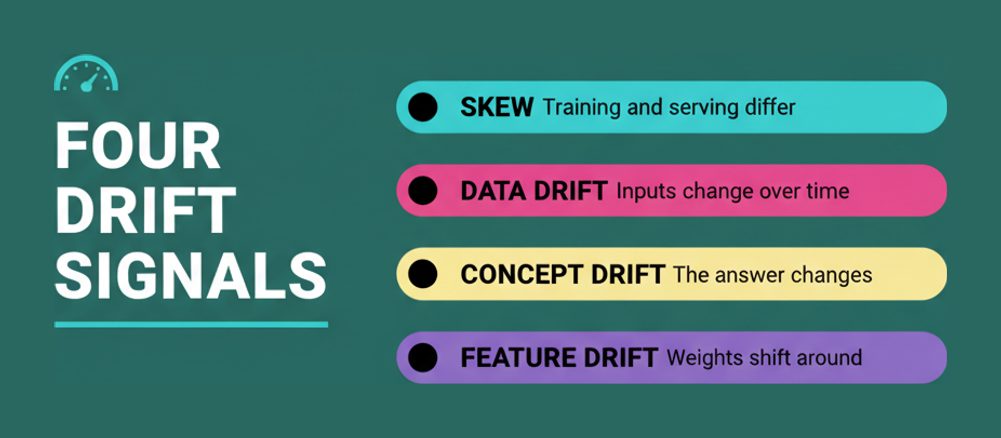
The smallest domain carries the most unexpected content. It covers building secure AI systems against data exfiltration, malicious prompting and oversharing with large language models, and it names Model Armor, safety filters and regular expressions as the controls. It also covers responsible AI and bias monitoring, model explainability, and the classic monitoring quartet of training-serving skew, data drift, concept drift and feature attribution drift.
Anyone whose experience is model building rather than model operations should treat these two domains as the priority, not the afterthought.
Which Open-Source Tools Does the Blueprint Name?
The objectives name PyTorch, sklearn and JAX for model development, XGBoost alongside PyTorch for serving containers, Kubeflow Pipelines and Kubeflow on Google Kubernetes Engine for orchestration, Apache Spark and Dataflow for preprocessing at scale, Ray for distributed work, and Managed Service for Apache Airflow for scheduling.
| Tool | Where it appears | What the question tends to ask |
|---|---|---|
| PyTorch, sklearn, JAX | Prototyping in notebooks | Which framework suits the task and how it runs on the platform |
| XGBoost | Serving from containers | Packaging a non-native framework for inference |
| Kubeflow Pipelines | Experiment tracking and orchestration | When to use it against the managed Pipelines service |
| Apache Spark, Dataflow | Preprocessing | Choosing the preprocessing tool by data scale and complexity |
| Apache Airflow, Ray | Orchestration and distributed compute | Scheduling pipelines and scaling training beyond one machine |
The recurring question shape is selection rather than syntax. You are given a workload and asked which of BigQuery SQL, Dataflow, Apache Airflow, Spark or an in-memory Python framework fits it, which is a judgement about scale and complexity rather than a coding exercise.
Kubeflow deserves particular attention because it appears twice, once as pipelines for experiment tracking and once running on Kubernetes for training. The Kubeflow project repository is the reference for what it actually does, which matters when the alternative option in a question is Google’s own managed equivalent.
How Should You Prepare for the GCP-PMLE Exam?
Start with the rename, because everything else depends on using the current names. After that, weight the effort toward training, serving and pipelines, which together are close to 60 percent of the paper. Google publishes no mandatory course, and the objectives assume real production experience rather than tutorial completion.
- Read the current official exam guide first and relearn the Agent Platform component names, since older courses still teach the Vertex AI vocabulary the questions no longer use.
- Work the scaling domain next, the largest at roughly 21 percent, covering model type selection, hyperparameter tuning and when to fine-tune a foundation model instead of training one.
- Learn the accelerator decision properly, including when a TPU beats a GPU and how data parallelism differs from model parallelism.
- Deploy the same model twice, once for batch inference and once for an online endpoint, then version both in the Model Registry.
- Practise a rollout, comparing two model versions with an A/B test and then a canary deployment, because both are named in the serving objectives.
- Build an end-to-end pipeline that validates its data, retrains on a policy and deploys through a continuous integration and delivery flow.
- Turn on model monitoring and produce all four failure signals deliberately: training-serving skew, data drift, concept drift and feature attribution drift.
- Cover the security objectives explicitly, including protection against data exfiltration and malicious prompting, since they sit in the domain most candidates skim.
The GCP-PMLE study companion on this site lists the objectives as a checklist if you want something to tick off as you go.
Who Should Sit This Exam Rather Than a Generative AI Credential?
GCP-PMLE is for people who build and run models. If your work is training, deploying, orchestrating and monitoring, this is the credential that matches it, and the generative AI material is included rather than separate. A leadership-oriented AI credential answers a different question about you entirely.
The dividing line is hands-on responsibility. This exam asks which accelerator to buy time on, how to keep preprocessing consistent between training and serving, and what to do when feature attribution drifts. Those are engineering decisions with operational consequences, and they are hard to answer from a strategy background.
It is also worth noting that generative AI now runs through every domain here, so choosing this exam does not mean choosing classical machine learning over modern work. Our Generative AI Leader guide covers the business-facing alternative if that is closer to your role.
Frequently Asked Questions
How long is the Google Professional Machine Learning Engineer exam?
Two hours, which Google states as the length on its own certification page. The money-site syllabus records the same figure as 120 minutes, and the paper holds 50 to 60 questions.
What is the passing score for GCP-PMLE?
The result is reported as pass or fail. Google publishes no percentage, and the money-site syllabus puts the effective threshold at approximately 70 percent, so plan above that rather than at it.
How much does GCP-PMLE cost?
200 US dollars plus tax where applicable, registered through Google CertMetrics. Foreign exchange and local tax vary the final amount depending on where the exam is booked.
Has the ML engineer exam changed recently?
Yes. Google states that the exam was updated to reflect the transition from Vertex AI to Gemini Enterprise Agent Platform, and directs candidates to a new exam guide for the current product names.
Which GCP-PMLE domain is worth the most?
Scaling prototypes into ML models at roughly 21 percent, closely followed by serving and scaling models at about 20 and pipeline automation at about 18. All the weightings are published as approximate.
Does the exam cover generative AI?
Throughout. Fine-tuning Gemini models, selecting from Model Garden, evaluating with an LLM as a judge and defending against malicious prompting all sit inside domains that also cover classical machine learning.
Is MLOps a big part of GCP-PMLE?
Roughly a third of the paper. Pipeline automation is about 18 percent and monitoring about 13, before counting the rollout strategies and model versioning that sit inside the serving domain.
Which languages is the exam offered in?
English and Japanese. Google lists both on the certification page, and there is no separate regional variant of the exam content.
Do I need to know Kubeflow for the exam?
It is named twice, once as Kubeflow Pipelines for orchestration and experiment tracking and once as Kubeflow on Google Kubernetes Engine for training. Knowing when to use it against the managed alternative is the examinable part.
What monitoring signals does the exam expect?
Training-serving skew, data drift, concept drift and feature attribution drift, along with continuous evaluation metrics for production models and the evaluation of generative solutions.
Conclusion
Before anything else, check whether your study material still uses the right product names. Google has said openly that this exam moved from Vertex AI to Gemini Enterprise Agent Platform, and on a multiple select paper the names are the answers.
Once the vocabulary is current, let the weightings do the planning. Training, serving and pipelines are close to 60 percent between them, so time spent on model selection, accelerator choice, batch against online inference and a real continuous training pipeline pays back faster than anything else. Give the monitoring domain more respect than its 13 percent suggests, because it holds the security material and the four drift signals, and both are easy marks for anyone who has actually turned monitoring on. Then work scenario questions until the product names come back without effort, since two minutes a question is only generous if you are not translating from last year’s names as you read.