Prompt engineering is examinable on a data scientist credential now. So is vector embedding, so is fine tuning, and they sit inside the largest domain of the exam rather than in an appendix. Most summaries of this certification still describe a syllabus that stopped at model deployment, and they are describing the previous version.
The Snowflake data scientist certification, exam code DSA-C03, is 65 questions in 115 minutes at 375 dollars, scored on a 0 to 1000 scale with 750 to pass. Its four domains run from data science concepts at 17 percent through feature engineering and model development to deployment, and generative AI now sits inside the largest of them.
Table of Contents
- What does the Snowflake data scientist certification examine?
- Why is prompt engineering on a data science exam?
- What does the DSA-C03 exam look like?
- What do the four DSA-C03 domains cover?
- Why does model development carry the largest share?
- Feature engineering happens in Snowpark, not in a notebook
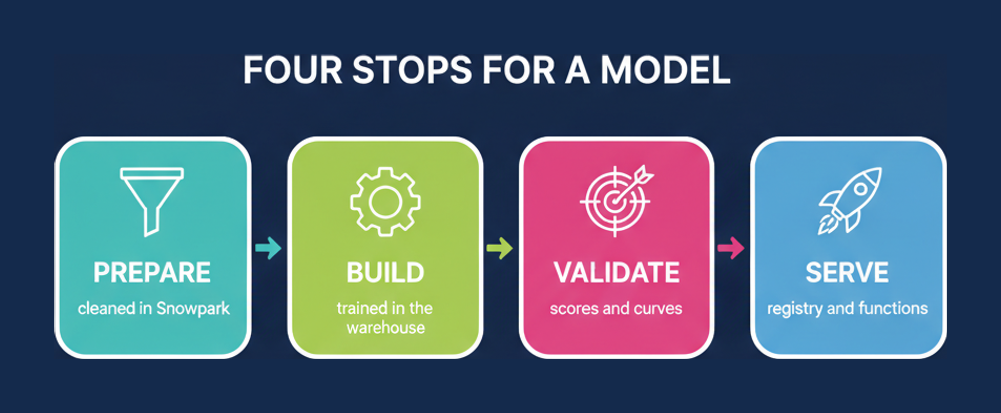
- What does deployment mean when the model stays in the warehouse?
- Who is DSA-C03 for, and how should you prepare?
- Frequently Asked Questions
- Conclusion
What does the Snowflake data scientist certification examine?
DSA-C03 examines whether you can do data science inside Snowflake rather than alongside it. Snowflake states that the credential validates five capabilities: outlining data science concepts, implementing Snowflake data science best practices, preparing data and using feature engineering, training and using machine learning models, and using generative AI and large language model capabilities.
That last capability is the newest and the most consequential. The other four describe a recognisable data science workflow; the fifth describes something that did not belong on this kind of exam two years ago.
The word doing the heavy lifting throughout is “in Snowflake”. This is not a general machine learning exam that happens to mention a warehouse. The objectives name Snowpark, Snowpark ML, Python user-defined functions, stored procedures, user-defined table functions, dynamic tables, the Snowpark Feature Store, the Model Registry and Snowpark Container Services. The platform is the subject, not the setting.
The money site’s DSA-C03 certification page sets the four weighted domains out beside the exam terms, which is the quickest way to see how much of the syllabus is platform-specific.
Why is prompt engineering on a data science exam?
Because Snowflake has put large language models inside the warehouse, and the data scientist is the person expected to use them. The model development domain names Snowflake Cortex, vector embedding, prompt engineering, fine tuning, and task-specific models for categorisation, summarisation, sentiment and information extraction.
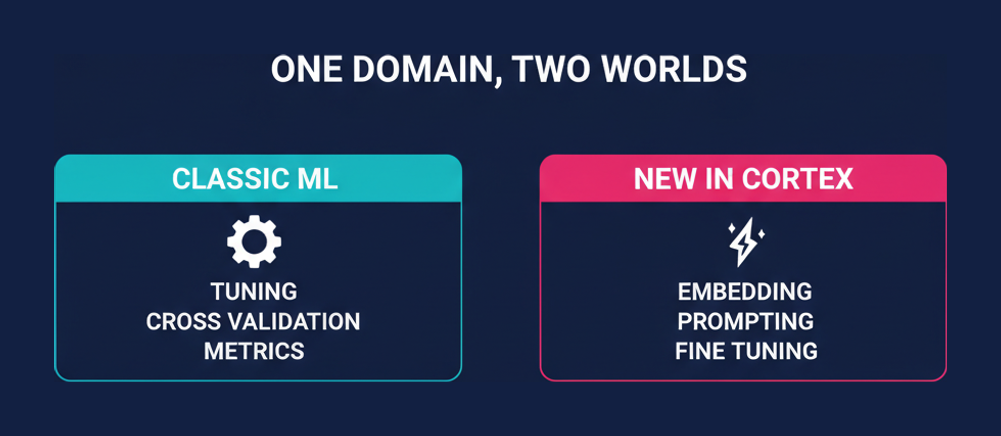
Read that list next to the traditional content in the same domain, which covers hyperparameter tuning, cross validation and optimisation metrics, and the intent becomes clear. Snowflake is treating a call to a hosted language model as one more technique a data scientist reaches for, sitting beside a gradient-boosted tree rather than in a separate discipline.
What this means for preparation
A candidate who learned Snowflake data science before Cortex existed has a genuine gap, and it is in the heaviest-weighted part of the paper. The Cortex LLM function reference is the fastest way to close it, because the exam names the task-specific functions rather than the theory behind them.
For anyone who wants the generative material in depth rather than as one domain among four, the Gen AI specialty credential covers exactly this ground as its whole syllabus, and the overlap between the two is now substantial.
Vector embedding is the concept to get right
Embedding is the mechanism that lets unstructured text sit next to structured data in the same query, and almost every practical Cortex pattern depends on it. It is one line in the objectives and it underpins retrieval, similarity and classification workflows alike, which makes it worth more attention than its single mention suggests.
What does the DSA-C03 exam look like?
DSA-C03 is 65 questions in 115 minutes, delivered through Pearson VUE at 375 dollars per attempt, and scored on a scale from 0 to 1000 with 750 required to pass. That works out at roughly 106 seconds a question, which is tight for a paper this technical.
| Field | Value |
|---|---|
| Exam name | SnowPro Advanced: Data Scientist |
| Exam code | DSA-C03 |
| Questions | 65 |
| Duration | 115 minutes |
| Passing score | 750, on a scale of 0 to 1000 |
| Price | USD 375 per attempt |
| Delivered by | Pearson VUE |
| Candidate profile | 2 or more years of hands-on Snowflake experience as a data scientist in production |
| Domains | 4, weighted |
A scaled score of 750 out of 1000 is not the same as 75 percent of the questions. Scaling exists so that different forms of the exam are measured against one standard even though the question sets differ, and Snowflake does not publish the transformation, so there is no way to convert 750 back into a number of correct answers.
Two things this article does not tell you
Snowflake’s certification page renders its overview and its pricing, but its exam details panel does not load for anything other than a browser. That means the validity period and any prerequisite credential could not be verified, and neither is asserted here. Both are worth confirming on the official DSA-C03 page before you register.
What do the four DSA-C03 domains cover?
DSA-C03 has four weighted domains: data science concepts at 17 percent, data preparation and feature engineering at 27 percent, model development at 31 percent and model deployment at 25 percent. The two middle domains together carry 58 percent, and both are heavily Snowflake-specific.
| Domain | Weight | What it examines |
|---|---|---|
| Data Science Concepts | 17% | Supervised and unsupervised learning, problem types from regression to time-series forecasting and image segmentation, the machine learning lifecycle, evaluation measures including the confusion matrix, and statistical foundations including distributions, outliers and the central limit theorem |
| Data Preparation and Feature Engineering | 27% | Cleaning and preparing data with Snowpark and SQL, exploratory analysis and profiling, Snowflake’s native statistical functions, preprocessing through scaling and encoding, DataFrames across Pandas and Snowpark, the Snowpark Feature Store, and presenting findings through Snowsight and Snowflake Notebooks |
| Model Development | 31% | Connecting Python to Snowflake, Cortex and the generative AI stack, building pipelines with dynamic tables and Python functions, hyperparameter tuning, optimisation metrics, cross validation and sampling, validation with ROC curves and residuals, and interpretation through feature impact and partial dependence |
| Model Deployment | 25% | External hosted models and external functions, in-Snowflake deployment with vectorised and scalar Python functions, the Model Registry, Snowpark Container Services, data drift and model decay, retraining, metadata tagging and versioning |
The smallest domain is the one most candidates are already strongest in. Data science concepts at 17 percent is standard theory that transfers from any other machine learning background, which means roughly 83 percent of the exam depends on knowing Snowflake specifically.
Why does model development carry the largest share?
Model development is 31 percent because it holds three separate bodies of work rather than one. It covers getting Python connected to Snowflake at all, the entire generative AI stack, and the traditional business of training, validating and interpreting a model. Any one of those would sustain a domain on its own.
The connection objectives alone name Snowpark, Snowpark ML, the Python connector with Pandas support, the Spark connector and connecting from an external development environment. Knowing which of those is appropriate to which situation is a recurring question shape, and it depends on understanding where the computation actually runs.
Training has several homes
The objectives name training with Python stored procedures, training with user-defined table functions, and training outside Snowflake through external functions. Those are three genuinely different architectures with different cost, scaling and governance consequences, and the exam expects you to be able to choose between them rather than to know one.
Validation and interpretation are examined separately
Validation covers the ROC curve, the confusion matrix, expected payout, residuals plots and model metrics. Interpretation is its own objective and covers feature impact, partial dependence plots and confidence intervals. Grouping them in your head is a mistake, because one asks whether the model works and the other asks why it produces the answers it does.
Optimisation metric selection is worth singling out, since the objectives name log loss, area under the curve and root mean squared error explicitly. Choosing the wrong metric for a problem type is a classic question, and the three named here map onto probabilistic classification, ranking and regression respectively.
Feature engineering happens in Snowpark, not in a notebook
Data preparation and feature engineering carries 27 percent, and the defining feature of the domain is where the work happens. Every preparation objective is framed around Snowpark for Python and SQL, native statistical functions and Snowflake Notebooks rather than around pulling an extract onto a laptop.
The practical consequence is that a data scientist who is fluent in the standard Python stack but has always exported data first will find the domain harder than the topic names suggest. Scaling, encoding, normalisation, binning and one-hot encoding are all familiar; doing them against a DataFrame that is actually executing as SQL is not.
Three DataFrame flavours, and the exam names all three
The objectives list Pandas, Snowpark and Snowpark pandas as separate things. That distinction is the single most useful thing to internalise in this domain: a pandas DataFrame holds data in memory on the client, a Snowpark DataFrame is a lazily-evaluated query plan that runs in the warehouse, and Snowpark pandas offers the familiar interface over the second of those. The Snowpark developer guide is the reference that makes the difference concrete.
Native statistical functions are free marks
Window functions, MIN, MAX, AVG, STDEV, VARIANCE, TOPn and the approximation functions are all named in the objectives, and they are the most learnable content in the domain. Anyone comfortable with SQL can close this gap in an evening, which makes it a good early win in a study plan.
The Feature Store is the newer item here. It is named once, and it is the mechanism for keeping engineered features consistent between training and serving, which is a problem most practitioners have solved badly by hand at some point.
What does deployment mean when the model stays in the warehouse?
Model deployment carries 25 percent and it is the domain that looks least like a general machine learning exam. The objectives split between putting a model into production and keeping it honest afterwards, and both halves are expressed in Snowflake mechanisms.
Production deployment covers external hosted models and external functions on one side, and vectorised and scalar Python user-defined functions, stored predictions, stage commands, the Model Registry and Snowpark Container Services on the other. The vectorised against scalar distinction matters in practice, because one processes a batch per call and the other a row, with very different throughput.
Model decay is examined as a first-class topic
Data drift and model decay appear by name, along with data distribution comparisons framed as two questions: does the data making predictions still look like the training data, and do the same inputs still produce the same outputs after deployment. That framing is unusually concrete for a syllabus, and it tells you the exam wants operational thinking rather than a definition.
Versioning and retraining close the loop
Metadata tagging, model versioning in the Model Registry and automation of retraining are the final objectives, and together they describe the lifecycle the first domain introduced in the abstract. Candidates who study the four domains as separate subjects miss that the last objective of the exam answers the first.
Who is DSA-C03 for, and how should you prepare?
Snowflake states the expected candidate has two or more years of hands-on Snowflake experience as a data scientist in a production environment, and may have worked in Python, R, SQL or PySpark. That is a genuine bar rather than a suggestion, and roughly 83 percent of the exam depends on platform knowledge that only production work builds.
- Confirm you actually meet the candidate profile before spending 375 dollars, because the weighting means general machine learning strength will not carry a thin Snowflake background.
- Start with the Snowflake-native statistical functions and window functions, which are the most learnable content in the heaviest preparation domain and give an early sense of progress.
- Rebuild one familiar feature engineering pipeline entirely in Snowpark, so that scaling, encoding and binning stop being notebook habits and become warehouse operations.
- Work through the three DataFrame types deliberately, comparing Pandas, Snowpark and Snowpark pandas on the same task and noticing where the computation happens in each.
- Train one model three ways, through a Python stored procedure, through a user-defined table function, and through an external function, since the exam asks you to choose between those architectures.
- Spend real time in Cortex, covering vector embedding, prompt engineering, fine tuning and at least two task-specific functions, because this is the newest content in the largest domain.
- Deploy a model into the Model Registry and serve predictions through both a scalar and a vectorised user-defined function, which makes the throughput distinction obvious.
- Set up a drift check by comparing a live prediction distribution against the training distribution, so the monitoring objectives are something you have done rather than read.
If you have not done SnowPro Core
The Advanced line assumes the platform fundamentals that the SnowPro Core credential covers, including warehouses, storage, roles and the query model. Whether Core is formally required could not be verified from any readable source, so confirm that with Snowflake, but the knowledge is assumed either way.
Frequently Asked Questions
How many questions are on the DSA-C03 exam?
Sixty-five questions in 115 minutes, which works out at roughly 106 seconds each.
What is the passing score for DSA-C03?
Seven hundred and fifty on a scale of 0 to 1000. Because the scaling transformation is not published, that does not translate into a fixed number of correct answers.
What does DSA-C03 cost?
USD 375 per attempt, which is the price across the SnowPro Advanced series. SnowPro Core sits at USD 175.
Does DSA-C03 cover generative AI?
Yes, and it is in the largest domain. Snowflake Cortex, vector embedding, prompt engineering, fine tuning and task-specific models all sit inside model development.
What are the DSA-C03 domains and weightings?
Data science concepts 17 percent, data preparation and feature engineering 27 percent, model development 31 percent and model deployment 25 percent.
What experience does Snowflake expect?
Two or more years of hands-on Snowflake experience as a data scientist in a production environment, with possible experience in Python, R, SQL or PySpark.
Is SnowPro Core required before DSA-C03?
Snowflake’s exam details panel does not render to anything but a browser, so no prerequisite is asserted here. Confirm it on the official page. The platform knowledge Core covers is assumed by the syllabus regardless.
How long is the certification valid?
No validity period is visible on any readable source, so none is stated here. Check Snowflake’s certification page before assuming a term.
Is DSA-C03 replacing DSA-C02?
DSA-C03 is the current code and the one Snowflake’s certification page names. Third-party material describing the credential under the older code is describing the previous syllabus, which did not include the generative AI content.
How long does preparation usually take?
Eight to twelve weeks alongside a job for somebody already working in Snowflake, with the largest single block going to Cortex if the generative content is new to you.
Conclusion
DSA-C03 is a Snowflake exam before it is a data science exam. Only 17 percent of it is portable theory; the rest depends on knowing how Snowpark, user-defined functions, stored procedures, the Feature Store, the Model Registry and Container Services actually behave.
The change worth acting on is the generative AI content in model development. Prompt engineering, vector embedding and fine tuning are examinable, they sit in the heaviest-weighted domain, and most study material still describes a syllabus that predates them.
Prepare by moving work you already do into Snowpark rather than by reading about it, spend a deliberate block on Cortex, and treat the 750 scaled mark as what it is: a standard, not a percentage you can compute your way to.