You run clusters for a living, your organisation has started talking about private inference, and someone has suggested you sit NCP-AI. The decision in front of you is whether Nutanix Certified Professional – Artificial Intelligence, the Nutanix credential built around Nutanix Enterprise AI, is meant for an infrastructure engineer like you or for the data science team down the corridor.
It is meant for you, with conditions. Nutanix describes the successful candidate in unusually concrete terms: years of virtual infrastructure work, a year of cloud native and Linux command line experience, and Kubernetes knowledge at the level of a working cluster administrator. This article sets out the NCP-AI prerequisites one by one, shows where each appears in the exam objectives, and gives you a way to check your own readiness before you spend 200 USD on an attempt.
Table of Contents
- Who Is the NCP-AI Exam Actually Written For?
- What Are the NCP-AI Prerequisites Nutanix Names?
- Can You Answer These Before You Book?
- How Much Kubernetes Does CKA-Level Knowledge Mean?
- What You Do Not Need: Data Science and Model Training
- What Do You Commit To When You Book NCP-AI?
- NCP-AI, NCP-CN or NCP-MCI: Which Professional Exam Fits?
- How Do You Close the Gaps in the Right Order?
- Frequently Asked Questions
- Conclusion
Who Is the NCP-AI Exam Actually Written For?
The NCP-AI exam is written for infrastructure and platform engineers who will install, configure, optimise and troubleshoot Nutanix Enterprise AI, and connect generative AI applications and agents to it. It suits virtualisation administrators moving towards Kubernetes and GPU workloads. It is not aimed at data scientists, because no objective asks you to train or tune a model.
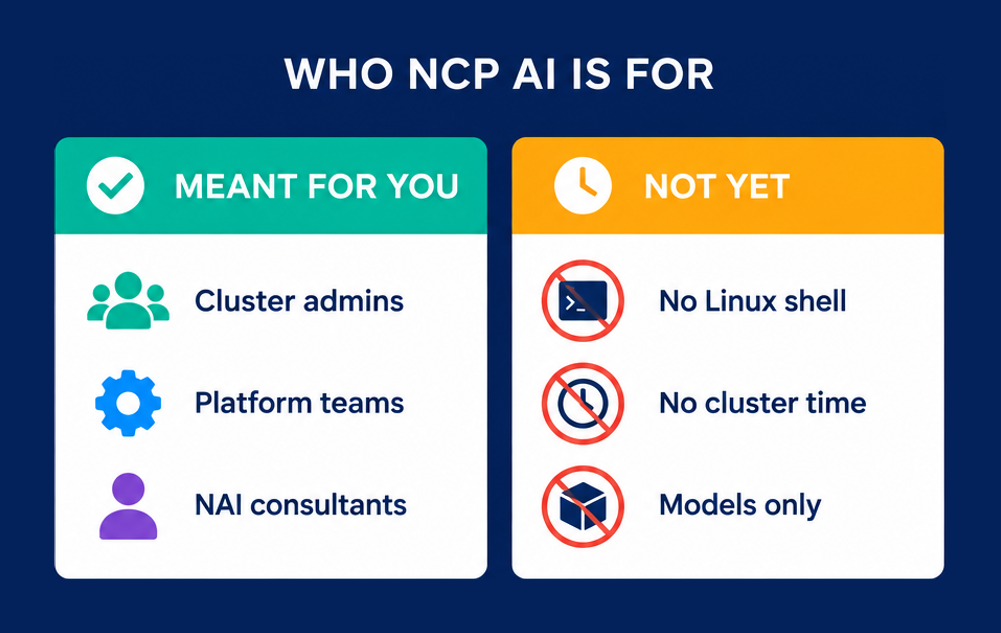
That matters because the name misleads in both directions. Infrastructure engineers see “Artificial Intelligence” and assume the exam belongs to someone else. Machine learning practitioners see it and assume their modelling skills will carry them. Neither is right.
The job the exam describes
Read the five syllabus sections as a job description. You stand up the platform, you import a large language model, you publish it behind an endpoint, you hand an API key to an application team, and you work out what broke when the endpoint slows down. Every one of those tasks is operations work.
The Nutanix Enterprise AI overview makes the same point from the product side. The platform runs on Kubernetes, it needs GPUs, and it can sit on Nutanix Kubernetes Platform or on a managed service such as EKS, AKS or GKE. Whoever looks after that stack is the person the credential is describing.
Three readers, three answers
- A Nutanix or VMware administrator with some Kubernetes exposure: yes, after closing the Kubernetes gap.
- A platform engineer who already runs Kubernetes in production: yes, after learning the Nutanix layer and GPU sizing.
- A data scientist with no infrastructure background: not yet, because the assumed experience is the hard part, not the AI vocabulary.
“To succeed in earning the NCP-AI certification, you should bring a strong foundation in virtualized infrastructure including virtual machines, hypervisors, and virtual networking.”
What Are the NCP-AI Prerequisites Nutanix Names?
The NCP-AI prerequisites are a candidate profile, not a list of required certificates. Nutanix says successful candidates have at least three years of virtual infrastructure experience and one year with cloud native technologies and the Linux command line, plus knowledge of NCI, cloud IaaS, GPUs, Nutanix Unified Storage and Kubernetes at Certified Kubernetes Administrator level.
The official NCP-AI page sets this out for version 6.10 of the exam, which awards the NCP-AI 6 certification. What the page does not do is tell you why each item is there. The objectives answer that.
| What Nutanix expects | Where it appears in the objectives | What happens without it |
|---|---|---|
| 3 years of virtual infrastructure | DNS, FQDN and certificate setup; storage classes; infrastructure performance views | Deployment questions read as unfamiliar networking puzzles |
| 1 year of cloud native work | NKP and non NKP installation; dark site installs; KServe as a prerequisite | You cannot tell a platform fault from a product fault |
| Linux command line | Querying endpoints with Python or Curl; reading tool calling commands | The application section becomes guesswork |
| GPU knowledge | Choosing the number and type of GPUs for a model; spotting an endpoint on CPU | Sizing scenarios have no anchor |
| Nutanix Unified Storage and NCI | Storage classes and CSI driver connectivity | Model import failures look random |
| CKA-level Kubernetes | System resources, taints, allocatable compute, container image failures | The troubleshooting section is out of reach |
Notice how little of that table is specific to AI. Five of the six rows would sit comfortably in any infrastructure exam. The AI content arrives on top of them, in model import, endpoint creation and output quality, and it assumes the base is already there.
Experience is not the same as eligibility
Nothing on the official page says you will be refused a booking without these years of experience. They describe who passes, not who may sit. Treat them as an honest forecast. If you are two years short on infrastructure and have never touched a cluster, the forecast is poor, however much you read about language models.
Can You Answer These Before You Book?
A quick readiness check for NCP-AI is to read real sample questions cold, before any study. If you can explain why each wrong option is wrong, your infrastructure base is sound. If the questions read as unfamiliar nouns, you have found your gap early and cheaply, before paying for an attempt.
The published samples are short scenarios. One describes a health check failing at the serving layer with KServe pods in error, and asks what breaks. Another describes an endpoint falling back to CPU acceleration and asks what to verify. A third gives you a certificate error where the FQDN is missing from the SAN field.
Work through the NCP-AI sample questions once with no preparation, then sort your misses into three piles.
- Misses about DNS, ingress and certificates point to the infrastructure base.
- Misses about pods, taints, labels and KServe point to Kubernetes.
- Misses about endpoints, API keys, sample requests and inference engines point to the product itself.
The third pile is the easy one. Product knowledge comes from the recommended course and from time in the interface. The first two piles take longer, and they are the ones the stated experience is there to cover.
What a good result looks like
Do not read a score into ten questions. Read the pattern. An engineer who misses only product questions is weeks away. An engineer who misses the Kubernetes questions is looking at a longer road, and is better off knowing that now.
How Much Kubernetes Does CKA-Level Knowledge Mean?
CKA-level knowledge means you can administer a Kubernetes cluster from the command line without guidance. Nutanix asks NCP-AI candidates for that level of knowledge, not for the certificate. In practice you should be able to inspect pods and nodes, reason about scheduling, and trace a failed workload to its cause, because the NCP-AI troubleshooting objectives assume all three.
The benchmark itself is public. The CNCF CKA programme is a two hour, performance-based exam solved at a command line, and its largest domain is Troubleshooting at 30 percent. That is a useful clue. The skill Nutanix is borrowing from CKA is mostly diagnosis.
| CKA domain | CKA weight | Where NCP-AI leans on it |
|---|---|---|
| Troubleshooting | 30% | Health check failures, endpoints that will not schedule, image download failures |
| Cluster Architecture, Installation and Configuration | 25% | Installation prerequisites and version compatibility |
| Services and Networking | 20% | FQDN, ingress and certificate problems after installation |
| Workloads and Scheduling | 15% | GPU nodes, taints and allocatable resources |
| Storage | 10% | Storage classes and CSI driver connectivity |
The scheduling detail that catches people
One NCP-AI objective asks you to determine which allocatable resources, including CPU, memory, GPUs and taints, could stop an endpoint from being scheduled. If the phrase taints and tolerations is new to you, that objective is closed. GPU nodes are commonly tainted so that ordinary workloads stay off them, and an endpoint without the matching toleration simply never starts.
You do not have to hold CKA to pass. However, if you could not pass CKA today, plan to study Kubernetes first and Nutanix Enterprise AI second.
What You Do Not Need: Data Science and Model Training
NCP-AI does not require data science, mathematics or model training skills. The objectives cover importing existing large language models, exposing them through endpoints, and improving output with guardrails and rerank models. You choose and operate models. You never build one, so an infrastructure engineer loses nothing by lacking a machine learning background.
The AI knowledge you do need is practical and narrow. It fits on a short list.
- Where models come from: the objectives name HuggingFace and NVIDIA NGC, plus a manual import route.
- What access a model needs: repository keys, and an accepted licence for Llama models.
- How a model is consumed: an OpenAI-compatible API, called with Python or Curl.
- How quality is judged: comparing prompt input with output through human feedback.
- How quality is improved: a different model, guardrails for safety, or a rerank model.
Licences deserve a note, since they produce a named failure in the troubleshooting section. Some models sit behind gated model access, where you must accept terms before a download is allowed. A valid token with an unaccepted licence still fails, and the exam expects you to recognise that.
“AI initiatives are employed to deliver strategic advantages, but those advantages can’t happen without optimized infrastructure control and security.”
That sentence is the reason the credential exists. Somebody has to own the infrastructure under the model, and this exam checks that they can.
What Do You Commit To When You Book NCP-AI?
Booking NCP-AI commits you to 75 multiple choice questions in 120 minutes at 200 USD per attempt. The passing score is 3000 on a scale of 1000 to 6000. The exam is offered in English and Japanese, and Nutanix announced it could be taken remotely or in person at a PSI testing center.
| Field | Value |
|---|---|
| Exam name | Nutanix Certified Professional – Artificial Intelligence |
| Exam code | NCP-AI, version 6.10 |
| Questions | 75 multiple choice |
| Duration | 120 minutes |
| Passing score | 3000 on a scale of 1000 to 6000 |
| Price | 200 USD per attempt |
| Languages | English and Japanese |
| Recommended course | Nutanix Enterprise AI Administration (NAIA) |
| Sections | 5, with no published weightings |
Two things follow from those numbers. First, 120 minutes across 75 questions is 96 seconds each, which is enough for recall items and tight for sizing scenarios. Second, a scaled score cannot be converted into a count of correct answers, so you cannot work out a safety margin in advance.
Because no section is weighted, you also cannot decide to skip one. A candidate strong on deployment and weak on troubleshooting has no way of knowing how much that weakness costs. For a decision about readiness, that argues for closing every gap and not gambling on a favourable mix.
NCP-AI, NCP-CN or NCP-MCI: Which Professional Exam Fits?
NCP-AI, NCP-CN and NCP-MCI are all Nutanix professional level exams with the same shape: 75 questions, 120 minutes, 200 USD and a passing score of 3000 on a 1000 to 6000 scale. They differ in subject. Choose NCP-MCI for core infrastructure, NCP-CN for the cloud native track, and NCP-AI for running Nutanix Enterprise AI.
| Exam | Full name | Best first choice if |
|---|---|---|
| NCP-MCI | Nutanix Certified Professional – Multicloud Infrastructure | You administer Nutanix clusters and have little Kubernetes experience |
| NCP-CN | Nutanix Certified Professional – Cloud Native | You are moving into Kubernetes on Nutanix and want that base certified |
| NCP-AI | Nutanix Certified Professional – Artificial Intelligence | You already have both bases and will operate model endpoints |
Since the three exams cost the same and run to the same length, price and effort on the day do not separate them. Your current job does. NCP-AI builds on skills that the other two exams certify directly, so it rewards candidates who arrive with both.
That does not make the other two exams a formal requirement. It makes them a sensible order for someone starting from virtualisation. The site’s Nutanix certification resources list the wider set of Nutanix exams if you want to plan more than one step ahead.
How Do You Close the Gaps in the Right Order?
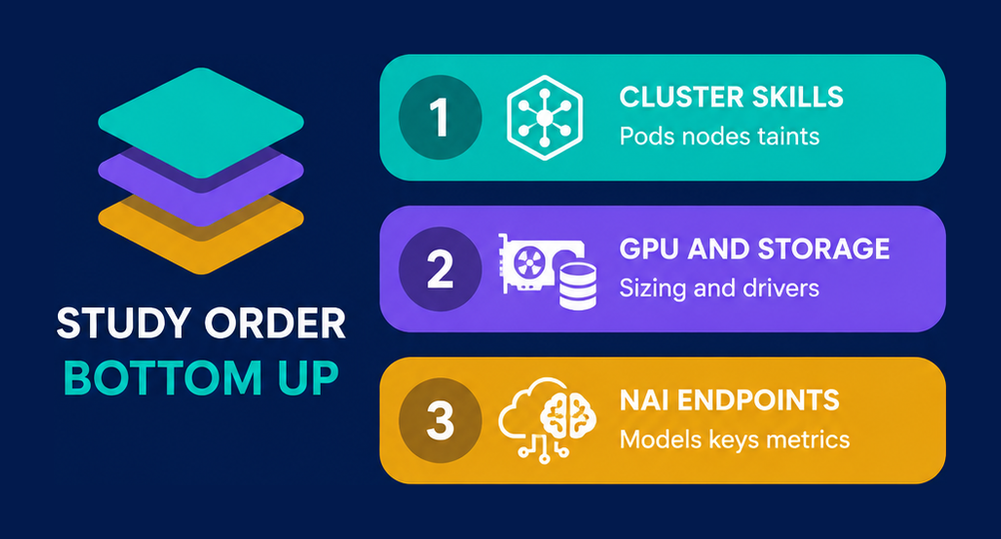
Close NCP-AI gaps from the bottom of the stack upwards: Kubernetes first, GPUs and storage second, Nutanix Enterprise AI third, and application integration last. Each layer explains the failures of the layer above it, so studying the product before the platform leaves you memorising symptoms you cannot diagnose.
- Sort your sample question misses into infrastructure, Kubernetes and product piles, so you know which gap is largest.
- Practise Kubernetes at the command line until you can read pod status, node resources and taints without looking anything up.
- Learn how GPU nodes are labelled and tainted, and how to confirm whether a workload is really using a GPU.
- Install Nutanix Enterprise AI in a lab, including the FQDN and certificate steps, and note every prerequisite you had to meet.
- Import one model from a repository with a key, then create an endpoint and size it for a stated throughput.
- Create an API key, share the endpoint details, and call the endpoint with Curl and then Python.
- Break the lab on purpose with an invalid token, an unaccepted licence and a missing GPU, and trace each fault to its layer.
The recommended course, Nutanix Enterprise AI Administration, covers steps four to six. It will not teach steps two and three from nothing, which is why the order matters.
Book when the sample questions feel like descriptions of things you have already done. At that point the exam is asking you to recall your own work.
Frequently Asked Questions
Is NCP-AI meant for infrastructure engineers or data scientists?
Infrastructure engineers. The exam measures installing, configuring, optimising and troubleshooting Nutanix Enterprise AI and connecting applications to it. No objective covers model training, so a data science background helps far less than Kubernetes and virtualisation experience.
What experience does Nutanix expect for NCP-AI?
At least three years of virtual infrastructure experience and one year with cloud native technologies and the Linux command line. Nutanix also expects knowledge of NCI, cloud IaaS, GPUs and Nutanix Unified Storage.
Do you need the CKA certificate before NCP-AI?
No. Nutanix asks for a Certified Kubernetes Administrator level of knowledge, not the certificate itself. If you could not pass CKA today, study Kubernetes before you study the product.
Do you need NCP-MCI or NCP-CN first?
The official NCP-AI page describes a candidate profile and lists no required prior certification. NCP-MCI and NCP-CN certify skills that NCP-AI assumes, so they make a sensible order for someone starting from virtualisation.
How many questions are on the NCP-AI exam?
The exam has 75 multiple choice questions in 120 minutes, which is 96 seconds per question on average.
What is the NCP-AI passing score?
The passing score is 3000 on a scale of 1000 to 6000. It is a scaled score, so it does not convert into a number of correct answers.
How much does NCP-AI cost?
The price is 200 USD per attempt. NCP-CN and NCP-MCI are listed at the same price.
Which languages is NCP-AI offered in?
English and Japanese. The exam blueprint guide is published in both languages as well.
Does NCP-AI include coding?
Only lightly. One objective asks you to issue a simple query to an OpenAI-compatible endpoint using Python or Curl, and another asks you to tell tool calling commands from non tool calling ones.
How long is the NCP-AI certification valid?
Neither the syllabus page nor the official exam page used for this article states a validity period, so confirm the current renewal rule with Nutanix University before you plan around it.
Conclusion
NCP-AI is an infrastructure credential, and the decision about sitting it is a decision about your infrastructure base. Three years of virtualisation, a year of cloud native work and administrator-level Kubernetes are the conditions Nutanix names, and the objectives show that each one is there for a reason.
If you meet them, the remaining work is the product: models, endpoints, keys and metrics across 75 questions in 120 minutes. If you do not, the honest move is to close the Kubernetes gap first and come back. Either way, test yourself on real questions before paying 200 USD.
For engineers who already hold the professional tier and want to see what the next level demands, the guide to the NCM-MCI master exam shows where the Nutanix ladder goes after this.