The OpenTelemetry Certified Associate never asks which monitoring product you run. Its syllabus names no backend at all. What it asks is how telemetry is created, shaped and moved: how an SDK turns a function call into a span, how context crosses a service boundary, and how a Collector pipeline receives, transforms and exports data before anything reaches a dashboard.
That makes the OpenTelemetry certification a data pipeline exam as much as an observability one. OTCA is a 90 minute, 60 question online exam from the Linux Foundation and the Cloud Native Computing Foundation, priced at $250 and valid for two years. This article walks through its four domains, explains why the API and SDK domain dominates the paper, and sets out a hands-on way to prepare.
Table of Contents
- What Is the OpenTelemetry Certified Associate Exam?
- How Is the OTCA Syllabus Weighted?
- Why Does the API and SDK Domain Carry 46 Percent?
- What Does OTCA Expect You to Know About the Collector?
- Observability Fundamentals and Pipeline Debugging
- Who Should Take the OpenTelemetry Certification?
- How Should You Prepare for the OTCA Exam?
- Where Does OTCA Lead After You Pass?
- Frequently Asked Questions
- Conclusion
What Is the OpenTelemetry Certified Associate Exam?
The OpenTelemetry Certified Associate (OTCA) is a vendor neutral, beginner level certification from the Linux Foundation and CNCF. It tests whether you understand observability concepts and the main OpenTelemetry components: the API, the SDK, the Collector and the pipelines that carry traces, metrics and logs. The exam is online, proctored and multiple choice, with no prerequisites.
The Linux Foundation and CNCF announced the credential on 15 November 2024, describing OpenTelemetry as the industry standard for tracing, metrics and logs. Buying the exam gives you twelve months to schedule and sit it, and two attempts, so one retake is included in the fee.
| OTCA exam fact | Value |
|---|---|
| Exam name | OpenTelemetry Certified Associate |
| Exam code | OTCA |
| Awarded by | The Linux Foundation, with the Cloud Native Computing Foundation |
| Number of questions | 60 |
| Duration | 90 minutes |
| Passing score | 75% |
| Exam fee | $250 USD, exam only |
| Format and delivery | Online, proctored, multiple choice |
| Exam eligibility | 12 months to schedule, one retake included |
| Validity | 2 years |
| Experience level and prerequisites | Beginner, no prerequisites |
The question count and passing score come from the VMExam syllabus page. The Linux Foundation’s own OTCA certification page confirms the fee, duration, format, validity, eligibility window and the four domain weightings, but it does not display a question count or a passing score, so check your candidate handbook before exam day.
How Is the OTCA Syllabus Weighted?
The OTCA syllabus has four domains. The OpenTelemetry API and SDK carries 46 percent, the OpenTelemetry Collector 26 percent, Fundamentals of Observability 18 percent, and Maintaining and Debugging Observability Pipelines 10 percent. Nearly three quarters of the OpenTelemetry certification therefore sits on the two places telemetry is produced and processed: the SDK and the Collector.
Some third party study guides still describe five domains with different percentages. The four domain split below is the one the Linux Foundation publishes on its certification page and in its launch announcement, and it matches the OTCA syllabus breakdown exactly, objective for objective.
| Domain | Weight | Objectives |
|---|---|---|
| Fundamentals of Observability | 18% | Telemetry Data; Semantic Conventions; Instrumentation; Analysis and Outcomes |
| The OpenTelemetry API and SDK | 46% | Data Model; Composability and Extension; Configuration; Signals (Tracing, Metric, Log); SDK Pipelines; Context Propagation; Agents |
| The OpenTelemetry Collector | 26% | Configuration; Deployment; Scaling; Pipelines; Transforming Data |
| Maintaining and Debugging Observability Pipelines | 10% | Context Propagation; Debugging Pipelines; Error Handling; Schema Management |
Two details in that table are easy to miss. Context Propagation appears twice, once under the API and SDK and again under debugging, so it is examined both as a concept and as a fault you have to find. And the word Pipelines appears in three of the four domains, which tells you how the exam thinks about OpenTelemetry: as a flow of data with stages, not as a library you install once.
Why Does the API and SDK Domain Carry 46 Percent?
The API and SDK domain carries 46 percent because it is where every signal begins. The OTCA expects you to know the OpenTelemetry data model, how the SDK is configured and extended, how traces, metrics and logs are produced, how SDK pipelines batch and export them, and how context propagation links them across services. It holds seven objectives, more than any other domain.
The API and the SDK do different jobs
The API is what application and library code calls to create spans, record metrics and emit logs. The SDK is the implementation behind it, where you configure sampling, processing and export. Questions in this domain often turn on that split: which settings live in code, which live in SDK configuration, and what Composability and Extension means when you plug in a different exporter or processor.
Two ways to instrument
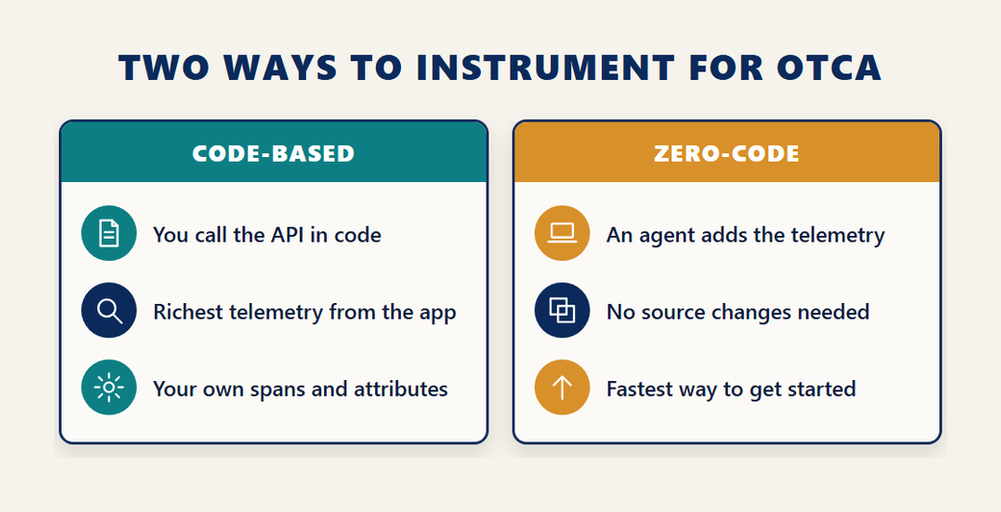
OpenTelemetry documents two approaches. Code-based instrumentation calls the API from your own code and gives the richest telemetry. Zero-code instrumentation adds telemetry through an agent or instrumentation library without changing source, which is the quickest way to start and the only option when you cannot modify the application. The Agents objective covers the second route.
Context propagation decides whether a trace survives
A trace that stops at the third service of a request is usually a propagation problem, not a backend one. OpenTelemetry’s default propagator uses the headers defined by the W3C Trace Context specification, and baggage lets you carry arbitrary key value pairs alongside the trace. Expect questions that describe a broken trace and ask where the context was lost.
“OpenTelemetry is a transformative open source observability project for empowering engineers to deeply analyze the intricate behaviors of distributed systems across many integrations.”
What Does OTCA Expect You to Know About the Collector?
The Collector domain is worth 26 percent and covers configuration, deployment, scaling, pipelines and transforming data. For the OTCA you need to read a Collector configuration and say what it does: which receivers take data in, which processors change it and in what order, which exporters send it on, and which pipelines are actually switched on.
Reading a configuration file
The official Collector configuration guide defines five component types. Receivers collect telemetry by pulling it or accepting pushed data. Processors filter, modify or transform it. Exporters send it to one or more destinations. Connectors join two pipelines, acting as an exporter for one and a receiver for the next. Extensions handle tasks outside the data path, such as health checks.
Three rules in that guide produce exam questions on their own:
- A component defined in the file does nothing until a pipeline under the service section lists it.
- Every pipeline is typed as traces, metrics or logs.
- Processors run in the order they are listed, so moving one changes the result.
Deployment, scaling and transformation
Deployment and Scaling ask where a Collector runs and how it handles more load, while Transforming Data asks how processors reshape attributes and records in flight. The Collector contrib repository holds the wider set of community components, including a receiver for Apache Kafka, which is a useful place to see how real pipelines connect telemetry to existing data infrastructure.
Observability Fundamentals and Pipeline Debugging
Fundamentals of Observability (18 percent) and Maintaining and Debugging Observability Pipelines (10 percent) together hold 28 percent of the OTCA. The first tests the vocabulary: telemetry data, semantic conventions, instrumentation, and what analysis can tell you. The second tests troubleshooting: context propagation failures, broken pipelines, error handling and schema management.
Semantic conventions are not optional reading
Semantic conventions are the agreed names for attributes such as an HTTP method or a database system. They are what let a query written for one service work against another. The objective sits in the fundamentals domain, and schema management in the debugging domain covers what happens when those names change between versions.
Debugging is a small domain with sharp questions
At 10 percent, debugging is the smallest domain, which is why many candidates leave it until last. It rewards people who have actually watched telemetry go missing. The usual causes are a component that was defined but never added to a pipeline, a processor placed in the wrong order, or context that was not propagated across an asynchronous hop. If you have caused each of those on purpose in a lab, these questions become quick marks.
Who Should Take the OpenTelemetry Certification?
The OpenTelemetry certification suits application engineers, DevOps engineers, reliability engineers and platform engineers who instrument services or run telemetry pipelines, which are the roles the Linux Foundation names in its launch announcement. It is a beginner level exam with no prerequisites, so it also works as a first credential for data engineers moving into observability.
Telemetry pipelines look a lot like the data pipelines this site usually covers. A Collector receives records, transforms them in a defined order and exports them to storage, and the hard problems are the familiar ones: schema changes, dropped records and back pressure. If you already build ingestion pipelines, the Collector domain will feel closer to home than the SDK domain.
The Linux Foundation is also clear that the exam sits on top of a broader foundation. It recommends a solid grounding in IT infrastructure, cloud computing, DevOps and security, and points to Linux and Kubernetes credentials as part of that grounding. Candidates who already work with clusters will recognise much of the deployment context, and our guide to the Certified Kubernetes Administrator exam covers the platform skills that sit underneath it.
How Should You Prepare for the OTCA Exam?
Prepare for the OTCA by building and breaking a small telemetry pipeline rather than only reading. Weight your time toward the API and SDK and the Collector, which together carry 72 percent of the marks, and study from the OpenTelemetry documentation and the published curriculum. Take your first timed attempt only once you can explain every objective in the four domain table.
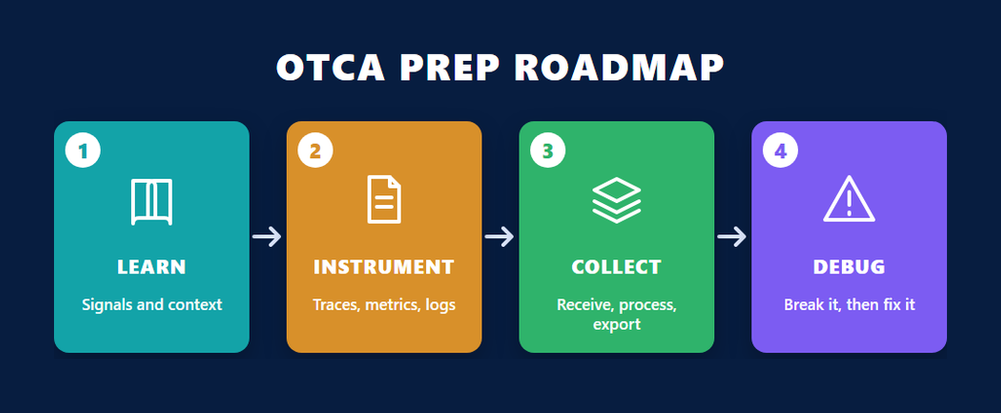
- Read the OpenTelemetry concepts pages on signals, instrumentation and context propagation, and map each page to an objective in the domain table.
- Instrument a small two service application by hand, producing traces, metrics and logs through the API rather than relying on an agent.
- Add zero-code instrumentation to the same application and compare what each approach records.
- Run a Collector in front of the application and write its configuration yourself, with at least one receiver, two processors and one exporter.
- Break the pipeline on purpose by removing a component from the service section, reordering processors and dropping propagation headers, then trace each fault to its cause.
- Review semantic conventions and schema management last, then sit a timed attempt against the 90 minute limit.
The Linux Foundation’s introductory course, Getting Started with OpenTelemetry (LFS148), follows a similar path, with hands-on labs for automatic instrumentation, manual traces, metrics and logs, and Collector pipelines. It asks for basic programming knowledge, preferably in Python and Java, which is a fair guide to the level the exam assumes. Treat it as a starting point and use the official documentation to cover each objective in full.
Where Does OTCA Lead After You Pass?
After OTCA, the Linux Foundation points candidates toward the Certified Kubernetes Administrator and, beyond that, the Kubestronaut programme for holders of several Kubernetes credentials. Your OTCA stays valid for two years, so plan the next step inside that window if you want the credentials to sit together on your profile.
For data and AI engineers, observability skills transfer directly to the newer agent and model tooling, where tracing a request through several services is part of normal operations. If that is your direction, our breakdown of the Model Context Protocol Associate exam covers another Linux Foundation associate credential built around how distributed components talk to each other.
Frequently Asked Questions
What is the OpenTelemetry certification?
It is the OpenTelemetry Certified Associate (OTCA), a vendor neutral, beginner level certification from the Linux Foundation and CNCF. It tests observability concepts and the core OpenTelemetry components, including the API, the SDK, the Collector and the pipelines that carry traces, metrics and logs.
How much does the OTCA exam cost?
The exam costs $250 USD on its own. That fee includes twelve months to schedule and take the exam and two attempts, so one retake is covered. The Linux Foundation also sells it in a bundle with an annual training subscription.
How many questions are on the OTCA exam and how long is it?
The exam has 60 multiple choice questions and lasts 90 minutes. It is delivered online with a remote proctor. The question count comes from the VMExam syllabus page; the Linux Foundation page confirms the 90 minute duration and the multiple choice format.
What is the passing score for OTCA?
The VMExam syllabus page gives a passing score of 75 percent. The Linux Foundation certification page does not display a passing score, so confirm it in the candidate handbook before you sit the exam.
Which OTCA domain is the largest?
The OpenTelemetry API and SDK, at 46 percent. It covers the data model, composability and extension, configuration, signals, SDK pipelines, context propagation and agents. The Collector is second at 26 percent, followed by observability fundamentals at 18 percent and pipeline debugging at 10 percent.
Are there prerequisites for the OpenTelemetry Certified Associate?
No. The Linux Foundation lists no prerequisites and rates the exam at beginner level. It does recommend a grounding in infrastructure, cloud, DevOps and security, and names Linux and Kubernetes credentials as part of that foundation.
How long is the OTCA certification valid?
The certification is valid for two years from the date you pass, according to the Linux Foundation certification page.
Do I need to know a specific monitoring backend for OTCA?
No. The syllabus names no backend product. It focuses on how telemetry is produced, propagated, processed and exported through OpenTelemetry itself, so time spent on one vendor’s dashboards does not map to any objective.
What should I learn after passing OTCA?
The Linux Foundation suggests the Certified Kubernetes Administrator next, and the Kubestronaut programme for those collecting several Kubernetes credentials. Data engineers may prefer to deepen Collector and pipeline work, since it maps closely to ingestion and transformation skills.
Conclusion
The OpenTelemetry certification rewards people who understand telemetry as data in motion. Nearly half of the OTCA sits on the API and SDK, a quarter on the Collector, and the rest on the vocabulary and debugging skills that keep pipelines trustworthy. It is a 60 question, 90 minute, $250 exam with no prerequisites and two years of validity.
Build a small instrumented application, put a Collector in front of it, and break it in every way the syllabus describes before you book. Then compare your notes against the four domain table, close any gaps, and sit the exam with the retake as a safety net rather than a plan.