Close the documentation tab. The Cloudera data engineering certification is sat with nothing open: no reference material, no white papers, no user guides, under a live online proctor, for 90 minutes. That rule shapes the preparation more than any single topic does, because everything you would normally look up in the Spark or Airflow documentation has to be in your head when the first of the 50 questions appears. Exam CDP-3002, titled Cloudera Data Engineer, passes at 55 percent and costs $330 through Cloudera’s own store.
The second thing to know is where the marks are. Spark carries 48 percent of the weighting and Performance Tuning, which is Spark tuning in all but name, carries another 22. Seven questions in ten therefore turn on how well you understand Spark execution, and the three remaining topics, Airflow, Deployment and Iceberg, share the last 30 percent at 10 each. This guide takes the weights at face value and studies the exam in that order. It covers what each topic lists, what the two newer objectives actually ask, how the Data Engineering service fits, who Cloudera says the credential is for, what happens on exam day, and a preparation sequence you can run from a trial environment.
Why Does Spark Decide the Cloudera Data Engineering Certification?
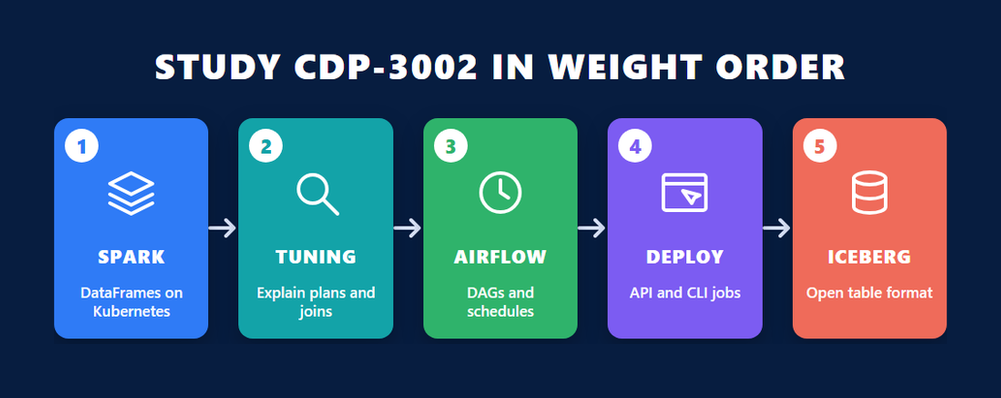
Spark decides the Cloudera data engineering certification because it is 48 percent of CDP-3002 outright and Performance Tuning, a further 22 percent, is Spark tuning: explain plans, join strategy, caching, partitioned and bucketed tables. Together they are 70 percent of a 50 question paper, roughly 35 questions, against a pass mark of 55 percent, which is 28 correct answers.
That arithmetic does not mean the other topics can be skipped. It means the order of study matters. A candidate who is fluent in DataFrames and can read a physical plan has most of the paper covered and can treat Airflow, Deployment and Iceberg as three short, bounded topics worth five questions each. A candidate who spends equal time on all five topics has spent 60 percent of their preparation on 30 percent of the marks.
What “Spark over Kubernetes” signals
The first Spark sub-objective is “Fundamentals on Spark over Kubernetes”, and it tells you which Spark the exam means. On the Cloudera platform, Spark jobs for data engineering run in the Data Engineering service, where Kubernetes schedules the driver and executors rather than YARN. The exam is not asking you to administer a Kubernetes cluster; it is asking you to understand what a Spark application looks like when its executors are pods, what resource settings mean in that world, and how a job is submitted to it. Keep that framing in mind through every Spark question.
What Does CDP-3002 Cost, and How Is It Delivered?
CDP-3002 costs $330 USD, runs for 90 minutes, has 50 questions and passes at 55 percent. Cloudera delivers it online under a live proctor through QuestionMark, with no allowed resources of any kind. Registration is through Cloudera’s education store, and Cloudera lists three courses as optional preparation, one of them free.
| Item | Detail |
|---|---|
| Exam name | Cloudera Data Engineer |
| Exam code | CDP-3002 |
| Questions | 50 |
| Duration | 90 minutes |
| Passing score | 55 percent |
| Price | $330 USD |
| Delivery | Online, proctored through QuestionMark |
| Allowed resources | None |
| Suggested training | Preparing with Cloudera Data Engineering; Advanced Spark Application Performance Tuning; DENG-152 Cloudera Iceberg Fundamentals (free OnDemand) |
Two figures that candidates often look for are not published. Cloudera’s CDP-3002 exam guide displays no validity period for the credential and no list of delivery languages, and the AnalyticsExam syllabus page does not state them either. Treat any figure you see elsewhere for either as unverified. The price is the one item the guide does not carry; it comes from the syllabus page and matches the store listing.
How Are the Five Topics Weighted?
The Cloudera Data Engineer exam has five weighted topics: Spark at 48 percent, Performance Tuning at 22, and Airflow, Deployment and Iceberg at 10 percent each. Seventeen sub-objectives sit beneath them, fourteen of which belong to the two Spark topics. Iceberg has one line, “Understand Iceberg”, and Deployment has two.
| Topic | Objectives | Weight |
|---|---|---|
| Spark | Fundamentals on Spark over Kubernetes; Work with DataFrames; Understand Distribute Processing; Implement Hive and Spark Integration; Understand Distributed Persistence | 48% |
| Airflow | Implement incremental extraction in Apache Airflow from source system; Use Apache Airflow to schedule ETL pipelines; Use Apache Airflow to schedule quality checks; Work with DAGs | 10% |
| Performance Tuning | Know Basic tools in (Spark) Performance Tuning; Understand Optimization Framework and Explain plans; Understand Inferring Schemas; Work with Improving Join Performance Leverage Caching Data for Reuse; Work with Partitioned and Bucketed Tables | 22% |
| Deployment | Use the API and CLI; Work in the Data Engineering Service | 10% |
| Iceberg | Understand Iceberg | 10% |
The table is printed in the order the syllabus lists it, which is not weight order. Read it as 48, 22, 10, 10, 10 and the shape of the exam is clear: two heavy Spark topics and three light ones. Cloudera’s own exam guide carries the same five topics with the same weights and the same objective wording, so there is no disagreement to resolve between the two sources.
How Should You Study the Spark Topic First?
Study the Spark topic of CDP-3002 as five connected ideas: how a Spark application runs when Kubernetes schedules it, how DataFrames express transformations, how work is distributed across executors, how Spark reads and writes Hive tables on the Cloudera platform, and how data persists between stages and jobs. Each is one of the five listed sub-objectives, and each shows up again inside the tuning topic.
DataFrames and distributed processing
“Work with DataFrames” is the broadest line on the paper. Expect questions on selecting, filtering, joining, grouping and aggregating with the DataFrame API, on reading and writing common formats, and on the difference between a transformation and an action. “Understand Distribute Processing” sits directly behind it: partitions, shuffles, stages and tasks, and why a wide transformation forces data movement while a narrow one does not. If you can draw what happens to a DataFrame when it is joined and then grouped, you understand both objectives.
Spark over Kubernetes
The Apache Spark project documents how a driver and its executors run as pods in Spark on Kubernetes, and that model is what the Data Engineering service presents to you. Learn the vocabulary at the level of the Spark documentation: driver pod, executor pods, resource requests, dynamic allocation, and what a failed executor means for a running job. The exam does not require you to write Kubernetes manifests.
Hive integration and persistence
“Implement Hive and Spark Integration” covers reading and writing tables that live in the Hive metastore from Spark, including the managed versus external distinction and how Spark SQL addresses a Hive database. “Understand Distributed Persistence” covers where data lands between stages and jobs: the storage layer underneath, file formats, and the persistence and checkpointing options Spark offers for reuse. Both objectives are easiest to learn by doing them in a trial workspace rather than by reading.
Once the five ideas are solid, the fastest way to find the gaps is a timed rehearsal. AnalyticsExam’s timed CDP-3002 practice exams are built around the same five topics and weights, so a weak score on the Spark questions tells you exactly which of the five sub-objectives to go back to before you touch Airflow or Iceberg.
What Does Performance Tuning Add on Top of Spark?
Performance Tuning is 22 percent of CDP-3002 and asks you to make Spark jobs faster and cheaper: read an explain plan, choose a join strategy, cache data that is reused, lay tables out as partitioned or bucketed, and understand what schema inference costs at read time. Every one of its five sub-objectives assumes the Spark fundamentals above.
Explain plans and the optimizer
“Understand Optimization Framework and Explain plans” is the heart of the topic. You should be able to look at the output of an explain call and identify the scan, the filter pushdown, the exchange that marks a shuffle, and the join operator chosen. Knowing why the optimizer picked a broadcast join over a sort merge join, and what you can change to influence that choice, is worth more than memorising configuration keys.
Joins, caching and table layout
The remaining objectives are the levers you pull after reading the plan. Improving join performance means broadcasting the small side, avoiding skew, and joining on the right keys. Leveraging caching means persisting a DataFrame that several later actions reuse and knowing when the cache costs more than it saves. Partitioned and bucketed tables decide how much data a query has to scan and whether a join can skip a shuffle altogether. “Understand Inferring Schemas” rounds it off: letting Spark infer a schema from a large file set is convenient and expensive, and the exam expects you to know when to declare the schema instead.
How Much Airflow and Iceberg Do the Newer Objectives Ask For?
Airflow and Iceberg are 10 percent of CDP-3002 each, about five questions apiece. Airflow has four sub-objectives, all about orchestration: incremental extraction from a source system, scheduling ETL pipelines, scheduling quality checks, and working with DAGs. Iceberg has one, “Understand Iceberg”, and Cloudera names a free course for it.
Airflow: the scheduler questions
The Data Engineering service ships Apache Airflow as its orchestration layer, and Cloudera’s documentation on Airflow in Cloudera Data Engineering is the right starting point because it shows how a DAG triggers Spark jobs defined in the service. Learn the DAG as a Python object with tasks, dependencies and a schedule; learn how an incremental extraction is expressed so that each run picks up only new data; and learn how a quality check becomes a task that can fail a pipeline. The syllabus wording “schedule quality checks” is a strong hint that at least one question is about placing a check inside a scheduled DAG rather than running it by hand.
Iceberg: one objective, one free course
“Understand Iceberg” is the only single-line topic on the paper, and Cloudera’s suggested training for it is DENG-152 Cloudera Iceberg Fundamentals, which is free and on demand. Cover what the Apache Iceberg table format adds over a plain Hive table: snapshots, time travel, schema and partition evolution, and the metadata layer that lets several engines read the same table safely. Cloudera has made the format a central part of its platform, which is why a 10 percent slice of a data engineering exam is reserved for it.
“Cloudera pioneered the Big Data industry, and remains a leading platform provider who continues to invest in making the Apache Iceberg open table format enterprise ready.”
For the exam, the practical reading of that statement is simple: expect Iceberg to appear as the table format a Spark job writes to, not as a separate product. Know what a snapshot is, what time travel means, and why partition evolution matters for a table that outlives its first design.
What Does the Deployment Topic Mean by API and CLI?
The Deployment topic of CDP-3002 is 10 percent and has two sub-objectives: “Use the API and CLI” and “Work in the Data Engineering Service”. It tests whether you can take a Spark application or an Airflow DAG and run it in Cloudera’s managed service as a defined job, from the command line or an API call, rather than only from a notebook.
Cloudera’s Data Engineering documentation describes the service as a set of virtual clusters inside an environment, with jobs and resources as its core objects. A job points at an application file and its arguments; a resource holds the files and dependencies a job needs. The CLI lets you create and update jobs, upload resources, run jobs and read their logs without opening the web console, and the API exposes the same operations for automation. Expect questions phrased as “which command” or “which object” rather than deep syntax.
The service runs inside a platform environment, so some understanding of what an environment is helps. The Cloudera public cloud administrator exam covers that layer in depth; for CDP-3002 you need only enough to know where a virtual cluster lives and why a job’s resources follow it.
Who Is the Cloudera Data Engineer Credential Written For?
Cloudera describes the Cloudera Data Engineer credential as being for professionals who design, build and optimise data workflows with Cloudera tools, mainly Spark and Airflow. That includes data modelling for efficient storage, performance work such as finding bottlenecks and tuning queries, and the security, monitoring and troubleshooting that keep a cluster’s pipelines running.
In practice that is a working pipeline developer or data platform engineer who already writes Spark jobs and wants a vendor credential that names the stack they use. It is not an analyst exam; SQL alone will not carry it. Nor is it a modelling exam. Someone who trains and serves models on the platform is better served by the Cloudera machine learning engineer credential, which shares the Spark foundation but weights its remaining marks toward model workbench and deployment.
One credential, two names
Cloudera’s certification catalogue now lists the exam as Cloudera Data Engineer, without the CDP prefix that older material, badge pages and some search results still use. The exam code is unchanged at CDP-3002, and the AnalyticsExam syllabus page already carries the new name. If you see “CDP Data Engineer” and “Cloudera Data Engineer” side by side, they are the same credential.
What Happens on Exam Day?
CDP-3002 is taken online under a live proctor through QuestionMark, and nothing may be open during the 90 minutes: Cloudera’s guide lists allowed resources as none and spells out that reference materials, white papers and user guides are all excluded. Cloudera asks candidates to review the QuestionMark system requirements before the appointment.
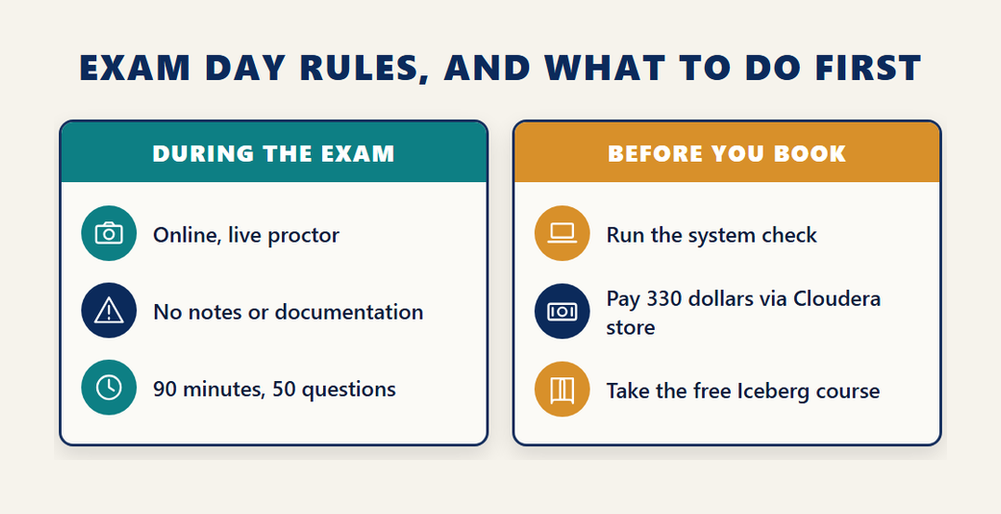
Booking runs through the Cloudera Education store, where the exam is listed at $330. Run the proctoring system check on the machine you will actually use, in the room you will actually sit in, several days before the date: the webcam, microphone and screen-sharing requirements are the part most people leave to the last minute. Cloudera provides a certification support mailbox for anything that goes wrong.
Pacing the 50 questions
Ninety minutes for 50 questions is 108 seconds each. The Spark and tuning questions, about 35 of them, are where a candidate loses time reading plans or code, so mark anything that takes more than two minutes and come back to it. The Airflow, Deployment and Iceberg questions are shorter and recall-based; answer them quickly to buy time for the heavy half.
How Do You Prepare in Weight Order?
Prepare for CDP-3002 by working the topics in weight order: Spark first, Performance Tuning second, then Airflow, Deployment and Iceberg as three short blocks, with a timed rehearsal between the heavy half and the light half. The sequence below follows the syllabus weights and Cloudera’s own suggested training, and it assumes access to a trial environment.
- Build DataFrame fluency in a Spark session: select, filter, join, group and aggregate, then read and write Parquet and Hive tables until the transformation and action distinction is automatic.
- Trace a job through partitions, stages and shuffles, and learn the Spark on Kubernetes vocabulary of driver pod, executor pods and resource requests.
- Run explain on your own queries, identify the exchange and join operators, and change one thing at a time: broadcast the small table, cache a reused DataFrame, partition or bucket a table.
- Sit a timed practice exam and mark every Spark or tuning question you missed against its sub-objective before moving on.
- Write one Airflow DAG that extracts incrementally from a source, runs a Spark job and ends with a quality check task that can fail the run.
- Define the same job in the Data Engineering service from the CLI, upload its resource, run it and read the log.
- Take the free DENG-152 Cloudera Iceberg Fundamentals course and create one Iceberg table, then query a previous snapshot.
- Repeat the timed rehearsal, then run the QuestionMark system check and book the exam.
Steps one to four should take the majority of your study time; that is where the majority of the marks are. Steps five to seven are each bounded by a handful of objectives and can be completed in a few focused sessions.
Frequently Asked Questions
How many questions are on the Cloudera Data Engineer exam?
CDP-3002 has 50 questions and runs for 90 minutes. The passing score is 55 percent, which on 50 questions means 28 correct answers.
How much does the Cloudera data engineering certification cost?
The exam is listed at $330 USD and is booked through Cloudera’s own education store. Cloudera’s optional training courses are priced separately, except DENG-152 Cloudera Iceberg Fundamentals, which is free on demand.
Which topic carries the most weight on CDP-3002?
Spark, at 48 percent. Performance Tuning adds 22 percent and is itself about tuning Spark, so Spark execution accounts for roughly 70 percent of the paper.
Is the Cloudera Data Engineer exam open book?
No. Cloudera lists allowed resources as none. Reference materials, white papers, user guides and any other resources are excluded, and the exam is taken online under a live proctor through QuestionMark.
Does the exam test Apache Airflow?
Yes. Airflow is a 10 percent topic with four objectives: incremental extraction from a source system, scheduling ETL pipelines, scheduling quality checks, and working with DAGs.
How much Iceberg do I need to know?
Iceberg is 10 percent of the exam with a single objective, Understand Iceberg. Cloudera’s suggested preparation is the free DENG-152 Cloudera Iceberg Fundamentals course, and the core ideas are snapshots, time travel, and schema and partition evolution.
Is CDP Data Engineer the same as Cloudera Data Engineer?
Yes. Cloudera’s catalogue now lists the credential as Cloudera Data Engineer without the CDP prefix. The exam code is still CDP-3002.
How long is the Cloudera Data Engineer certification valid?
Cloudera’s exam guide for CDP-3002 does not display a validity period, and the AnalyticsExam syllabus page does not state one either. Figures quoted on third-party pages are unverified; check Cloudera’s certification pages at the time you book.
Do I need Kubernetes experience for CDP-3002?
You need to understand how a Spark application runs when Kubernetes schedules its driver and executors, because the first Spark objective is Fundamentals on Spark over Kubernetes. You do not need to administer a Kubernetes cluster or write manifests.
Conclusion
The Cloudera data engineering certification is a Spark exam with three short topics attached. Forty-eight percent of CDP-3002 is Spark, 22 percent is Spark tuning, and Airflow, Deployment and Iceberg take 10 percent each, for 50 questions in 90 minutes at a 55 percent pass mark and $330. Nothing may be open during the exam, so the plans, commands and DAG patterns have to be learned by doing them in a trial environment rather than bookmarked. Study in weight order, use a timed rehearsal to find the Spark gaps before you spend time on the lighter topics, take the free Iceberg course, and run the proctoring system check before you book. The credential now appears in Cloudera’s catalogue as Cloudera Data Engineer; the code and the exam behind it have not changed.