A support agent built on the Claude Agent SDK looks up an order, the lookup times out, and the tool hands back two words: “Operation failed.” The agent cannot tell a timeout from a policy refusal, so it retries, then retries again, then tells the customer something vague. Nothing in that story is a model problem. It is an architecture problem, and it is exactly the kind of decision the Claude architect certification is built to examine.
The exam behind it is CCAR-F, Claude Certified Architect: Foundations. It has 60 items, a 120 minute time limit, a scaled pass mark of 720 on a 100 to 1,000 scale and a $125 fee, and every question sits inside one of four production scenarios drawn at random from a bank of six. This guide explains what each of the five domains asks you to design, how the scenarios shape the questions, who is allowed to sit the exam, how it compares with the other three Claude credentials, and how to prepare with the hands-on builds Anthropic itself recommends.
What Does the Claude Architect Certification Actually Test?
The Claude architect certification tests judgment about tradeoffs when you build production systems with Claude. CCAR-F covers four technologies, Claude Code, the Claude Agent SDK, the Claude API and the Model Context Protocol, and asks which design choice is right in a realistic customer situation rather than whether you can recite a feature list.
Anthropic’s own exam guide frames the credential around informed decisions, and the task statements read that way. You are rarely asked what a setting is called. You are asked which of four plausible approaches stops an agent from skipping a required verification step, which error shape lets a coordinator decide whether to retry, or whether a migration that touches dozens of files belongs in plan mode. The wrong answers are usually things a capable developer might genuinely try, which is what makes the paper harder than its foundation label suggests.
Knowledge versus skills
Every task statement in the guide is split into “knowledge of” and “skills in”. The knowledge half describes concepts, such as how tool results are appended to conversation history. The skills half describes actions, such as continuing a loop while the stop reason is tool use and ending it on end turn. Questions draw on both, so reading documentation alone leaves the skills half thin. The candidate who has actually built a loop, hit a failure and fixed it recognises the right option faster.
How Is CCAR-F Structured, Scored and Priced?
CCAR-F has 60 multiple-choice and multiple-response items, and each item tells you how many responses to select. You get 120 minutes, the exam is proctored online or at a test center, and the pass mark is a scaled 720 on a 100 to 1,000 scale. The fee is $125 USD and the credential is valid for 12 months.
| Item | Detail |
|---|---|
| Credential | Claude Certified Architect: Foundations |
| Exam code | CCAR-F |
| Number of items | 60 |
| Item format | Multiple-choice and multiple-response |
| Structure | 4 scenarios drawn from a bank of 6 |
| Time limit | 120 minutes |
| Passing score | Scaled 720 on a 100 to 1,000 scale |
| Exam fee | $125 USD |
| Delivery | Proctored, online and/or test center |
| Validity | 12 months from the date awarded |
Two details on the score report are worth knowing before you sit. You receive a pass or fail with your scaled score, and you also receive a percent-correct figure for each domain. That breakdown is the most useful thing a failed attempt gives you, because it tells you which of the five domains to rebuild before the retake.
Retakes and rescheduling
Pearson VUE runs delivery for Anthropic. If you do not pass, the waiting period is 14 days after the first attempt, 30 days after the second and 90 days after the third, and you can take up to four attempts at one exam in any rolling 12 month period. Test center appointments can be moved or cancelled up to 48 hours before the start time. Candidates who pass receive a digital badge through Credly.
The 12 month validity is short by certification standards, and it is a deliberate signal. The technologies on this paper change quickly, and a credential that lasts a year tells an employer the holder was tested against something close to the current platform.
Who Can Sit CCAR-F, and Who Is It Written For?
CCAR-F is open to members of the Claude Partner Network, and membership is free for firms. The intended candidate is a solution architect who designs and ships production applications with Claude, typically with six months or more of practical work across the Claude API, the Agent SDK, Claude Code and MCP, including an honest sense of where large language models fail.
The eligibility rule surprises people who arrive from vendor programs where anyone can buy a voucher. Anthropic describes the program in its expanded certification announcement as a quality benchmark for the consulting and engineering firms that deploy Claude for clients, and certified practitioner counts feed directly into a firm’s tier in the network. The top tier, Global Premier, requires 1,000 certified practitioners along with customer and reference thresholds. That is why the exam is proctored and identity verified rather than a course completion quiz.
“The companies that pull ahead over the next twelve months will be the ones with enough skilled people to put Claude to work on their hardest problems. Every major technology shift has been carried by a trained, trusted workforce, and AI is no different.”
The scale is already large. Anthropic reported in July 2026 that more than 36,000 consultants across more than 1,300 organisations had been certified since the March launch, and that more than 400,000 people had completed Claude training through Anthropic Partner Academy, its free partner training platform.
How booking works
- Your firm joins the Claude Partner Network at no cost and registers its practitioners.
- You register at the Anthropic Partner Academy and purchase the CCAR-F exam there for $125.
- If this is your first Pearson exam, you receive an email with your Pearson username and password.
- You log in to your Pearson account and schedule the exam online or at a test center.
The Partner Academy also hosts the self-paced preparation course for the credential, so the same account serves for training and booking.
How Are the Five CCAR-F Domains Weighted?
CCAR-F has five domains. Agentic Architecture and Orchestration is the largest at 27 percent, Claude Code Configuration and Workflows and Prompt Engineering and Structured Output carry 20 percent each, Tool Design and MCP Integration carries 18 percent, and Context Management and Reliability carries 15 percent. The weights reflect Anthropic’s job task analysis.
| Domain | Weight | Objectives |
|---|---|---|
| Agentic Architecture & Orchestration | 27% | Agentic loops; coordinator-subagent orchestration; subagent invocation, context passing and spawning; multi-step workflows with enforcement and handoff; Agent SDK hooks for tool call interception and data normalization; task decomposition; session state, resumption and forking |
| Tool Design & MCP Integration | 18% | Tool interfaces with clear descriptions and boundaries; structured error responses for MCP tools; distributing tools across agents and configuring tool choice; integrating MCP servers into Claude Code and agent workflows; the built-in tools Read, Write, Edit, Bash, Grep and Glob |
| Claude Code Configuration & Workflows | 20% | CLAUDE.md hierarchy, scoping and modular organization; custom slash commands and skills; path-specific rules; plan mode versus direct execution; iterative refinement; CI/CD integration |
| Prompt Engineering & Structured Output | 20% | Prompts with explicit criteria to reduce false positives; few-shot prompting; structured output through tool use and JSON schemas; validation, retry and feedback loops; batch processing; multi-instance and multi-pass review |
| Context Management & Reliability | 15% | Preserving critical information in long interactions; escalation and ambiguity resolution; error propagation across multi-agent systems; context in large codebase exploration; human review and confidence calibration; provenance and uncertainty in multi-source synthesis |
Read the weights alongside the scenarios rather than on their own. Agentic architecture leads, but several scenarios list three primary domains at once, so a single question about a support agent can test orchestration, tool errors and escalation together. Studying domain by domain is still the right way to learn; testing yourself should mix them, the way the exam does. When the objectives feel familiar, VMExam’s timed CCAR-F practice exam is a way to rehearse that mixing under the 120 minute clock and find the weak domain before Pearson’s score report does.
Which Six Scenarios Can Appear on Exam Day?
Six scenarios make up the bank and four of them, chosen at random, appear on each sitting. Each sets a production context such as a support agent or a CI pipeline and frames a group of questions. Because you cannot know which four you will get, you have to prepare all six, and every one of them maps to named primary domains.
- Customer Support Resolution Agent: An Agent SDK agent with MCP tools for customers, orders, refunds and escalation, aiming for 80 percent or better first-contact resolution while knowing when to hand off. Primary domains: agentic architecture, tool design, context management.
- Code Generation with Claude Code: A team using Claude Code for generation, refactoring, debugging and documentation, with custom slash commands, CLAUDE.md configuration and the plan mode decision. Primary domains: Claude Code configuration, context management.
- Multi-Agent Research System: A coordinator delegating to subagents that search, analyse documents, synthesise and write cited reports. Primary domains: agentic architecture, tool design, context management.
- Developer Productivity with Claude: An agent that helps engineers explore unfamiliar codebases and automate repetitive work using the built-in tools and MCP servers. Primary domains: tool design, Claude Code configuration, agentic architecture.
- Claude Code for Continuous Integration: Automated review, test generation and pull request feedback inside a pipeline, with prompts tuned to cut false positives. Primary domains: Claude Code configuration, prompt engineering.
- Structured Data Extraction: Pulling fields from unstructured documents, validating them against JSON schemas and handling edge cases cleanly for downstream systems. Primary domains: prompt engineering, context management.
Notice how often context management appears. It is the smallest domain by weight but is a primary domain in four of the six scenarios, which means it surfaces inside questions that look, at first glance, like they are about something else.
What Does Agentic Architecture and Orchestration Ask You to Design?
Agentic Architecture and Orchestration, 27 percent of CCAR-F, asks you to design the control flow of agents. That means a correct agentic loop, coordinator and subagent patterns, how context is passed when a subagent is spawned, workflows that enforce required steps, Agent SDK hooks, task decomposition, and session resumption and forking.
The loop and its stopping condition
The guide is unusually specific about the loop. A correct loop continues while the stop reason is tool use, appends each tool result to the conversation so the model can reason about the next step, and ends on end turn. It also names the anti-patterns: deciding the loop is finished by parsing natural language, relying on an arbitrary iteration cap as the main stopping rule, or treating the presence of assistant text as a completion signal. Expect distractors built from exactly those mistakes. The Claude Agent SDK documentation is the reference to build against while you practise.
Enforcement belongs in code, not in the prompt
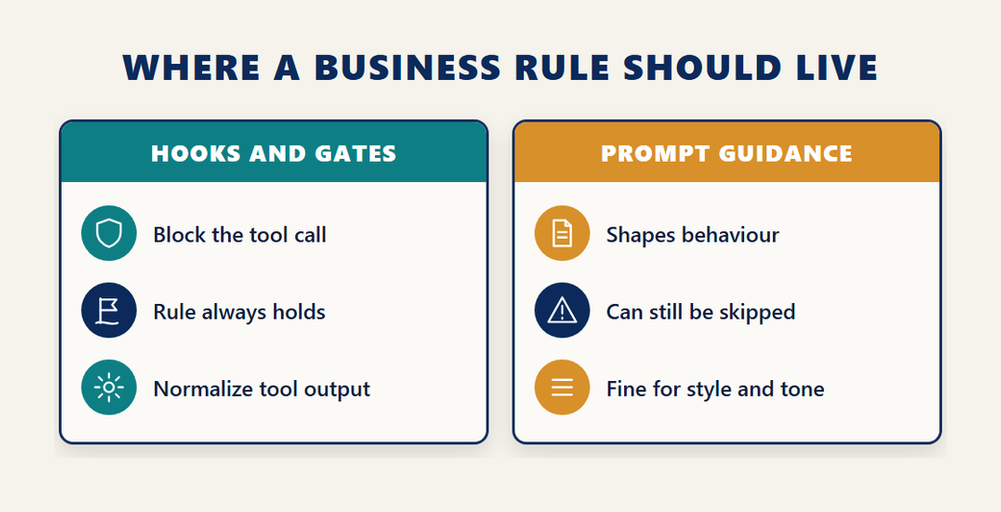
A recurring theme is the difference between programmatic enforcement and prompt guidance. If a business rule must hold, such as verifying a customer before any refund, the exam favours a hook or a prerequisite gate that blocks the downstream tool call over an instruction in the system prompt asking the model to remember. Prompts shape behaviour; hooks guarantee it. The same logic covers data normalization, where a hook intercepts tool output and reshapes it before the model sees it.
Coordinators, subagents and sessions
For multi-agent questions, think about what each subagent actually needs. Passing a coordinator’s entire history to every subagent wastes context and blurs focus; passing too little leaves the subagent guessing. Session questions turn on a similar judgment: resume a session when the prior context is still mostly valid, and start fresh with a summary when it is not.
How Deep Does the Tool Design and MCP Domain Go?
Tool Design and MCP Integration is 18 percent of CCAR-F and goes deeper than connecting a server. It tests how tools are described so the model chooses correctly, how errors are structured so agents recover sensibly, how tools are spread across agents, how MCP servers are wired into Claude Code and agents, and when each built-in tool fits.
The opening scene of this guide is a Domain 2 question in disguise. The guide wants errors that carry a category such as transient, validation or permission, a flag saying whether a retry makes sense, and a human-readable explanation. A uniform “Operation failed” leaves the agent unable to choose between retrying, explaining a policy to the customer or escalating. A related distinction the exam returns to is an access failure, which needs a retry decision, versus a valid empty result, which is a successful query that simply found nothing.
MCP is now a foundation project
MCP is not an Anthropic-only interface any more. Anthropic contributed it to the Linux Foundation’s Agentic AI Foundation launch in December 2025, alongside projects from Block and OpenAI, and the specification and SDKs are developed in the open in the MCP project on GitHub. For CCAR-F that matters in one practical way: the protocol knowledge you build transfers to any MCP client. If you want a credential that tests the protocol itself rather than Claude’s use of it, the Model Context Protocol Associate exam is the vendor-neutral counterpart.
Built-in tools
The domain also lists the built-in tools by name: Read, Write, Edit, Bash, Grep and Glob. Questions here are about fit, for example reaching for Grep to locate a symbol across a large repository instead of reading files one by one, and keeping verbose discovery out of the main context.
Which Claude Code Settings and Workflows Are Tested?
Claude Code Configuration and Workflows, 20 percent of CCAR-F, tests how Claude Code is set up for a team. The objectives cover the CLAUDE.md hierarchy and modular imports, custom slash commands and skills, path-specific rules, the choice between plan mode and direct execution, iterative refinement techniques and running Claude Code inside CI/CD pipelines.
CLAUDE.md hierarchy
The CLAUDE.md memory hierarchy runs from user level, through project level, down to directory level. A classic exam situation is a new team member who is not receiving the team’s conventions because those conventions live in someone’s user-level file, which is never shared through version control. The fix is to move them to the project level. The guide also expects you to know the import syntax for keeping CLAUDE.md modular and the .claude/rules/ directory, where rule files with glob patterns in their frontmatter load only when matching files are being edited.
Skills and slash commands
Project-scoped commands and skills live under .claude/ and travel with the repository; user-scoped ones stay personal. Skills support frontmatter options, and the guide’s own exercises use a forked context and an allowed-tools restriction so that a skill runs in isolation without polluting the main conversation.
Plan mode or direct execution
Plan mode is for work with architectural weight: large changes, several valid approaches, multi-file migrations. Direct execution suits a well-scoped fix with a clear stack trace. The strongest answer is often a combination, planning a library migration first and then executing the agreed approach. The guide also names the Explore subagent as the way to keep verbose discovery output from exhausting the main context window.
How Are Prompt Engineering and Context Management Tested?
Prompt Engineering and Structured Output (20 percent) and Context Management and Reliability (15 percent) together make up over a third of CCAR-F. The first tests explicit criteria, few-shot examples, schema-enforced output, validation and retry loops and batch design. The second tests what survives a long session, when to escalate, and how errors and uncertainty move between agents.
Specific criteria beat vague caution
The guide is direct that instructions such as “be conservative” or “only report high-confidence findings” do not raise precision the way categorical criteria do. A review prompt that says which issues to report and which to skip, with an example for each severity level, produces fewer false positives, and fewer false positives protect developer trust in the categories that are accurate. Few-shot examples are the other lever: two to four targeted examples that show why one action was chosen over plausible alternatives.
Structured output and retries
For extraction, the exam favours tool use with a JSON schema that marks optional and nullable fields, so the model can return null instead of inventing a value. When validation fails, a retry should include the document, the failed output and the specific error. Some failures, such as information that is simply absent from the source, cannot be fixed by retrying, and recognising that is part of the skill. Large volumes go through the Message Batches API, with failures handled by custom ID. These patterns are close cousins of what retrieval and agent exams on other platforms test, such as the Alibaba LLM engineer professional credential, but CCAR-F frames them through Claude’s own tooling.
Context that survives
Context questions are concrete. Progressive summarisation tends to blur amounts, dates and what the customer was promised, so the guide recommends a persistent block of case facts kept outside the summarised history. Verbose tool output should be trimmed to the relevant fields before it accumulates. Long inputs suffer from a lost-in-the-middle effect, so key findings belong at the start. Escalation triggers include a customer asking for a human, a gap in policy and an inability to make progress.
How Does CCAR-F Compare With the Other Claude Certifications?
CCAR-F is one of four Claude credentials. Claude Certified Associate: Foundations covers practical everyday use, Claude Certified Developer: Foundations targets engineers building with the API, and Claude Certified Architect: Professional covers integration architecture, governance and evaluation at enterprise scale. Each path starts at a foundation level and advances to professional.
| Credential | Code | Focus |
|---|---|---|
| Claude Certified Associate: Foundations | CCAO-F | Practical, everyday use of Claude on Claude-related projects, for technical and business roles |
| Claude Certified Developer: Foundations | CCDV-F | Engineers building applications with the Claude API, tool use and agent development |
| Claude Certified Architect: Foundations | CCAR-F | Solution architects designing and building agent systems with Claude |
| Claude Certified Architect: Professional | CCAR-P | Integration architecture, governance and evaluation for large enterprises |
One timing detail matters if you are choosing between them now. Pearson VUE’s Anthropic page announces that the Associate Foundations, Developer Foundations and Architect Professional exams will carry updated content from December 7, 2026, with updated exam guides published on November 17, 2026. CCAR-F is not on that list, so the current Architect Foundations guide remains the one to prepare from.
“AI is moving faster than most people’s ability to build the skills to use it confidently, and that gap is exactly what verified assessment is built to close.”
If you design systems rather than write most of the code, CCAR-F is the natural entry point. If you mostly write application code against the API, the Developer credential is closer to your day, and the Professional architect exam is the step after Foundations.
How Should You Prepare for CCAR-F?
Prepare for CCAR-F by building, not reading. The official CCAR-F exam guide recommends a set of hands-on projects that between them cover every domain: an Agent SDK agent, a configured Claude Code project, MCP tools, an extraction pipeline, prompt and review design, and context and escalation patterns.
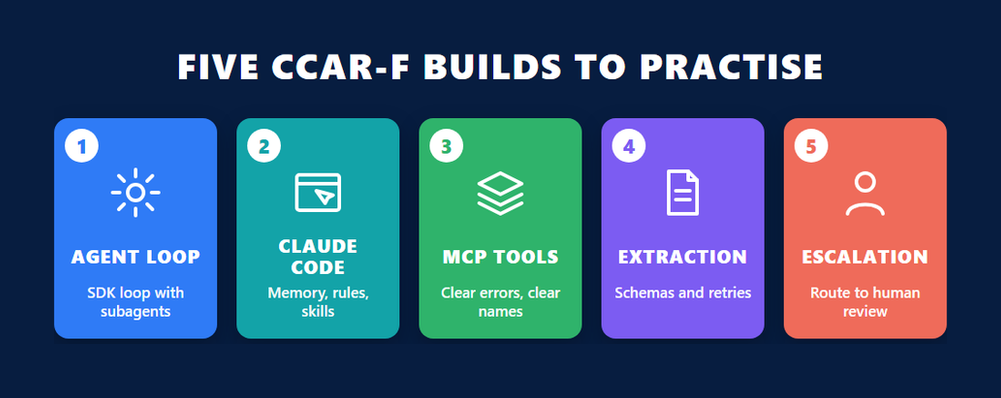
The guide’s preparation list translates into a practical build plan:
- Build an agent with the Claude Agent SDK that runs a complete loop with tool calling, error handling and session management, then practise spawning subagents and passing context between them.
- Configure Claude Code for a real project with a CLAUDE.md hierarchy, path-specific rules, custom skills with frontmatter options, and at least one MCP server.
- Design and test MCP tools whose descriptions clearly separate similar tools, with structured error responses and retryable flags, and test tool selection with ambiguous requests.
- Build an extraction pipeline with tool use and JSON schemas, validation and retry loops, optional and nullable fields, and batch processing through the Message Batches API.
- Practise prompt engineering with few-shot examples for ambiguous cases, explicit review criteria and multi-pass review for large code reviews.
- Study context patterns: extract facts from verbose tool output, keep scratchpad files for long sessions and delegate to subagents to manage context limits.
- Review escalation and human-in-the-loop design, including confidence-based routing for human review.
The guide also includes worked exercises, the first of which combines several of these: three or four MCP tools with deliberately similar purposes, a loop that handles both stop reasons, structured errors, and a hook that blocks operations above a threshold and routes them to escalation. If you can build that exercise and explain each choice, you have covered a large share of three domains. Finish with the exam guide’s sample questions and the Partner Academy course, then rehearse under time.
Frequently Asked Questions
How many questions are on the Claude Certified Architect: Foundations exam?
CCAR-F has 60 items in multiple-choice and multiple-response format, and each item states how many responses to select. You have 120 minutes to complete it.
What score do you need to pass CCAR-F?
The passing score is a scaled 720 on a scale of 100 to 1,000. The score report also shows your percent-correct for each of the five domains.
How much does the Claude architect certification cost?
The exam fee is $125 USD, purchased through the Anthropic Partner Academy. Claude Partner Network membership for firms is free, and the Partner Academy training is free for partners.
Can anyone take the CCAR-F exam?
Exams are available to members of the Claude Partner Network. A firm joins the network at no cost and registers its practitioners, who then book through the Partner Academy and Pearson VUE.
Is CCAR-F the same as CCA-F?
CCA-F is not an official code. Anthropic’s program and Pearson VUE list the exam as Claude Certified Architect: Foundations with the code CCAR-F, so a search for CCA-F about the Claude architect exam leads to this credential.
How long is the Claude Certified Architect credential valid?
The credential is valid for 12 months from the date it is awarded, according to the official exam guide.
Is CCAR-F changing on December 7, 2026?
No. Pearson VUE’s notice of updated content from December 7, 2026 names the Associate Foundations, Developer Foundations and Architect Professional exams. CCAR-F is not on that list.
How many times can I retake the exam?
You can take up to four attempts at one exam in a rolling 12 month period. The waiting periods are 14 days after the first attempt, 30 days after the second and 90 days after the third.
Which domain carries the most weight?
Agentic Architecture and Orchestration, at 27 percent. Claude Code Configuration and Workflows and Prompt Engineering and Structured Output follow at 20 percent each.
Conclusion
The Claude architect certification rewards people who have shipped agents and watched them fail. CCAR-F packs 60 items into four random scenarios from a bank of six, weights agentic architecture highest at 27 percent, and keeps returning to the same lessons: enforce rules in code, give tools structured errors, keep critical facts out of summaries, and choose plan mode when the change is large. It costs $125, needs Claude Partner Network membership and lasts 12 months. Build the projects the exam guide lists, test yourself across mixed scenarios, and you will recognise most of the right answers before you finish reading the options.